
RF microneedling explained: how radiofrequency boosts collagen results
 Owner, CoLaz Aesthetics Clinic
The short version
- Standard microneedling triggers a mostly surface-level collagen response with fine needles alone.
- RF microneedling adds radiofrequency heat through the needle tips, warming the mid-to-deep dermis and driving noticeably deeper collagen and elastin remodelling.
- It is best suited to atrophic acne scars, mild skin laxity, enlarged pores and uneven texture, with realistic results that build over months.
- Most patients need a course of around 3 to 4 sessions, spaced 3 to 4 weeks apart, with the best result several weeks after the final session.
- It is a medical treatment. Choose a qualified clinician, avoid at-home devices, and expect honest limits, not promises of a perfect result.
TL;DR
- Standard microneedling triggers a mostly surface-level collagen response with fine needles alone.
- RF microneedling adds radiofrequency heat through the needle tips, warming the mid-to-deep dermis and driving noticeably deeper collagen and elastin remodelling.
- It is best suited to atrophic acne scars, mild skin laxity, enlarged pores and uneven texture, with realistic results that build over months.
- Most patients need a course of around 3 to 4 sessions, spaced 3 to 4 weeks apart, with the best result several weeks after the final session.
- It is a medical treatment. Choose a qualified clinician, avoid at-home devices, and expect honest limits, not promises of a perfect result.
RF microneedling is one of the treatments people ask us about most once they have researched acne scars or early skin laxity. It sits a step up from standard microneedling, and the difference is not marketing, it is physics. Adding radiofrequency changes how deep the treatment works and what it can realistically improve.
The honest answer is that RF microneedling is a strong option for the right skin concern and an over-specification for others. This guide explains what the radiofrequency actually adds, what it treats well, how many sessions you should plan for, and where the real safety limits are.
What is RF microneedling?
RF microneedling is a treatment that combines fine-needle microneedling with radiofrequency energy delivered through the tips of those needles. The needles create controlled micro-channels in the skin, and as they sit in the dermis they release radiofrequency heat into the surrounding tissue.
Standard microneedling relies on the injury of the needle alone to trigger repair. Adding radiofrequency introduces a second, deeper stimulus: controlled heat. In one recent split-face trial, the microneedle radiofrequency array delivered current to specific depths of the dermis, producing a measured thermal injury that the skin then repairs by laying down new collagen.
Most devices use insulated needles so the heat is concentrated at the tip in the dermis, with minimal heating of the surface. A clinical review describes this design as a way to reach the dermis while sparing the epidermis, which is part of why the treatment suits a range of skin tones when it is done carefully.
How does adding radiofrequency change the result?
Radiofrequency changes the result by heating the mid-to-deep dermis, which drives a stronger and deeper wave of collagen and elastin production than needles alone. Heat is the extra ingredient that standard microneedling does not have.
When the dermis is warmed to a controlled temperature (the same review describes an optimal working range of around 65 to 70 degrees Celsius at the needle tip), it activates the wound-healing growth factors that tell your fibroblasts to rebuild. The depth of the needles is adjustable, commonly set somewhere between about 0.5 and 3.5 millimetres, so the clinician can place that heat where the concern actually sits.
The laboratory evidence backs the idea up. A 2025 comparison study found that the radiofrequency-treated side of the skin showed higher collagen and elastin levels and fewer worn-out (senescent) fibroblasts than the side treated with microneedling alone. A separate dose-response analysis showed that turning the energy up produced a measurable, graded increase in dermal remodelling.
RF microneedling vs standard microneedling: what is the difference?
The core difference is heat and depth: standard microneedling works mainly at the surface through mechanical injury, while RF microneedling adds targeted dermal heating for deeper remodelling. Both build collagen, but they are not interchangeable.
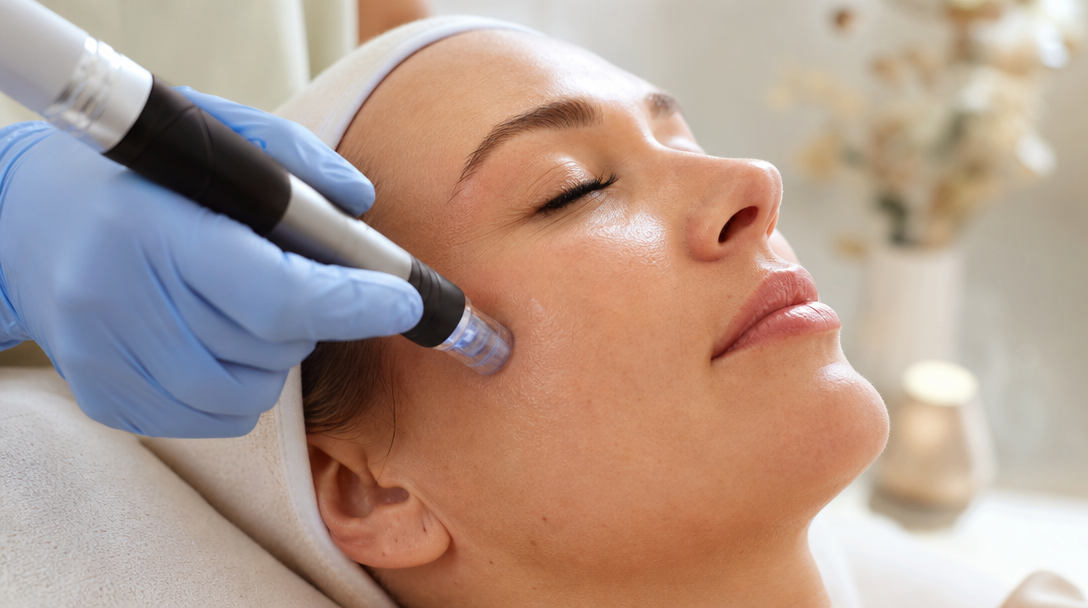
In plain terms, standard microneedling is an excellent all-rounder for texture, dullness and fine lines, and it is gentler and often more affordable. RF microneedling is the stronger tool when the concern is deeper: bound-down acne scars, mild laxity, or larger pores that have not responded to surface treatments. The devices used for pen microneedling, such as a Dermapen, work on the same collagen-induction principle without the radiofrequency layer.
Neither is automatically better. The right choice depends on how deep your concern is, your skin type and your downtime tolerance, which is exactly the sort of thing we assess before recommending either one.
Does RF microneedling work for acne scars?
Yes, RF microneedling is one of the better-evidenced non-surgical options for atrophic (indented) acne scars. It reaches the fibrous tissue that tethers a rolling or boxcar scar and rebuilds collagen underneath it.
The clinical numbers are realistic rather than dramatic. In a study of microneedle radiofrequency for post-acne scarring, patients had four sessions three weeks apart, and physicians rated 70 percent of results as good to excellent, with an overall reduction in scar scores of around 34 percent and patient satisfaction of about 82 percent. A wider systematic review of microneedling for atrophic scars reached a similar conclusion: consistent, meaningful improvement, but not total erasure.
That word “improvement” matters. No honest clinic will tell you a course removes acne scars completely, because it does not. What most patients see is softer, shallower scars and more even texture, and that is often combined with other approaches for the best outcome. Our acne scarring page explains how we tend to layer treatments for stubborn scars.
Beyond acne scars: laxity, pores and texture
RF microneedling is not only a scar treatment. Because the heat tightens existing collagen and stimulates new collagen at depth, it is also used for mild skin laxity, enlarged pores and general texture on the face and neck.
For mild sagging, the dermal heating gives a gradual firming effect that standard needling cannot match, which is why it overlaps with dedicated radio frequency skin-tightening treatments. Enlarged pores often look smaller as the surrounding skin thickens and tightens. And the histological work showing more collagen and elastin after treatment lines up with what the American Academy of Dermatology lists microneedling as helping with: scars, uneven tone and texture.
The sensible framing is that RF microneedling is a skin-quality and remodelling treatment. It refines and firms. It does not replace surgery for advanced laxity, and it does not add volume the way a filler does.
How many sessions will you need, and when will you see results?
Most people need a course of around 3 to 4 sessions, spaced roughly 3 to 4 weeks apart, with the fullest result showing several weeks to a few months after the final session. This is not a one-visit treatment.
The reason for the wait is biology. Collagen remodelling is slow, so the skin keeps improving in the weeks after each session rather than on the day. The acne-scar study above used four sessions and measured its results a month after the last one, and the split-face trial found scar volume kept improving out to 12 weeks. Judging the result too early is the most common mistake.
Downtime is usually short. Expect redness like mild sunburn on the day, sometimes with light swelling or pinpoint marks that settle over 24 to 72 hours. Most people are back to normal within a day or two, though this varies with the energy and depth used.
Is RF microneedling safe, and what are the risks?
RF microneedling is generally safe in trained hands, but it is a genuine medical treatment with real risks, and 2026 is a good moment to be clear about that. The most common side effects are temporary: redness, swelling and occasional minor bruising. In the acne-scar study, redness appeared in every patient but resolved within 24 hours, with post-inflammatory pigmentation in only two of forty patients.
The bigger point is who performs it. The US regulator recently issued a safety briefing about radiofrequency microneedling risks, and in response the American Academy of Dermatology urged patients to have these treatments done by an appropriately qualified provider who understands facial anatomy and can manage complications. Poor technique or the wrong settings can cause burns, scarring or pigment change, which is the opposite of what you came for.
Two rules follow from this. First, avoid at-home devices. The AAD lists at-home microneedling and dermarolling among the unsafe trends it warns against, because of the infection and injury risk. Second, be wary of before-and-after promises that sound too certain, since the ASA is clear that clinics cannot guarantee a cosmetic outcome. Careful, realistic wording is a good sign, not a weak one.
What we plan for in the clinic
In my experience, the patients who are happiest with collagen-induction treatments are the ones who came in for a proper assessment first, not a quick sale. One patient in his late twenties came to our Hounslow clinic with mild rolling acne scars, having been quoted over £1,500 for a single laser resurfacing session elsewhere. We built him a course of microneedling with a polynucleotide booster instead, and his scars softened noticeably over the course, with a day of mild redness rather than a week off work.
The lesson I take from cases like that is to match the depth of the treatment to the depth of the problem. For genuinely bound-down scars or mild laxity, adding radiofrequency is worth it. For surface texture and dullness, standard microneedling often does the job. At CoLaz, every treatment starts with a free consultation, and for energy-device treatments we patch test 48 hours before your first session and write the plan down before you commit to anything. If your skin is not suited to it that day, we will say so.
Start with an honest consultation
RF microneedling is a genuinely useful treatment for acne scars, mild laxity, pores and texture, and an unnecessary step up for concerns that surface treatments already handle. The device is not the decision. The assessment is.
If you are weighing up microneedling with or without radiofrequency, book a free consultation at your nearest CoLaz clinic. We will look at your skin, tell you honestly which version fits your concern, and set out the sessions, spacing and realistic result in writing before you decide.
Ready to begin
Book a free Microneedling consultation at your nearest CoLaz clinic
Time with a qualified clinician: a skin assessment, an honest recommendation and no obligation. Read about Microneedling at CoLaz, from £149 (decolletage, inner thighs or breast, single session).
More on Skin
Keep reading
-

Acnelan treatment: the in-clinic peel for active, inflammatory acne
Acnelan is a professional acne peel system with a daily home routine. Here is what is in it, how the course runs, what results look like and when another route suits you better. Read the article -

Sunekos vs Profhilo: which skin booster is right for your skin?
Sunekos and Profhilo are both injectable skin boosters, but one is pure stabilised hyaluronic acid and the other adds amino acids. Here is how they differ and how to choose. Read the article -

PRP face treatment (the vampire facial): what it actually does for your skin
PRP uses a small sample of your own blood to support collagen and skin repair. Here is what the research really shows, how many sessions most people need and what to expect on the day. Read the article
Book a free consultation at your nearest CoLaz clinic
Time with a qualified clinician: a skin assessment, an honest recommendation and a written plan. No obligation.