
Microneedling aftercare day by day: the realistic 7-day timeline
 Owner, CoLaz Aesthetics Clinic
The short version
- Microneedling works by triggering your skin's own repair response, so the first week of aftercare is part of the treatment, not an optional extra.
- Expect redness like a mild sunburn on day 1, tightness and light peeling by days 2 to 3, fresher-looking skin by days 4 to 5, and near-normal skin by days 6 to 7.
- Keep the routine simple: gentle cleanser, hyaluronic acid, a bland moisturiser and daily broad-spectrum SPF. No makeup for the first 24 hours.
- Avoid retinoids, vitamin C, exfoliating acids, saunas, hot workouts and direct sun in the first week while the skin barrier recovers.
- Collagen keeps building for 4 to 6 weeks, with fuller results across a planned course. At CoLaz, every course starts with a free consultation.
TL;DR
- Microneedling works by triggering your skin’s own repair response, so the first week of aftercare is part of the treatment, not an optional extra.
- Expect redness like a mild sunburn on day 1, tightness and light peeling by days 2 to 3, fresher-looking skin by days 4 to 5, and near-normal skin by days 6 to 7.
- Keep the routine simple: gentle cleanser, hyaluronic acid, a bland moisturiser and daily broad-spectrum SPF. No makeup for the first 24 hours.
- Avoid retinoids, vitamin C, exfoliating acids, saunas, hot workouts and direct sun in the first week while the skin barrier recovers.
- Collagen keeps building for 4 to 6 weeks, with fuller results across a planned course. At CoLaz, every course starts with a free consultation.
Good microneedling aftercare is what turns a red, slightly tender face into the smoother, brighter skin you booked the treatment for. The needling itself takes under an hour. The week that follows is where your skin does most of the work.
This is an honest, day-by-day guide to what happens to your skin after microneedling, what genuinely helps, and what quietly sets your results back. Nothing here replaces the plan your clinician gives you in person, but it will tell you what is normal and what is not.
Why does microneedling need aftercare at all?
Microneedling needs careful aftercare because the treatment works by injuring your skin on purpose. A device with fine needles creates thousands of controlled micro-injuries in the skin, which switch on the body’s natural wound-repair process.
Those tiny channels close over within hours, but underneath, your skin spends the next few weeks laying down fresh collagen and elastin. In scar tissue, this repair gradually converts disorganised collagen into more orderly collagen, which is the process behind scar remodelling over a course of sessions.
The catch is that in the first day or two your skin barrier is temporarily weaker and the micro-channels leave it more absorbent and more open to irritation. That is exactly why the products you use, and the ones you avoid, matter so much in the first week.
What does the microneedling healing process look like day by day?
Most people move through the same microneedling healing stages, and knowing the pattern in advance takes the worry out of it. Here is the realistic day-by-day timeline for a standard microneedling session.
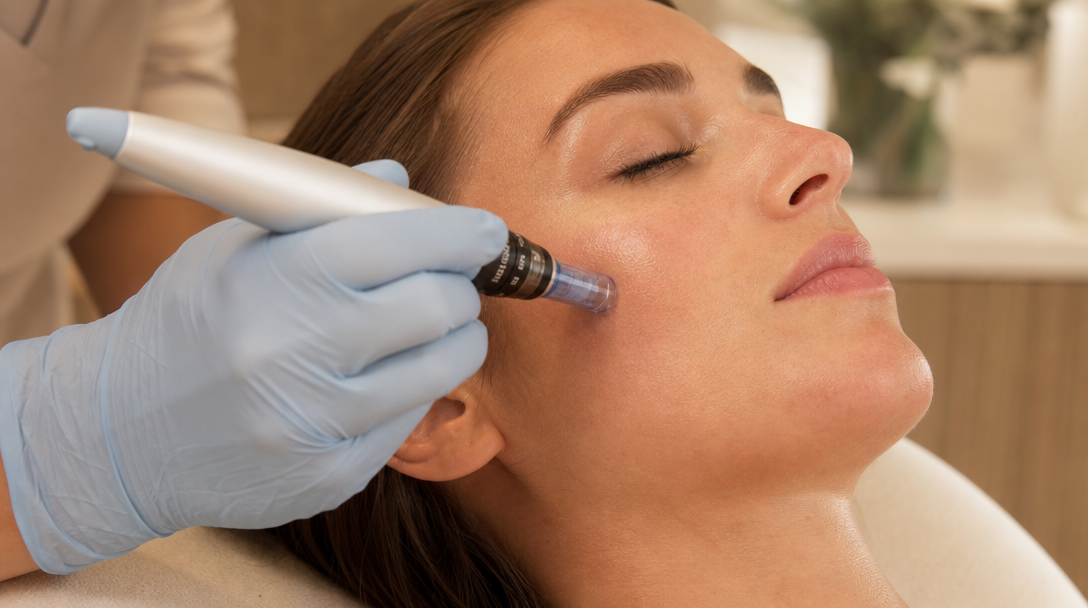
Day 1: redness and heat
Straight after treatment your skin will look flushed and feel warm, tight and a little sensitive, much like a mild sunburn. Some swelling is normal, and on deeper skin tones the change may read as a warmer or slightly darker tone rather than obvious redness.
For the first 24 hours, cleanse only with cool or lukewarm water and clean hands, and leave makeup off. The American Society for Dermatologic Surgery notes that the redness and swelling are temporary and usually start to settle within a day or two.
Day 2 to 3: tightness and light peeling
By the second and third day the redness has usually calmed a good deal and the skin can feel tight, dry or slightly rough. Some people notice light flaking as the surface renews itself. This is normal microneedling downtime, not a reaction.
Do not pick or scrub the flaking skin. Let it shed on its own, keep the skin well moisturised, and stay away from workouts, saunas and anything that makes you sweat heavily.
Day 4 to 5: fresher skin
Around days four and five most of the visible healing is done. The flaking tends to finish, tone evens out, and many people say their skin already looks brighter and feels smoother.
You can usually start to reintroduce a gentle vitamin C or a light active at this point, but only if your skin feels calm and your clinician has said it is fine.
Day 6 to 7: back to normal
By days six to seven the skin generally looks and feels normal again. The AAD describes the after-effects of microneedling as usually clearing within a few days to a week, with minimal downtime overall.
Stronger actives such as retinoids can normally go back in around now. The deeper collagen work, though, is only just getting started under the surface.
What should your microneedling aftercare routine include?
Your microneedling aftercare routine should be short, gentle and boring, because a recovering skin barrier does not want to be challenged. For the first few days, less is genuinely more.
A simple, safe first-week routine looks like this:
- A gentle, fragrance-free cleanser with cool water.
- A plain hyaluronic acid serum to support hydration while the barrier function recovers.
- A bland, non-irritating moisturiser to keep the skin comfortable.
- A broad-spectrum mineral SPF every morning.
Wait at least 24 hours before applying makeup, as the AAD advises, so the tiny channels have time to close first. If a serum or booster was applied in clinic as part of your treatment, follow the specific timings your clinician gave you rather than layering extra products on top.
What should you avoid after microneedling?
In the first week after microneedling you should avoid anything that strips, heats or inflames the skin. The clinical evidence is clear that microneedling is a genuine skin injury, so the aim of post microneedling care is to protect the barrier, not to push it.
For roughly the first 5 to 7 days, keep away from:
- Retinoids, vitamin C, glycolic acid, salicylic acid and any exfoliating active.
- Physical scrubs, cleansing brushes and harsh cleansers.
- Saunas, steam rooms, hot yoga, intense workouts and very hot showers.
- Swimming pools and direct sun.
- Makeup for the first 24 hours, then only clean brushes after that.
Sweat and heat can irritate freshly needled skin and slow the healing, which is why the gym and the sauna wait a few days. If in doubt, keep the routine minimal and ask your clinic before adding anything back in.
How important is sun protection after microneedling?
Sun protection is one of the most important parts of after microneedling care, because treated skin is temporarily more sensitive to light. Skipping it is the fastest way to undo a good result.
Fresh micro-channels and a briefly weakened barrier make the skin more reactive, and in some people that inflammation can trigger post-inflammatory pigmentation, where the treated area heals darker than the surrounding skin. This risk is higher on darker skin tones, which is one reason a qualified clinician uses more conservative settings and plans careful aftercare for Fitzpatrick IV to VI skin.
The practical rule is simple. Use a broad-spectrum SPF of at least 30, apply it every morning, and reapply through the day if you are outdoors. Where you can, stay out of strong midday sun for the first couple of weeks while the skin settles.
Is some redness or peeling normal, or a warning sign?
Mild redness, tightness and light peeling for a few days are completely normal, but spreading redness, pus, or increasing pain are not. Knowing the difference means you can relax about the ordinary and act quickly on the rare.
Normal, expected healing includes short-lived redness or a warmer tone, mild swelling on day one, a tight or dry feeling, and light flaking that shows up around days two to three. All of this fits the standard clinical applications of microneedling and usually settles within the week.
Contact your clinic or GP if you see signs that do not fit that pattern: redness that spreads or worsens after day three, yellow crusting or pus, a fever, or pain that builds rather than fades. These can point to infection, which is uncommon with professional treatment but needs prompt attention. It is also worth knowing that the regulator has issued a safety warning about the separate radiofrequency version of microneedling, which is a stronger, heat-based device and carries its own risks. That is a good reason to have any needling treatment done by a qualified clinician who assesses your skin first.
When will you actually see microneedling results?
You will see the first hints of microneedling results within a couple of weeks, but the fuller change builds gradually over the following months. Microneedling rewards patience, not one dramatic session.
Collagen production ramps up over the 4 to 6 weeks after each session, so tone and texture keep improving well after the redness has gone. For concerns such as acne scarring, the AAD notes that a course of 3 to 5 treatments, spaced 2 to 4 weeks apart, can fade acne scars by around 50 to 70 per cent. This matches what we see in clinic.
At our Hounslow clinic, we treated a patient in his late twenties with mild rolling acne scars over a course of four Dermapen microneedling sessions, spaced six weeks apart. His downtime was around 24 hours of mild redness each time, not a week off work, and by the end of the course his scars were noticeably softer and his skin texture more even. I would never promise complete scar removal, because that is not realistic, but a clear improvement in the appearance of the scars is what most patients on this protocol see.
Starting microneedling the right way at CoLaz
The best aftercare starts before the needling, with a proper assessment of your skin. At CoLaz, every course of microneedling begins with a free consultation, where we check your Fitzpatrick skin type, your history of pigmentation or scarring, your current skincare, and any medication that would mean waiting or adjusting the plan.
We then write your plan down, including the number of sessions, the spacing and the exact aftercare for your skin, before you decide to book. If you are weighing up your options, our guide to Dermapen microneedling explains the device differences, and our acne scarring page covers how microneedling fits alongside peels and other treatments. Our Dermapen page has the detail on the specific pen system we use.
If you are thinking about microneedling for scarring, texture or fine lines, the honest next step is a conversation. Book a free consultation at your nearest CoLaz clinic and we will tell you what is realistic for your skin, in writing, before anything is booked.
Ready to begin
Book a free Microneedling consultation at your nearest CoLaz clinic
Time with a qualified clinician: a skin assessment, an honest recommendation and no obligation. Read about Microneedling at CoLaz, from £149 (decolletage, inner thighs or breast, single session).
More on Skin
Keep reading
-

Acnelan treatment: the in-clinic peel for active, inflammatory acne
Acnelan is a professional acne peel system with a daily home routine. Here is what is in it, how the course runs, what results look like and when another route suits you better. Read the article -
Sunekos vs Profhilo: which skin booster is right for your skin?
Sunekos and Profhilo are both injectable skin boosters, but one is pure stabilised hyaluronic acid and the other adds amino acids. Here is how they differ and how to choose. Read the article -

PRP face treatment (the vampire facial): what it actually does for your skin
PRP uses a small sample of your own blood to support collagen and skin repair. Here is what the research really shows, how many sessions most people need and what to expect on the day. Read the article
Book a free consultation at your nearest CoLaz clinic
Time with a qualified clinician: a skin assessment, an honest recommendation and a written plan. No obligation.