
Hydrafacial vs facial: what is the actual difference?
 Owner, CoLaz Aesthetics Clinic
The short version
- A Hydrafacial is device-led: a vortex wand cleanses, exfoliates, extracts and infuses serum in one 30 to 60 minute sitting.
- A traditional facial is hand-and-product led, shaped by the therapist's assessment, massage and choice of mask on the day.
- A peer-reviewed study found the device route increased epidermal thickness and skin antioxidant levels, where the same serum applied by hand did not.
- A Hydrafacial costs more (from £99 at CoLaz) than a deep cleanse facial (from £35), because the device, serums and consumables cost more.
- Neither clears scarring, pigmentation or volume loss on its own. Both work best inside a wider plan agreed at a free consultation.
TL;DR
- A Hydrafacial is device-led: a vortex wand cleanses, exfoliates, extracts and infuses serum in one 30 to 60 minute sitting.
- A traditional facial is hand-and-product led, shaped by the therapist’s assessment, massage and choice of mask on the day.
- A peer-reviewed study found the device route increased epidermal thickness and skin antioxidant levels, where the same serum applied by hand did not.
- A Hydrafacial costs more (from £99 at CoLaz) than a deep cleanse facial (from £35), because the device, serums and consumables cost more.
- Neither clears scarring, pigmentation or volume loss on its own. Both work best inside a wider plan agreed at a free consultation.
If you are weighing up a Hydrafacial vs facial, the honest answer is that they are two different categories of treatment, not two names for the same thing. One is driven by a patented machine and a set of serums. The other is driven by a trained therapist’s hands and the products they choose for your skin on the day. Both cleanse, exfoliate and hydrate. They get there in different ways, at different price points, with different strengths. Here is how to tell which one your skin actually needs.
What is the actual difference between a Hydrafacial and a regular facial?
The core difference is the delivery method: a Hydrafacial uses a vortex wand and patented serums to do several jobs in one pass, while a traditional facial uses the therapist’s hands, steam and chosen products. Everything else, the strengths, the price and the downtime, follows from that one difference.
A Hydrafacial is a form of hydradermabrasion. The published study definition describes it as crystal-free exfoliation combined with the pneumatic application of a serum. In plain terms, the wand loosens dead skin and lifts debris from the pores using gentle suction, then pushes a hydrating or clarifying serum back into the skin in the same motion. The protocol is standardised, so the treatment is fairly consistent from one visit to the next.
A traditional facial is more flexible and more personal. The therapist reads your skin, cleanses, often softens the pores with steam, performs manual extraction by hand, massages the face, and finishes with a mask suited to what they see that day. Two people having the “same” facial can have quite different treatments, because a good therapist adapts as they go.
How does a Hydrafacial work, step by step?
A Hydrafacial works in a set sequence of stages delivered by one handpiece, usually in about 30 to 60 minutes. The order matters, because each stage prepares the skin for the next.
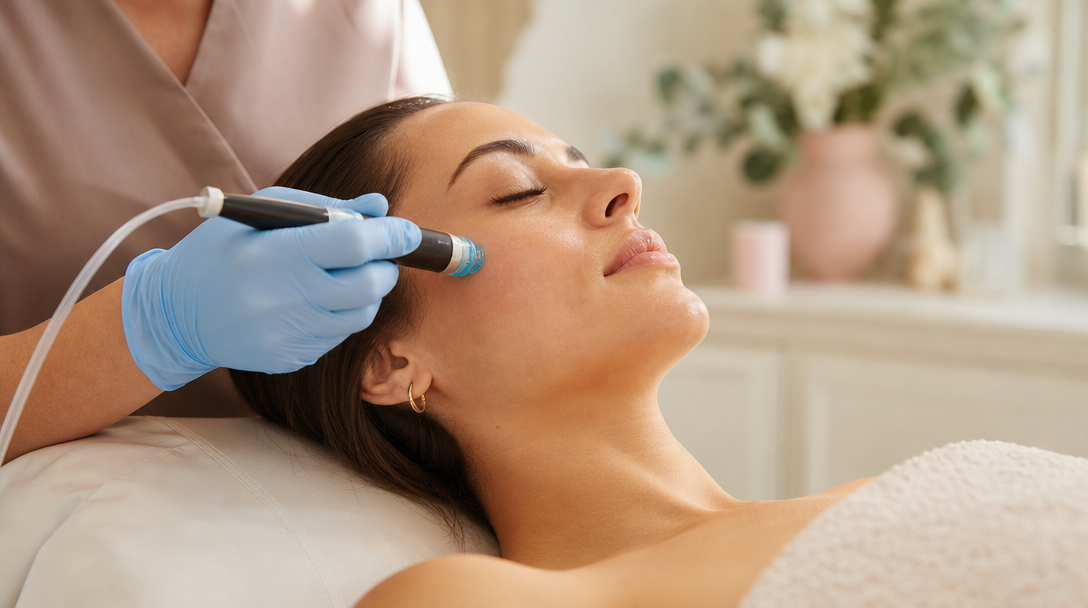
- Cleanse and light exfoliation. The wand sweeps away surface oil and dead skin to expose a fresh layer.
- A gentle acid loosen. A mild blend helps lift hardened oil and debris from the pores so they clear more easily.
- Painless extraction. Instead of squeezing by hand, the device uses suction to draw out the loosened contents of the pores.
- Serum infusion. The skin is fed a serum, often built around antioxidants, hyaluronic acid and peptides, while the wand is still in contact.
There is usually no downtime. Most people leave with an immediate, even glow and can wear makeup the same day. At CoLaz the Hydrafacial starts from £99 for the Express tier, with longer concern-based tiers for skin that needs more. For a fuller breakdown of each stage, see what Hydrafacial does.
What does a traditional facial do that a machine cannot?
A traditional facial gives you hands-on assessment, massage and the freedom to change course mid-treatment, which a fixed device protocol does not. That human element is the real value of a classic facial, and it is easy to overlook.
The therapist can feel where your skin is congested, spend longer on one area, lighten the pressure where you are sensitive, and switch products if your skin reacts. Facial massage also supports circulation and lymphatic drainage and, for many people, the treatment is genuinely relaxing in a way a machine-led session is not.
At CoLaz the deep cleanse facial covers cleanse, exfoliation, manual extraction, a mask and a finish, from £35 for a 30 minute session. It suits congested or dull skin, blackheads, and anyone who wants a calmer, more tactile treatment at a lower price point. What a manual facial cannot do is deliver the standardised, suction-and-infusion result of a device in a single consistent pass.
Hydrafacial vs facial: which gives better results?
For measurable changes in skin quality, the device-led route has more published evidence behind it, but “better” depends entirely on your goal. The honest position is that both improve the skin, and the gap is smaller than the marketing suggests.
In Freedman’s controlled comparison, the group treated with hydradermabrasion showed increased epidermal thickness, higher skin antioxidant levels and greater fibroblast density, with reduced fine lines, pore size and pigmentation. The group given the same serum by hand showed no structural change. A separate clarifying series reported in a peer-reviewed journal found improvement in active acne over a course of treatments. These are small studies, so the figures should be read as encouraging rather than definitive.
The wider family of device exfoliation is also well documented. An evidence review of microdermabrasion and a separate histology study showed epidermal thickening and new collagen after a course, with the main mechanism being controlled removal of the stratum corneum, the skin’s outer layer. Researchers continue to map where these treatments sit among resurfacing options, and studies pairing diamond-tip dermabrasion with good topical skincare report better results than either alone.
| Feature | Hydrafacial | Traditional facial |
|---|---|---|
| Driven by | Vortex device and set serums | Therapist’s hands and chosen products |
| Extraction | Suction, standardised | Manual, judged by the therapist |
| Downtime | None for most people | None for most people |
| Best at | Consistent glow, hydration, congestion | Relaxation, tailored care, massage |
| CoLaz price | From £99 (Express) | From £35 (deep cleanse, 30 min) |
Is a Hydrafacial worth the higher price?
A Hydrafacial is worth the higher price if you want a quick, even glow with no downtime and a consistent result from a standardised protocol, especially before an event. A traditional facial is worth it if you want hands-on, relaxing, adaptable care at a lower price.
The price gap is not a markup for its own sake. A Hydrafacial uses a costly device, single-use tips and patented serums, so the consumable cost per treatment is genuinely higher than a manual facial. At CoLaz, every price is a “from” figure set at the lowest single-session entry tier, and we confirm your actual price in writing at the consultation. You can see the full list on our transparent pricing page. We do not sell a fixed block of facials on day one before we have seen your skin.
A clinic view: Hydrafacial as the supporting cast, not the lead
In my experience, the most common mistake is expecting one facial of either kind to fix a long-standing concern. A patient in her late forties came to our Wembley clinic for a Hydrafacial and asked if a one-off would clear her dull skin and large pores. The honest answer was no. A Hydrafacial cleanses, exfoliates and hydrates beautifully, and it gives an immediate brightening, but on its own it does not resolve pore size, pigmentation or texture.
We built her a longer plan instead: a Hydrafacial monthly for skin health, a short course of medium-depth peels for the texture, and a skin-remodelling course for elasticity. A facial, device-led or hands-on, is the supporting cast, not the lead actor. Patients deserve to hear that before they book.
Timing is the other thing I plan carefully. A bride came into our Hounslow clinic four weeks before her wedding wanting makeup-ready skin. We planned a short course of dermaplaning, then a Hydrafacial seven days before the day, so her skin had time to settle without any last-minute redness. For events, I finish the bigger treatments four to six weeks ahead and book the gentle smoothing facials in the final week or two.
Which facial should you book?
Book a Hydrafacial if you want a fast, no-downtime glow before an event or as monthly maintenance, and book a traditional facial if you want relaxing, hands-on care or you are working to a tighter budget. Many patients alternate between the two across the year, and that is a sensible plan.
Whichever you choose, the practitioner matters more than the menu. UK regulators are clear that many non-surgical treatments can legally be carried out by people with very little training, so the NHS advises checking a practitioner has the right training and insurance. Both Save Face and the regulator suggest looking for an accredited register entry, and the Care Quality Commission has guidance on choosing safely. At CoLaz, your skin is assessed first and your plan is written down before you decide.
The clearest next step is to talk it through with a clinician who can look at your skin. Book a free consultation at your nearest CoLaz clinic, and we will tell you honestly whether a Hydrafacial, a traditional facial, or a wider plan is the right fit for what you want to change.
Ready to begin
Book a free Hydrafacial consultation at your nearest CoLaz clinic
Time with a qualified clinician: a skin assessment, an honest recommendation and no obligation. Read about Hydrafacial at CoLaz, from £99 (Express, 30 minutes).
More on Skin
Keep reading
-

Acnelan treatment: the in-clinic peel for active, inflammatory acne
Acnelan is a professional acne peel system with a daily home routine. Here is what is in it, how the course runs, what results look like and when another route suits you better. Read the article -

Sunekos vs Profhilo: which skin booster is right for your skin?
Sunekos and Profhilo are both injectable skin boosters, but one is pure stabilised hyaluronic acid and the other adds amino acids. Here is how they differ and how to choose. Read the article -

PRP face treatment: what it actually does for your skin
PRP uses a small sample of your own blood to support collagen and skin repair. Here is what the research really shows, how many sessions most people need and what to expect on the day. Read the article
Book a free consultation at your nearest CoLaz clinic
Time with a qualified clinician: a skin assessment, an honest recommendation and a written plan. No obligation.