
Do chemical peels work for acne scars?
 Owner, CoLaz Aesthetics Clinic
The short version
- Chemical peels can soften acne scars, particularly rolling and boxcar scars, but they rarely flatten deeper ice-pick scars on their own.
- Medium-depth TCA peels show the strongest evidence in clinical trials, with one comparative study reporting marked or excellent improvement in over half of patients after four sessions.
- Glycolic acid peels are a gentler alternative with less downtime, and salicylic acid is best for skin still battling active acne alongside scars.
- Combining peels with microneedling produces better results than either treatment on its own, according to peer-reviewed meta-analyses.
- At CoLaz, we map your scars by type at the consultation and plan a course of peels, microneedling, or both, with realistic targets rather than a single-session promise.
Yes, chemical peels can work for acne scars, but the honest answer is more careful than that. The type of scar decides the type of peel, the depth of peel decides the size of the result, and the combination of treatments almost always beats any single one. The wrong peel on the wrong scar, or one peel where a course was needed, leaves patients disappointed and convinced peels do not work at all.
Below is what the evidence actually shows, which peels move which scars, how peels compare with microneedling, and how we plan an acne-scar course at CoLaz across our seven UK clinics. The aim is realistic targets and a treatment plan that earns them, not a sales pitch.
What kinds of acne scars do peels actually treat?
Chemical peels work best on rolling and boxcar scars, work less well on deep ice-pick scars unless used with the specific TCA CROSS technique, and do little for thick, raised hypertrophic scars. The NHS lists three main scar types and treatments differ for each.
The NHS guidance on acne complications splits scarring into:
- Ice-pick scars: small, deep holes that look like the skin has been punctured with a sharp object.
- Rolling scars: bands of scar tissue under the skin that give the surface a wavy, uneven look.
- Boxcar scars: round or oval depressions or craters in the skin.
Most patients with acne scarring have a mix of all three, often with some red or pigmented marks left from older breakouts (“post-inflammatory hyperpigmentation”) layered on top. A treatment plan that ignores that mix and applies one peel to everything tends to underwhelm. A plan that maps the area scar-by-scar and uses different tools for different scars tends to deliver.
Peels are also not the right answer for active cystic acne. The NHS acne page reinforces that severe active acne needs medical treatment first, often through a GP or a dermatologist. We will say so at the consultation and route you accordingly before we put any acid on the skin.
What does the clinical evidence say about peels for acne scars?
Medium-depth TCA peels have the strongest evidence for atrophic acne scars. Glycolic and salicylic acid peels also work, with gentler downtime and slightly weaker but still meaningful results. The data is consistent across multiple peer-reviewed trials.
A 2025 single-arm clinical trial on medium-depth peels for moderate acne and atrophic scars enrolled twenty young adults. Two yellow peel sessions, four weeks apart, produced an 85.7 per cent reduction in inflammatory lesions, more than a 20 per cent reduction in scar volume measured by 3D imaging, and a 25 to 26 per cent decrease in sebum production. Side effects were limited to transient redness and four to five days of moderate peeling.
A split-face comparison glycolic vs TCA ran four sessions four weeks apart on thirty patients. TCA outperformed glycolic on physician assessment, with marked-to-excellent improvement in 53.3 per cent of TCA-treated faces vs 6.7 per cent on glycolic. TCA also produced more dryness and crusting. The authors concluded TCA is the more potent option for mild-to-moderate atrophic scars while glycolic remains a viable alternative for patients prioritising tolerability.
A larger evidence-based review of chemical peels for acne and acne scars in Asian skin (relevant because most CoLaz patients live in the UK but represent a wide range of Fitzpatrick types) summarised:
- Salicylic acid 30 per cent: significant improvement of comedonal and inflammatory acne, mild side effects.
- Glycolic acid 35 to 70 per cent: fair-to-good improvement with overall skin brightening.
- TCA CROSS at 100 per cent: excellent results in more than 70 per cent of patients for ice-pick scars specifically.
- Lactic acid and combination peels: superficial scarring improves with multi-session courses.
That fourth row matters. The TCA CROSS technique is a different way of using TCA: instead of painting it across the whole face, a sterile applicator places a tiny drop of 80 to 100 per cent TCA into the base of each individual ice-pick scar. The acid causes a controlled, focal wound at the base of the scar that fills in with collagen as the skin heals. The same trial reported excellent improvement (more than 70 per cent of scar depth) in 73.3 per cent of patients after four monthly sessions. CROSS is the answer to ice-pick scars that broader peels cannot reach.
How does the depth of a peel decide what it can do?
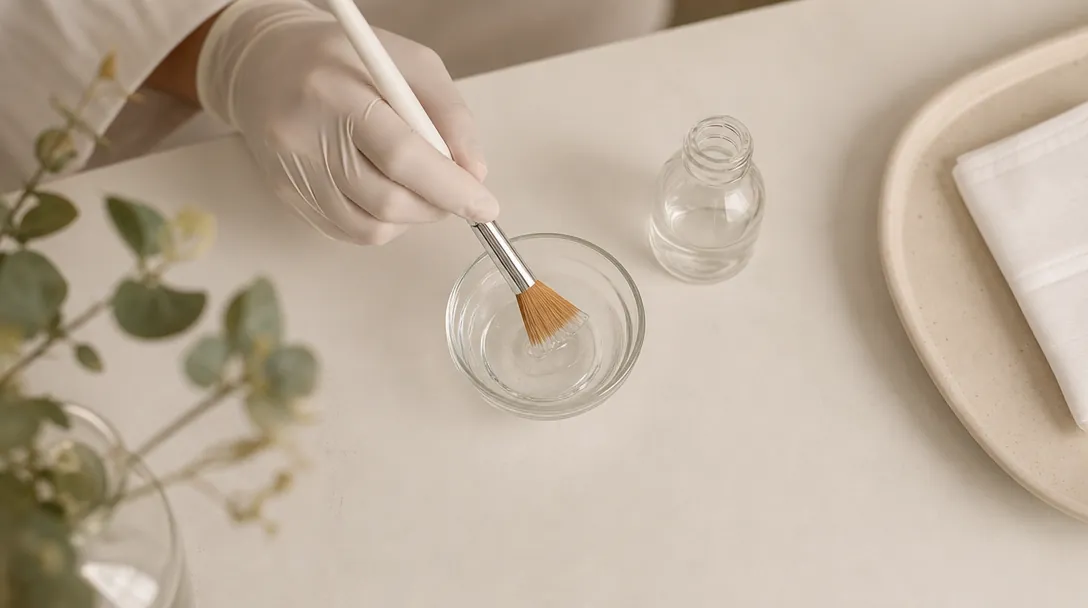
Chemical peels are categorised by depth, and depth decides both downtime and what kind of scar they can move. Superficial peels stay at the top of the epidermis; medium peels reach the upper dermis; deep peels reach the mid-dermis. Deeper does more but costs more downtime.
A practical mapping:
- Superficial peels: mandelic, lactic, low-strength salicylic and glycolic. Lunchtime treatment, mild flaking for a day or two, gentle smoothing and brightening. Good for post-inflammatory pigmentation marks and surface texture, not enough on their own for atrophic scars.
- Medium-depth peels: 35 per cent TCA, Jessner’s solution, modified Jessner-TCA combinations. Five to seven days of visible peeling, significant brightening and a measurable effect on shallow rolling and boxcar scars. Most evidence for atrophic acne scarring sits here.
- Deep peels: high-concentration TCA, phenol-based. Two to three weeks of downtime, more risk of pigment changes especially in darker skin tones. Generally not run as a routine clinic treatment in the UK.
- TCA CROSS: high-concentration TCA used focally inside individual ice-pick scars. Localised crusts on each treated scar that resolve over five to seven days. Specific and effective for ice-pick depth that broader peels cannot reach.
The depth needed is decided in clinic against the actual scars rather than booked online from a tier name. The same “TCA peel” label can mean very different concentrations in different settings.
Which peel suits which scar type?
The shortest matrix runs like this:
- Rolling scars: medium-depth TCA or Jessner-TCA, ideally combined with microneedling.
- Boxcar scars: medium-depth TCA peel, with TCA CROSS at the base of the deepest ones.
- Ice-pick scars: TCA CROSS at 80 to 100 per cent, run as a focal treatment per scar.
- Mixed atrophic scars with pigmentation: glycolic acid 35 to 70 per cent for the brightening alongside any of the above for the texture.
- Active inflammatory acne plus scars: salicylic acid first, treat the acne, then layer scar work in once the active phase is under control.
The science behind that last row is in the salicylic acid review, which describes salicylic as lipid-soluble (so it sinks into oily pores rather than being repelled), comedolytic (clearing blocked pores) and anti-inflammatory. It is the right tool for active acne. TCA at scar-treating concentrations on actively inflamed skin is more likely to make things worse.
How do peels compare with microneedling for acne scars?
Microneedling tends to edge out chemical peels for atrophic acne scars when run head-to-head, but the combination of the two beats either alone in peer-reviewed evidence.
A JCAD comparison study of microneedling versus 35 per cent glycolic acid peel ran six sessions in each group and found microneedling produced superior improvement in atrophic acne scars by both physician and patient assessment. The mechanism makes sense: microneedling creates controlled micro-channels into the dermis that trigger collagen remodelling, whereas a superficial peel mainly acts on the epidermis.
A 2025 meta-analysis of combined chemical peeling with microneedling versus monotherapy concluded the combination produced statistically significant improvement in acne scar outcomes compared with either treatment alone. Practical pattern: microneedling at the start of each combined session opens the skin and stimulates collagen, the peel layered on after the needling drives both deeper.
This is also why we plan most acne-scar courses at CoLaz as combination courses rather than as a single tool. A typical layout for a patient with mixed scarring:
- Session 1: assessment and patch test for the chosen peel.
- Sessions 2 to 7 (every 4 to 6 weeks): alternate medium-depth peels and microneedling or Dermapen treatments.
- Session 8 onwards: TCA CROSS on remaining ice-pick scars where present.
- Maintenance every 3 to 6 months depending on results.
We will be explicit about what each session is for. Patients who understand the logic of the course are also the patients who get the best results, because they follow aftercare properly and stay the distance.
What does downtime and aftercare actually look like?
Downtime depends on the peel depth. Superficial peels: a day or two of mild flaking. Medium-depth peels: five to seven days of visible peeling, redness for up to a week. TCA CROSS: localised crusts on each treated scar that resolve over five to seven days.
A few aftercare rules apply across all peels:
- Strict sun protection for the duration of the course. Daily SPF 50 on the treated area, including in winter and on cloudy days. UV exposure on freshly peeled skin is the main driver of post-inflammatory hyperpigmentation, which can take months to fade.
- No picking, peeling or scrubbing the skin while it sheds. The new skin underneath is fragile and lifting flakes early scars more than the original problem.
- No retinoids, AHAs or BHAs for a few days either side, longer for medium-depth peels.
- Gentle cleansers and a barrier-supporting moisturiser for the first week.
- No saunas, steam rooms or heavy workouts for forty-eight hours after a peel.
We give written aftercare at the end of every session and we check in with patients before the next one to make sure recovery is on track.

What about pigmentation in darker skin tones?
Patients with Fitzpatrick types IV to VI need a more cautious peel strategy because the risk of post-inflammatory hyperpigmentation is higher. The right plan is achievable, but it is not the same plan used on lighter skin.
A few decisions we make differently for darker skin:
- Lower peel concentrations stepped up across the course rather than starting at maximum strength.
- Glycolic and salicylic peels are often a safer starting point than TCA, because of the lower pigmentation risk profile.
- Pre-treatment priming with hydroquinone or tretinoin in the weeks before the course, where appropriate, to reduce the chance of pigment changes.
- Stricter SPF protocol during and after the course, with explicit avoidance of sun and sunbeds throughout.
- Patch testing that uses the actual peel solution at the planned concentration before the first full session.
That cautious approach mirrors the evidence-based review in Asian skin types. Done properly, atrophic acne scarring in darker skin responds to peels. Done in a hurry, it does not.
How does CoLaz plan an acne-scar peel course?
Every acne-scar patient at CoLaz starts with a free consultation where we map the actual scars by type. That sounds simple but it is the step most often skipped, and it is the step that decides whether a peel course will help you or disappoint you.
What happens at the consultation:
- Scar mapping. We identify ice-pick, rolling and boxcar scars across the face, note any active acne, and look for post-inflammatory pigmentation.
- Skin assessment. Fitzpatrick type, any history of hyperpigmentation, current skincare, recent isotretinoin or other medical treatment.
- Treatment plan in writing. Likely a combination of chemical peels, microneedling, and TCA CROSS where ice-pick scars are present. Realistic numbers, realistic expectations.
- Patch test. Forty-eight hours before the first peel, against the actual concentration that will be used.
We will not sell an eight-session package on day one. The patch test tells us how your skin responds to the peel; the plan is then confirmed in writing.
UK aesthetics is governed by voluntary accreditation through the JCCP and the Save Face register, both Professional Standards Authority-recognised. Every clinician running peels at CoLaz is trained on the full menu and on the limits of each peel, so the conversation in the consultation is about the right treatment for your scars, not the most expensive one on the list.
If you are ready to find out what your specific scar plan would look like, the free consultation at your nearest CoLaz clinic is included with no obligation. Bring photos taken in natural light and any acne medication history; we will plan from there.
Ready to begin
Book a free Chemical Skin Peels consultation at your nearest CoLaz clinic
Time with a qualified clinician: a skin assessment, an honest recommendation and no obligation. Read about Chemical Skin Peels at CoLaz, from £99 (BHA salicylic peel, single session).
More on Skin
Keep reading
-

Acnelan treatment: the in-clinic peel for active, inflammatory acne
Acnelan is a professional acne peel system with a daily home routine. Here is what is in it, how the course runs, what results look like and when another route suits you better. Read the article -

Sunekos vs Profhilo: which skin booster is right for your skin?
Sunekos and Profhilo are both injectable skin boosters, but one is pure stabilised hyaluronic acid and the other adds amino acids. Here is how they differ and how to choose. Read the article -

PRP face treatment: what it actually does for your skin
PRP uses a small sample of your own blood to support collagen and skin repair. Here is what the research really shows, how many sessions most people need and what to expect on the day. Read the article
Book a free consultation at your nearest CoLaz clinic
Time with a qualified clinician: a skin assessment, an honest recommendation and a written plan. No obligation.