
Dermaplaning aftercare: what to use and what to avoid
 Owner, CoLaz Aesthetics Clinic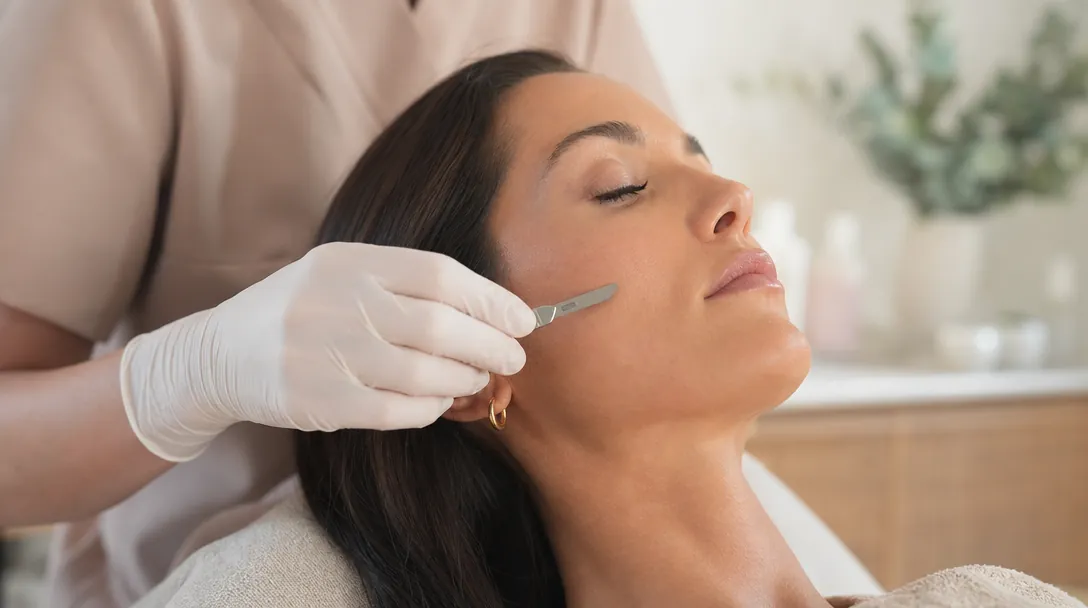
The short version
- Dermaplaning removes vellus hair and the top dead-skin layer, so the new surface is briefly more sensitive to UV, heat and active ingredients.
- Use a broad-spectrum SPF 30 or higher with a 4 or 5-star UVA rating every day for at least a week after, ideally a mineral formulation in the first 24 to 48 hours.
- Avoid retinoids, AHAs, BHAs and physical scrubs for seven days; avoid heavy make-up, swimming and saunas for 48 hours.
- Vellus hair does not grow back thicker or darker; the AAD and dermatology textbooks have been clear on this for decades.
- At CoLaz, every dermaplaning client leaves with a printed aftercare card and a follow-up reminder for any active or peel scheduled in the next two weeks.
Dermaplaning gives skin one of the fastest visible glows in aesthetics: vellus hair gone, top layer of dead skin gone, make-up sitting flatter the next morning. What people are not usually told is that for the first 48 hours after a session, that fresh surface is also more vulnerable to sun, heat and active ingredients than your normal skin. Get the aftercare right and you get the glow without the irritation; get it wrong and you can pigment, break out or end up with a tight, flaky face for a week.
Below is the realistic aftercare guide we give every CoLaz dermaplaning patient, with the products to use, the ingredients to skip, and the timeline to follow.
What does dermaplaning actually do to the skin?
Dermaplaning uses a single-use sterile surgical blade held at a 45-degree angle to gently scrape away the outermost layer of dead skin cells (the stratum corneum) and the fine vellus hair (peach fuzz) on the surface of the face. A systematic review in Aesthetic Plastic Surgery groups dermaplaning with other non-invasive resurfacing treatments and notes that its benefits are immediate but temporary, typically holding for three to four weeks before the stratum corneum regenerates.
It is a mechanical exfoliation, not a chemical one. Nothing penetrates below the top layer of skin, which is why it has no real downtime and can be done in 30 to 40 minutes. The trade-off is that the new surface is briefly thinner and more permeable, which is why aftercare matters. For the first 24 to 48 hours, topical products absorb faster, UV penetrates more easily and the skin barrier is gently recalibrating, similar in principle to skin in the few days after a chemical peel or a light Hydrafacial, just at a milder level. The general NHS guidance on cosmetic procedures is to follow the aftercare your clinician gives you precisely, especially in the first week.
What should you put on your skin in the first 24 hours?
In the first 24 hours after dermaplaning, keep your skincare to three things: a gentle cleanser, a basic moisturiser and a broad-spectrum mineral sunscreen. Nothing with acids, retinol or scent.
The shortlist of what to use:
- A gentle, fragrance-free cleanser to take off any residue and SPF at the end of the day. No scrubs, no hot water, no muslin cloth on the first day.
- A simple ceramide or hyaluronic acid moisturiser to support the barrier. Aim for something with five or fewer ingredients you recognise.
- Mineral sunscreen with zinc oxide or titanium dioxide, broad-spectrum, SPF 30 or higher with a 4 or 5-star UVA rating in line with NHS sun guidance. Mineral over chemical for the first 48 hours because mineral filters sit on the surface rather than absorbing into a slightly more permeable barrier.
What to skip on day one:
- Anything with retinol, retinaldehyde, tretinoin or any retinoid.
- AHAs (glycolic, lactic, mandelic) and BHAs (salicylic).
- Vitamin C in high concentrations.
- Strong fragrances, essential oils or “actives” packs.
- Physical scrubs, exfoliating cloths or face brushes.
The reason is simple: your skin has just had a controlled mechanical exfoliation. Stacking a chemical exfoliation on top doubles the irritation without doubling the benefit.
What should you avoid in the first 48 hours?
For 48 hours after dermaplaning, avoid direct sun, sunbeds, saunas, steam rooms, hot yoga, swimming pools and any heavy sweating. The combination of a more permeable surface and heat is what causes most of the post-dermaplaning irritation and breakouts we see in clinic.
The full 48-hour avoid list:
- Direct sun on the face. Hat, shade or stay indoors during peak UV hours.
- Sunbeds and self-tanners. Both can cause uneven pigment uptake on the new surface.
- Saunas, steam rooms and hot baths. Heat dilates blood vessels and prolongs redness.
- Hot yoga and intense exercise. Sweat on freshly exfoliated skin is a recipe for breakouts.
- Chlorinated and salt water. Skip swimming pools and the sea for at least 72 hours.
- Heavy make-up and full-coverage foundation. Wait 24 hours; mineral powder is fine after.
- Other resurfacing treatments. No microdermabrasion, microneedling, chemical peels or IPL for at least seven days.

When can you bring back retinoids, acids and exfoliants?
Most actives can come back into your routine after seven days, starting with the gentlest first and stacking back up over the second week. Retinoids are usually the last to return.
The realistic timeline we give patients:
- Days 1 to 2: cleanser, moisturiser, mineral SPF only.
- Days 3 to 5: standard chemical SPF is fine. Vitamin C serum can be reintroduced at low strength.
- Days 6 to 7: gentle AHAs and BHAs back at usual frequency. Hyaluronic acid serums fine throughout.
- Day 7 onwards: retinoids and stronger actives back. Microneedling, peels and IPL can be scheduled from day 8 if your clinician advises.
If you have a course of treatments that combines dermaplaning with another modality (a popular pairing is dermaplaning followed two weeks later by a light chemical peel or a Hydrafacial), the aftercare protocol resets at every step. We will write the schedule out for you at the consultation rather than leaving you to guess.
Will my vellus hair grow back darker or thicker?
No. Vellus hair regrowth after dermaplaning keeps the same diameter, colour and texture as before. It only feels stubbier in the first week because the cut end is blunt rather than tapered.
The American Academy of Dermatology and every dermatology textbook are clear on this point. Hair structure is determined at the follicle, not at the cut end. A blade across the surface trims hair flush with the skin; it does not change the follicle below it. When the hair grows back in three to four weeks, it will be the same colour, diameter and texture as before.
This is the single most common worry first-time dermaplaning patients raise. If the appearance of vellus hair really bothers you, the right options are either:
- Dermaplaning every four to six weeks as a routine, in line with your normal hair cycle.
- Electrolysis for permanent removal of individual hairs.
- Laser hair removal is generally not suitable for vellus hair because there is too little pigment for the laser to target.
Why is sun protection so important after dermaplaning?
Sun protection is critical after dermaplaning because the newly exposed surface has less of its dead-cell barrier, so UV penetrates more efficiently and the risk of pigmentation and burns is briefly higher than usual.
The NHS sunscreen guidance gives the baseline for daily protection: SPF 30 or higher, broad-spectrum, with at least four-star UVA protection, applied 30 minutes before going outside, and reapplied every two hours when you are out. Adults are routinely under-applying; the NHS quotes six to eight teaspoons of sunscreen for whole-body coverage, and most of us use less than half of that on the face and neck alone.
After dermaplaning, we ask patients to:
- Use SPF 30 minimum, 50 ideal, every day for the first week, even indoors near windows.
- Choose mineral over chemical in the first 48 hours (zinc oxide or titanium dioxide).
- Reapply every two hours if outdoors, sweating or near reflective surfaces (water, snow, sand).
- Wear a hat and stay in the shade during peak UV hours for the first three days.
Skipping SPF is the single most common reason a beautifully done dermaplaning result ends up with new pigmentation a fortnight later. It is also the easiest mistake to avoid.
What if my skin reacts more than expected?
Mild redness, slight tightness and a touch of flaking for two to three days are normal. Persistent redness for more than three days, new breakouts that do not settle, or any signs of infection (heat, swelling, yellow discharge) are not, and you should contact the clinic.
Dermaplaning is a surface treatment that does not break the skin barrier, and the JCCP-listed modalities cover the higher-risk procedures alongside it, which is part of why dermaplaning is considered lower-risk when done correctly. The things that push a session into the complication category are usually the same:
- A clinician using a reused or non-sterile blade.
- Working over active acne, cold sores, eczema or sunburned skin.
- Stacking it on the same day as a chemical peel or microneedling without recovery between.
- Sending the patient home with no SPF guidance.
If your skin is reacting and you are not sure whether it is normal post-treatment redness or something more, call the clinic. A five-minute walk-in check is better than guessing for three days at home.

How does CoLaz handle dermaplaning aftercare?
Every CoLaz dermaplaning patient leaves with a printed aftercare card, a labelled mineral SPF sample for the first day, and a phone number to call if anything looks off in the first 72 hours. Aftercare is part of the treatment, not an optional extra.
Most patients booking dermaplaning are also considering a Hydrafacial, a chemical peel or a microneedling course, and the spacing between those matters. If we know you are coming back for a peel in two weeks, the aftercare guidance for the gap is slightly different than for a one-off session.
We hold ourselves to the same standard the NHS guidance on cosmetic procedures recommends: practitioners on a Professional Standards Authority-accredited register such as the JCCP or Save Face, with appropriate training and insurance.
If you are weighing dermaplaning against another exfoliation route, or combining it with a peel or a Hydrafacial, the free consultation is the place to write the plan out properly.
Ready to begin
Book a free Dermaplaning consultation at your nearest CoLaz clinic
Time with a qualified clinician: a skin assessment, an honest recommendation and no obligation. Read about Dermaplaning at CoLaz, from £65 (full face, single session).
More on Skin
Keep reading
-

Acnelan treatment: the in-clinic peel for active, inflammatory acne
Acnelan is a professional acne peel system with a daily home routine. Here is what is in it, how the course runs, what results look like and when another route suits you better. Read the article -

Sunekos vs Profhilo: which skin booster is right for your skin?
Sunekos and Profhilo are both injectable skin boosters, but one is pure stabilised hyaluronic acid and the other adds amino acids. Here is how they differ and how to choose. Read the article -

PRP face treatment: what it actually does for your skin
PRP uses a small sample of your own blood to support collagen and skin repair. Here is what the research really shows, how many sessions most people need and what to expect on the day. Read the article
Book a free consultation at your nearest CoLaz clinic
Time with a qualified clinician: a skin assessment, an honest recommendation and a written plan. No obligation.