
HIFU treatment results: month by month, what is realistic
 Owner, CoLaz Aesthetics Clinic
The short version
- HIFU is not an instant lift. Most of the visible change happens between 8 and 12 weeks, with the full effect at around 6 months.
- A 2025 systematic review of 45 studies found skin laxity improved by 18 to 30 per cent, mostly in the lower face, neck and around the eyes.
- HIFU suits mild to moderate laxity. It does not do the job of a surgical face lift on heavier sagging.
- At CoLaz, HIFU is 1 to 2 sessions from £399 for the neck and jawline, with a top-up every 12 to 18 months.
- We will not treat an area that has had dermal filler recently. That is checked at your free consultation.
TL;DR
- HIFU is not an instant lift. Most of the visible change happens between 8 and 12 weeks, with the full effect at around 6 months.
- A 2025 systematic review of 45 studies found skin laxity improved by 18 to 30 per cent, mostly in the lower face, neck and around the eyes.
- HIFU suits mild to moderate laxity. It does not do the job of a surgical face lift on heavier sagging.
- At CoLaz, HIFU is 1 to 2 sessions from £399 for the neck and jawline, with a top-up every 12 to 18 months.
- We will not treat an area that has had dermal filler recently. That is checked at your free consultation.
Most people who ask us about HIFU treatment results have seen a before-and-after photo somewhere and want to know when they will look like that. The honest answer is that HIFU works on a slow curve, and the photo you saw was almost certainly taken months after the session, not days.
That gap between expectation and biology is where disappointment comes from. So this is the timeline we actually give patients across our seven UK clinics, with the published evidence behind each stage, and a clear list of who this treatment suits and who it does not.
What are realistic HIFU treatment results?
Realistic HIFU treatment results are a modest tightening and a cleaner jaw and neck line, not a new face. Published work puts the improvement in skin laxity at 18 to 30 per cent, concentrated in the lower face, the neck and the area around the eyes.
That number is worth sitting with. A 20 per cent improvement in laxity is visible to you and to people who know your face well. It is not visible from across a room, and it will not close the gap on skin that has already lost significant structural support.
Patient-reported figures are more generous than the objective ones. A meta-analysis of 42 studies found 89 per cent of patients showed investigator-assessed improvement and 84 per cent reported satisfaction, but satisfaction dropped to 62 per cent in the studies that offered patients a neutral answer option. In other words, some of the enthusiasm in the literature is a survey-design effect. Plan for the objective number, and treat anything above it as a bonus.
How does HIFU tighten the skin?
HIFU focuses ultrasound energy at a fixed depth below the surface, creating small points of controlled thermal injury that the body repairs by making new collagen. The surface of the skin is not broken, which is why there is no wound and no recovery time in the usual sense.
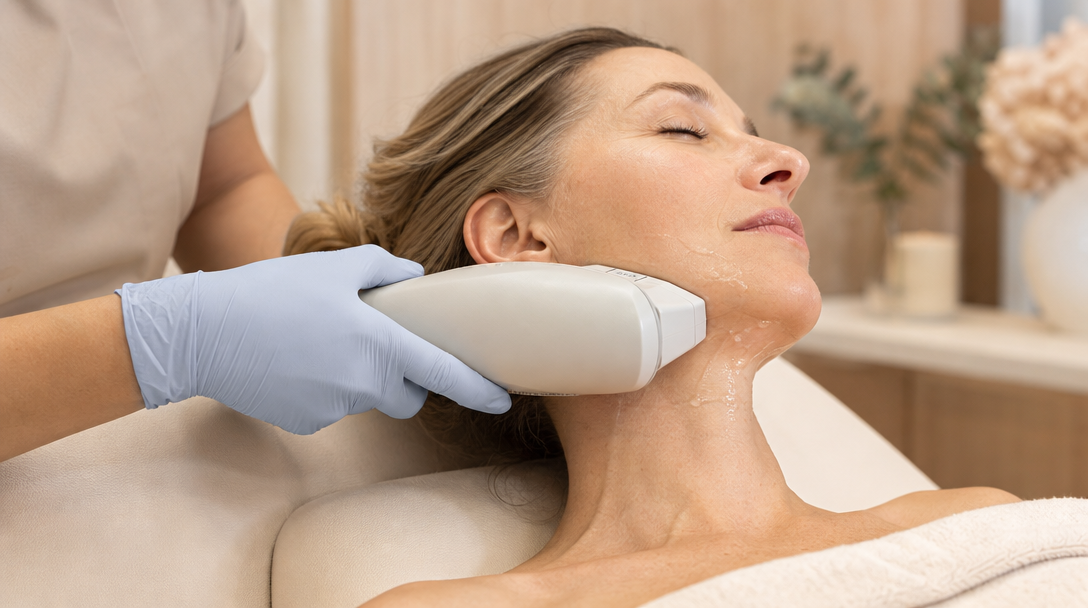
The repair response is the whole treatment. Laboratory work shows HIFU increases both collagen and elastin fibre synthesis in ageing skin, working through a signalling pathway that pushes fibroblasts (the cells that build collagen) back into an active state. A separate histological analysis across treatment depths of 2.0mm to 6.0mm confirmed increased collagen and elastin fibre synthesis in treated tissue, with 85.3 per cent of participants satisfied with the outcome.
Two things follow from that mechanism. Collagen takes weeks to build and months to mature, so nothing meaningful can appear on day one. And the treatment works with what your skin can still produce, which is why age and general skin quality matter more than the machine settings.
The month by month HIFU results timeline
Here is the timeline we write into a patient’s plan. The clinic figures come from our own protocol; the wider ranges match the published facial skin tightening literature.
| Stage | What is happening | What you see |
|---|---|---|
| Day 0, straight after | Immediate collagen contraction from the heat | A slight tightness or lift that is real but temporary |
| Days 1 to 7 | Mild inflammatory response begins | Possible redness, tenderness to touch, occasional tingling |
| Weeks 2 to 4 | New collagen starts being laid down | Usually nothing obvious. This is the quiet phase |
| Weeks 8 to 12 | Collagen deposition accelerates | The first result most patients notice: a firmer jaw and neck line |
| Months 3 to 6 | Collagen matures and reorganises | Gradual, steady improvement. The full result at around 6 months |
| Months 6 to 12 | New collagen behaves like your own | The result holds, then softens slowly as normal ageing resumes |
| Months 12 to 18 | Baseline drift | Time for a top-up session if you want to hold the result |
The quiet phase between weeks 2 and 4 is the one that unsettles people. Patients often message us at the three-week mark convinced nothing has worked. Nothing has gone wrong. Collagen simply does not build on a schedule that suits our patience.
That pattern is the same one I see across every collagen-based treatment we run. When a patient understands the timeline before the session, they wait calmly and are pleased at month three. When they do not, they are disappointed at week two and stop believing in the plan.
How long do HIFU treatment results last?
HIFU treatment results typically hold for around 12 months, after which normal ageing gradually takes the skin back towards baseline. In our clinics we plan a top-up every 12 to 18 months rather than promising a fixed endpoint.
The best long-term data comes from a study that followed patients out to a full year. At 90 days, 90 per cent of subjects reported improvement; at 180 days that rose to 95 per cent; and at one year, 95 per cent still reported improvement on both the subject and physician scales. Blinded assessors were stricter, confirming objective lifting in 43 per cent of the subjects assessed at 12 months.
There is a reason the result fades. Adult skin loses collagen yearly at roughly 1 per cent as an intrinsic part of ageing, and a HIFU session does not switch that process off. It resets the balance for a period. Maintenance is part of the result, not an upsell, and we say so at the consultation.
Who gets the best results from HIFU?
The best candidates have mild to moderate skin laxity in the lower face, neck, brow or body, and skin that still has reasonable elasticity to work with. In practice that is most commonly people in their late 30s to mid 50s who have noticed a softening jaw line rather than heavy sagging.
Good signs that HIFU is likely to suit you:
- Your main concern is a slightly blurred jaw line or early looseness under the chin.
- Your skin still springs back reasonably well when gently pinched.
- You are happy to wait three to six months for the result to arrive.
- You have realistic goals about degree, not a photograph of somebody else’s face.
If your concern is ageing skin across the whole face rather than laxity specifically, a skin quality treatment such as a hyaluronic acid remodeller often fits the goal better. One of our Reading patients in her early fifties came in asking for cheek filler because a colleague had had it. What she was actually unhappy with was loose skin along the jaw line and a tired look overall. We planned Profhilo instead, two sessions four weeks apart, and by week eight her skin tone had improved and her jaw line looked tighter without changing the shape of her face. The right product is whichever one matches the goal, not whichever one the patient walked in asking for.
Who is not a candidate for HIFU?
You are not a candidate if you have had dermal filler in the same area recently, if you are pregnant or breastfeeding, or if your skin laxity has gone past what an energy device can meaningfully change.
The filler rule catches people out, so it is worth being specific. HIFU delivers heat at a set depth, and heat can affect hyaluronic acid that is sitting in the same plane. HIFU is one of the treatments we turn patients away from at CoLaz for exactly this reason. We would rather reschedule you than degrade work you have already paid for.
We also decline when the honest answer is that the treatment cannot deliver what the patient wants. Heavy jowling, significant loose skin in the neck, or a substantial fat pad under the chin are not laxity problems that ultrasound solves. If your concern sits in the jawline and chin category and the underlying issue is volume rather than skin tone, we will tell you at the consultation and talk through what would actually work.
Does HIFU replace a surgical face lift?
No. HIFU tightens existing skin by a modest percentage; a surgical face lift removes and repositions tissue, which is a different order of change entirely.

This distinction matters more than any other point in this article, because it decides whether you will be happy. If you look in the mirror and want your jaw line to look a little cleaner and your neck a little firmer, HIFU is a reasonable option. If you look in the mirror and want the change a face lift produces, no energy device will get you there, and any clinic that suggests otherwise is not being straight with you.
The NHS advises thinking through your reasons, the full costs including maintenance, and taking a cooling-off period after any consultation before deciding. That is sensible for HIFU as much as for surgery, and every CoLaz consultation is built to give you that space.
What side effects should you expect after HIFU?
Expect mild redness and some tenderness or a deep ache in the treated area for a few days, and nothing that stops you going back to work the same day.
The published rates are reassuring. A complications review reports transient redness in 30 to 50 per cent of patients resolving within 24 to 48 hours, swelling in 10 to 20 per cent resolving within a few days, and nerve irritation in under 1 per cent, typically temporary. Bruising and short-lived numbness are also described.
Serious events are rare but real, and they are almost always about technique rather than technology. A published nerve injury case report describes temporary numbness and impaired movement of the upper lip after treatment near an area where facial nerve branches run close to the surface. This is why operator training matters. Every laser, IPL and energy-device treatment at CoLaz is delivered by a practitioner holding a VTCT or Ofqual Level 4 qualification, and non-permissible zones are mapped before a single pulse is delivered.
HIFU, radio frequency or threads: which matches your goal?
These three get compared constantly, usually badly, because they do different jobs on different timescales.
| Treatment | Mechanism | Onset | Typical longevity |
|---|---|---|---|
| HIFU | Focused ultrasound heat at a fixed depth, collagen remodelling | 8 to 12 weeks, full at 6 months | Around 12 to 18 months |
| Radio frequency | Bulk dermal heating, gentler, more sessions | 6 to 12 weeks, cumulative | Around 6 to 12 months |
| PDO thread lift | Physical repositioning with absorbable threads | Immediate | Around 12 to 24 months |
Radio frequency is the gentler option and generally needs a course rather than one or two sessions, which suits people who prefer smaller steps. Threads give an immediate mechanical lift that neither energy device can replicate, but they sit in the highest-risk category under the proposed English licensing scheme, so who delivers them matters enormously.
On regulation generally, the picture in England is still moving. The government published its consultation response in August 2025 and a further consultation is expected before legislation, with the JCCP competency framework for higher-risk procedures feeding into it. Until that lands, the practical protection is asking your clinic what qualification the person holding the handpiece actually holds.
How we plan HIFU at CoLaz
Every HIFU course starts with a free consultation, not a booking form. We assess the degree and type of laxity, check what treatments you have had in the area and when, take your medical history, and then tell you honestly whether ultrasound is the right tool for your goal.
If it is, the practical detail is straightforward. The HIFU facelift runs at 1 to 2 sessions, takes 60 to 90 minutes per session, and starts from £399 for the neck and jawline. You will feel a heating sensation deep in the skin during treatment, mild tenderness for a few days after, and gradual tightening over the following months. Your plan is written down and handed to you before you commit to anything.
If HIFU is not the right tool, we will say so and explain what is. Turning down treatment that cannot deliver what a patient wants is a normal part of the job here, and it is the reason patients come back.
Book a free consultation at your nearest CoLaz clinic and we will give you an honest assessment of what HIFU can and cannot do for your skin.
Ready to begin
Book a free HIFU Facelift consultation at your nearest CoLaz clinic
Time with a qualified clinician: a skin assessment, an honest recommendation and no obligation. Read about HIFU Facelift at CoLaz, from £399 (neck and jawline).
More on Skin
Keep reading
-

Acnelan treatment: the in-clinic peel for active, inflammatory acne
Acnelan is a professional acne peel system with a daily home routine. Here is what is in it, how the course runs, what results look like and when another route suits you better. Read the article -

Sunekos vs Profhilo: which skin booster is right for your skin?
Sunekos and Profhilo are both injectable skin boosters, but one is pure stabilised hyaluronic acid and the other adds amino acids. Here is how they differ and how to choose. Read the article -

PRP face treatment (the vampire facial): what it actually does for your skin
PRP uses a small sample of your own blood to support collagen and skin repair. Here is what the research really shows, how many sessions most people need and what to expect on the day. Read the article
Book a free consultation at your nearest CoLaz clinic
Time with a qualified clinician: a skin assessment, an honest recommendation and a written plan. No obligation.