
Acnelan treatment: the in-clinic peel for active, inflammatory acne
 Owner, CoLaz Aesthetics Clinic
The short version
- Acnelan is a professional, in-clinic acne peel system from mesoestetic, built around salicylic acid, mandelic acid and a salt of azelaic acid, with a daily home routine between sessions.
- At CoLaz the typical course is four to six in-clinic sessions spaced two to three weeks apart, available at our Reading clinic, priced at consultation.
- It is designed for mild to moderate active acne, oily congested skin and the darker marks acne leaves behind. Severe, scarring or cystic acne needs a doctor.
- The home routine matters as much as the clinic sessions. Most patients notice fewer active spots after the second session, with the fuller change across the course.
- Acnelan is not a replacement for prescription treatment when you need it. It can sit alongside a GP or dermatology plan once your prescriber agrees.
TL;DR
- Acnelan is a professional, in-clinic acne peel system from mesoestetic, built around salicylic acid, mandelic acid and a salt of azelaic acid, with a daily home routine between sessions.
- At CoLaz the typical course is four to six in-clinic sessions spaced two to three weeks apart, available at our Reading clinic, priced at consultation.
- It is designed for mild to moderate active acne, oily congested skin and the darker marks acne leaves behind. Severe, scarring or cystic acne needs a doctor.
- The home routine matters as much as the clinic sessions. Most patients notice fewer active spots after the second session, with the fuller change across the course.
- Acnelan is not a replacement for prescription treatment when you need it. It can sit alongside a GP or dermatology plan once your prescriber agrees.
Acnelan treatment is one of the most specific things we offer for active acne at CoLaz, and also one of the most misunderstood. Patients often arrive thinking it is a stronger facial, or a product they can buy and use at home. It is neither. Acnelan is in-clinic peel chemistry, applied by a trained specialist, and paired with a strict daily routine between visits. This guide explains what is in it, how a course runs, what results are realistic and when a different route will serve you better.
What is Acnelan treatment?
Acnelan treatment is a professional acne protocol from the Spanish skin brand mesoestetic that combines in-clinic peel sessions with a structured home routine.
The in-clinic step uses a concentrated peel mask that is only supplied to trained practitioners. It is not sold over the counter. At home, you use supporting products between sessions to keep oil, blocked pores and inflammation under control while the skin renews.
The idea is that acne has several drivers working at once: too much oil, dead skin blocking the pore, bacteria inside the blocked pore and inflammation around it. A single product rarely tackles all four. Acnelan is built as a course so that the clinic sessions and the home care reinforce each other over several weeks.
How does an Acnelan peel work on active acne?
The Acnelan peel works by loosening the dead skin and oil that block pores, while calming the inflammation around active spots.
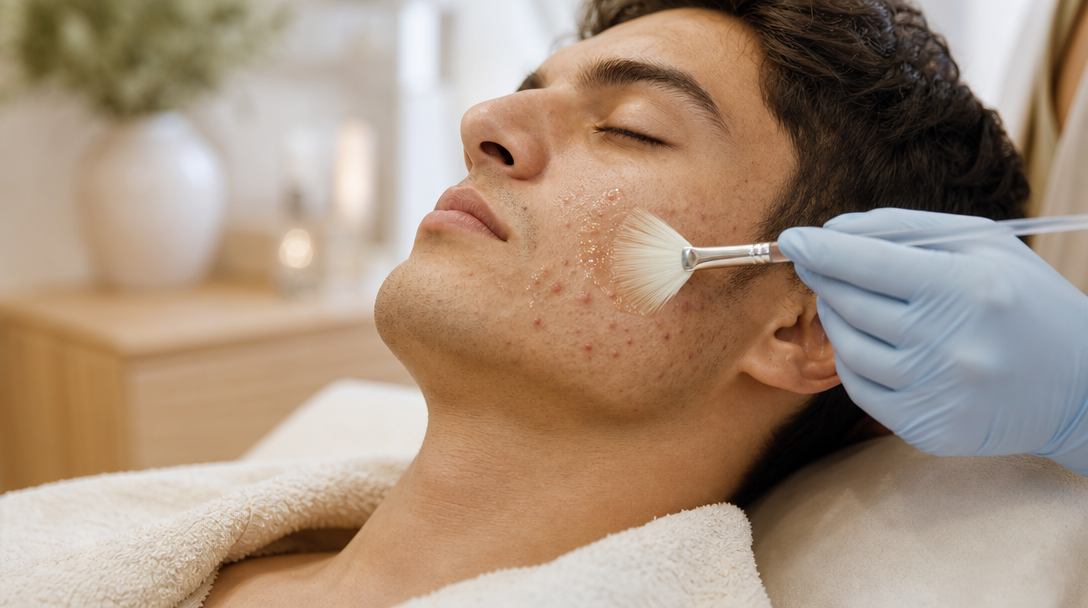
The manufacturer describes the core formula, the m.acne complex, as a blend of salicylic acid, mandelic acid and sodium lepargylate (a salt of azelaic acid), working alongside a retinoid-type complex. In plain English:
- Salicylic acid is oil-soluble, so it can travel into an oily pore and help clear the blockage from inside. This is why it is a long-standing acne ingredient.
- Mandelic acid is a larger acid molecule that penetrates more slowly, which tends to make it gentler. It has antibacterial properties of its own.
- Azelaic acid helps calm redness and has a role in reducing the darker marks that acne can leave, especially in deeper skin tones.
The evidence for these ingredients is real but modest. The 2024 American Academy of Dermatology acne guidelines give salicylic acid and azelaic acid a conditional recommendation, which means they can help, but the supporting studies are smaller than those behind prescription treatments. A Cochrane review of topical acne acids reached a similar view: some benefit, mostly low-quality evidence. We would rather you hear that from us than discover it later.
Who is Acnelan for, and who should wait?
Acnelan suits patients with mild to moderate active acne, oily and congested skin, or darker marks left behind by healed spots.
It tends to be a good fit if:
- You have papules and pustules (red bumps and yellow-headed spots) on the cheeks, jawline or forehead.
- Your skin is oily, with frequent blackheads and whiteheads.
- Over-the-counter products have not made a lasting difference.
- You can commit to the daily home routine between sessions.
It is not the right call if you are pregnant or breastfeeding, have an active skin infection, eczema flare or cold sore in the area, are tanned or recently sun-exposed, or have a history of keloid scarring on the face. We also do not treat anyone who is taking isotretinoin or has taken it in the last six months.
Severe acne is different. The NICE guideline on acne management advises referral to a consultant dermatologist-led team for the most severe forms of acne, and considering referral when acne is scarring, causing persistent pigment change or psychological distress, or not responding to treatment. If that describes your skin, the right first step is your GP, not a peel.
What an Acnelan course looks like at CoLaz
Every course starts with a free consultation. A trained mesoestetic specialist looks at your acne severity, your skin type, your current skincare, your medical history and your goals, then agrees the protocol with you in writing. Pricing for the in-clinic sessions and the home products is confirmed before anything is booked.
From there, a typical course runs like this:
- Preparation. Retinol and acid-based products in your own routine are paused for one week before each session.
- In-clinic sessions. Four to six sessions, spaced two to three weeks apart, each lasting around 45 to 60 minutes. The skin is cleansed and degreased, the peel is applied in controlled layers with the clinician checking your skin throughout, and a barrier cream and SPF 50 go on before you leave.
- Home routine. You start the supporting home products the same day and use them daily between sessions.
- Maintenance. Once the course is complete, many patients keep their results with a single session every two to three months alongside daily home care.
Most patients have mild redness and a tight, warm feeling for the rest of the day, then light flaking from day two or three that usually settles by day five to seven. Active spots can look more inflamed for around 48 hours before they settle. Do not pick or scrub the flaking skin. NICE skincare advice is clear that picking acne lesions raises the risk of scarring.
What results can you expect from Acnelan treatment?
Most patients see a noticeable reduction in active spots and oiliness after the second session, with the most meaningful change in clarity and post-acne marks across the full course.
The manufacturer’s own multicentre study in Spain followed volunteers with mild to moderate acne through three clinic sessions, 15 to 21 days apart, plus home care. It reported reductions close to 80% in both inflamed and non-inflamed spots and in pigmentation. Those figures are encouraging, but read them with care: the study was run by the brand, the sample size is not published, and there was no comparison group.
A fair way to think about it is this. Acnelan can help reduce active acne and the marks it leaves, and many patients are pleased with the change. It does not change the underlying reasons your skin is acne-prone, which is why maintenance matters. Patient guidance from the British Association of Dermatologists notes that acne often settles by the early to mid twenties, but for many adults it carries on well beyond that.
Acnelan vs salicylic acid peels: what is the difference?
The main difference is that Acnelan combines several acne-targeting acids with a structured home routine, while a standard salicylic peel is a single acid used session by session.
Single-acid peels do work. In a randomised study of 50 patients with mild to moderate acne, six sessions of either 30% salicylic acid or 45% mandelic acid peels, two weeks apart, gave broadly similar overall improvement. Salicylic acid did slightly better on blackheads and whiteheads, mandelic acid slightly better on inflamed spots, and mandelic acid caused fewer side effects.
That trade-off is the reason combination formulas exist. Acnelan blends both acids with an azelaic acid salt, so it aims to cover blocked pores, inflamed spots and post-acne marks in one protocol. If your acne is mainly congestion, a course of chemical peels may be all you need. If you have active inflamed spots plus darker marks, Acnelan is often the stronger fit. We will say honestly which one suits you at consultation.
How does Acnelan compare with prescription acne treatments?
Prescription treatments have stronger evidence for moderate to severe acne, and Acnelan is best seen as a professional option for mild to moderate acne or as support alongside medical care.
The NHS acne guidance sets out the prescription route: topical treatments, antibiotic combinations and, for severe acne, isotretinoin, which can only be prescribed by a specialist. Isotretinoin is the most powerful option for severe or scarring acne. At CoLaz, it also rules out peels, both while you take it and for six months afterwards.
For adult women with persistent acne, the hormone-blocking tablet spironolactone is another route. The SAFA trial, run in England and Wales with 410 women, found it improved acne compared with placebo and is a useful alternative to oral antibiotics. That is a conversation for your GP or dermatologist.
Here is how the main routes compare:
| Route | Best suited to | Who provides it |
|---|---|---|
| Over-the-counter actives | Mild, occasional breakouts | Self-care, pharmacist |
| Acnelan course | Mild to moderate active acne, oily skin, post-acne marks | Trained clinic specialist |
| Prescription topicals and antibiotics | Mild to severe acne | GP |
| Spironolactone | Persistent acne in adult women | GP or dermatologist |
| Isotretinoin | Severe, scarring or treatment-resistant acne | Consultant dermatologist |
If you are already on a prescription topical or tablet, tell us at consultation and check with your prescriber before starting any peel.
Why your skin tone changes the plan
Acne in deeper skin tones often leaves behind dark patches, called post-inflammatory hyperpigmentation, that can last longer and feel more upsetting than the spots themselves. Peels can help fade those marks, but the wrong peel on the wrong skin can make them darker. An evidence review of peels for acne in Asian skin lists pigmentation change as a known side effect in darker skin types, and a short review on pigmentation in skin of colour stresses careful patient selection.
I have seen this first-hand. A patient at our Slough clinic once asked for a strong TCA peel because a friend had one. She was Fitzpatrick type IV with a history of post-inflammatory pigmentation, and a medium-depth peel without preparation could have left her darker than when she started. We declined it, prepared her skin at home for six weeks, then used a course of gentle salicylic acid peels. By month four her marks were lighter and her texture smoother.
The same principle applies to Acnelan. We match the protocol to your skin type, we prepare the skin when it needs it, and we adjust the course if your skin reacts. If deep, pitted scarring is your main concern rather than active spots, our acne scarring options such as microneedling are usually a better fit.
Your next step
If you are living with active spots, oily skin or stubborn post-acne marks, start with a conversation rather than a product. You can read the full Acnelan treatment page for aftercare and FAQs, or book a free consultation at our Reading clinic. We will assess your skin, tell you honestly whether Acnelan is the right protocol, and put the plan and the price in writing before you commit.
Ready to begin
Book a free Acnelan (Acne Treatment) consultation at your nearest CoLaz clinic
Time with a qualified clinician: a skin assessment, an honest recommendation and no obligation. Read about Acnelan (Acne Treatment) at CoLaz, price on consultation.
More on Skin
Keep reading
-

Sunekos vs Profhilo: which skin booster is right for your skin?
Sunekos and Profhilo are both injectable skin boosters, but one is pure stabilised hyaluronic acid and the other adds amino acids. Here is how they differ and how to choose. Read the article -

PRP face treatment (the vampire facial): what it actually does for your skin
PRP uses a small sample of your own blood to support collagen and skin repair. Here is what the research really shows, how many sessions most people need and what to expect on the day. Read the article -

Salmon DNA polynucleotides: what they are and why aesthetics is hooked
Purified fragments of salmon DNA, known as polynucleotides or PDRN, are one of the fastest-growing skin boosters in UK clinics. Here is what the research says about how they work and what to realistically expect. Read the article
Book a free consultation at your nearest CoLaz clinic
Time with a qualified clinician: a skin assessment, an honest recommendation and a written plan. No obligation.