
Sunekos vs Profhilo: which skin booster is right for your skin?
 Owner, CoLaz Aesthetics Clinic
The short version
- Profhilo is pure stabilised hyaluronic acid. It hydrates and bio-remodels the skin for firmer, more elastic tone across the face, neck or hands.
- Sunekos combines hyaluronic acid with six amino acids, the building blocks of collagen and elastin, and is often chosen for crepey skin and the under-eye area.
- Profhilo is usually two sessions four weeks apart. Sunekos is usually three to four sessions spaced around two weeks apart.
- Neither is a filler and neither changes the shape of your face. Both improve skin quality gradually over weeks, not overnight.
- Choose by skin condition and treatment area, not by which name you have heard more often. Some patients do best with both, planned in sequence.
TL;DR
- Profhilo is pure stabilised hyaluronic acid. It hydrates and bio-remodels the skin for firmer, more elastic tone across the face, neck or hands.
- Sunekos combines hyaluronic acid with six amino acids, the building blocks of collagen and elastin, and is often chosen for crepey skin and the under-eye area.
- Profhilo is usually two sessions four weeks apart. Sunekos is usually three to four sessions spaced around two weeks apart.
- Neither is a filler and neither changes the shape of your face. Both improve skin quality gradually over weeks, not overnight.
- Choose by skin condition and treatment area, not by which name you have heard more often. Some patients do best with both, planned in sequence.
Sunekos vs Profhilo is one of the comparisons we are asked about most at CoLaz, usually by patients who have read about both and are not sure where one ends and the other begins. Both are injectable skin boosters. Both improve the quality of your skin rather than adding volume. But they are built differently, they follow different courses and they tend to suit different skin. This guide sets out the honest difference so you can walk into a consultation with the right questions.
What is the difference between Sunekos and Profhilo?
The core difference is the formula: Profhilo is pure hyaluronic acid, while Sunekos is hyaluronic acid combined with a blend of amino acids.
Hyaluronic acid is a sugar molecule your skin already makes to hold on to water. From the mid-thirties onwards, the body produces less of it, which is one reason skin starts to look thinner, drier and less springy. Both products put hyaluronic acid back into the skin.
Where they part company is what happens next. Profhilo relies on a specially stabilised form of hyaluronic acid to hydrate the skin and prompt it to remodel itself. Sunekos adds six amino acids (glycine, L-proline, L-lysine, L-leucine, L-valine and L-alanine), which are the raw materials your cells use to build collagen and elastin. One is a hydrating scaffold. The other is a hydrating scaffold plus a supply of building blocks.
Neither one is a dermal filler. Neither is designed to change the shape of your cheeks, lips or jawline.
How does Profhilo work?
Profhilo works by spreading a high concentration of stabilised hyaluronic acid under the skin, where it hydrates the tissue and encourages your own cells to produce more collagen and elastin.
The product combines high and low molecular weight hyaluronic acid into what researchers call hybrid cooperative complexes. It is made with a heat process rather than chemical cross-linking agents. Laboratory work suggests this formulation resists breakdown and supports fibroblasts (the cells that make collagen and elastin) better than either form of hyaluronic acid on its own.
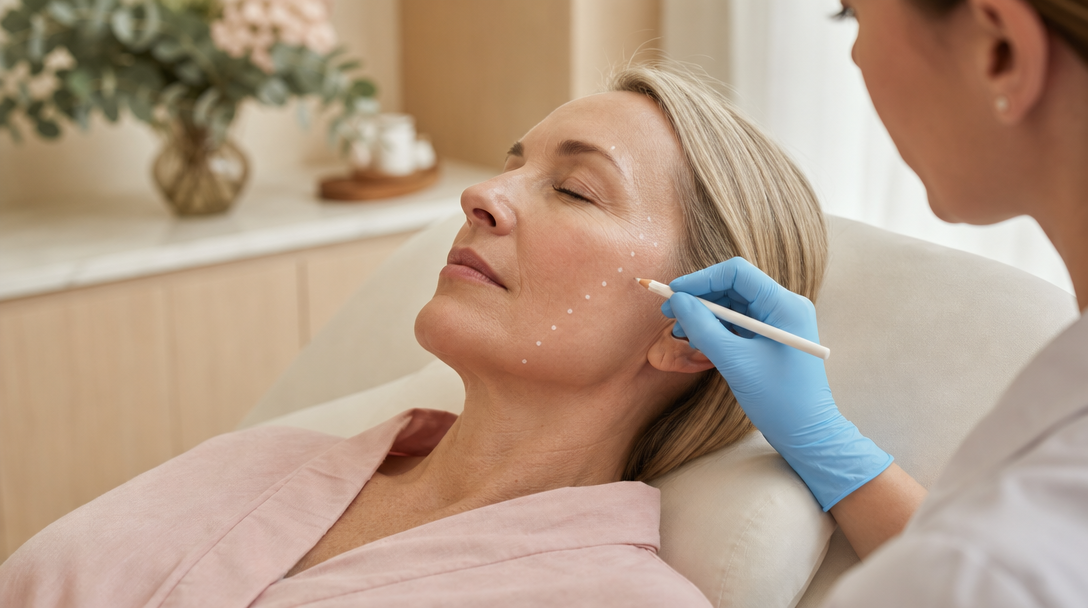
At CoLaz, Profhilo on the face uses five injection points per side, a technique called Bio-Aesthetic Points. The product then disperses outwards from each point. The typical course is two sessions, four weeks apart, with a top-up at six to nine months. Each session takes around 30 minutes, and you can expect small injection bumps for a few hours, with smoothing over about eight weeks.
In a 16-week study of 64 women aged 38 to 60, two sessions four weeks apart improved skin surface texture by around 16% at week 4, and the improvements in texture, cheek volume loss and wrinkle severity were still present at week 16.
How does Sunekos work?
Sunekos works by delivering low molecular weight hyaluronic acid together with amino acids into the dermis, with the aim of giving your skin both hydration and the raw materials to build new collagen and elastin.
The product is placed as a series of micro-injections across the area being treated, in a grid or fanning pattern, rather than at five set points. That makes it well suited to small, delicate areas, which is why it is often used around the eyes and on the forehead, as well as the face, neck and décolletage.
At CoLaz, the typical Sunekos course is three to four sessions, spaced around two weeks apart, with maintenance every six months or so. Each session takes 20 to 30 minutes. You can expect minor injection bumps, then gradual brightening and tightening over the following weeks.
The research base is smaller than for Profhilo, but it is growing. A 2026 systematic review pooled 11 studies of amino acid-enriched hyaluronic acid for facial rejuvenation and found a significant reduction in wrinkle severity and a measurable increase in dermal thickness. Side effects reported were mostly mild and short-lived (redness, swelling and tenderness), with no serious adverse events.
Sunekos vs Profhilo at a glance
This table sets out the practical differences we explain at the consultation.
| Profhilo | Sunekos | |
|---|---|---|
| What it is | Pure stabilised hyaluronic acid | Hyaluronic acid plus six amino acids |
| Main aim | Hydration and bio-remodelling for firmer, more elastic skin | Hydration plus collagen and elastin support for crepey, fine-lined skin |
| Injection pattern | Five set points per side of the face | Multiple micro-injections across the area |
| Popular areas | Face, neck, hands | Under-eyes, forehead, face, neck, décolletage |
| Typical course at CoLaz | 2 sessions, 4 weeks apart | 3 to 4 sessions, around 2 weeks apart |
| Maintenance | Every 6 to 9 months | Around every 6 months |
| Session time | 30 minutes | 20 to 30 minutes |
| Price at CoLaz | From £225 per session (course of two, face, neck or hands) | From £250 (dark eye circles or forehead, single session) |
Pricing for both is confirmed in writing at your consultation, area by area, before any session is booked.
Sunekos vs Profhilo: which suits your skin?
The right choice depends on what you would like to change and where, rather than on which product is better overall.
As a general guide, these are the patterns we see most often:
- Profhilo tends to suit overall loss of bounce and hydration across the lower face, jawline and neck, crepey skin on the back of the hands, and patients from their mid-thirties onwards who want a fresher look across a larger area with fewer appointments.
- Sunekos tends to suit fine lines and thin, crepey skin in smaller areas, tired-looking or hollow under-eyes, and forehead lines where a lighter, more targeted product makes sense. A periorbital study of 23 women found that three sessions 15 days apart significantly reduced dark-circle and wrinkle scores one month after treatment.
- Neither is the right tool for adding volume to hollow cheeks or reshaping lips. That is a conversation about fillers, and we will say so honestly.
One example from our Reading clinic shows why goals come first. A patient in her early fifties came in asking for cheek fillers because a colleague had them. When we looked at what she was actually unhappy with, it was loose skin along the jawline and a tired look across the whole face. Filler in the cheeks would not have given her that. We planned Profhilo instead: two sessions, four weeks apart. By week eight her skin tone had improved and her jawline looked tighter without changing the shape of her face.
The same principle works in the other direction. If your main concern is the delicate skin under your eyes, a product placed across the whole face at five points is not the most precise choice, and Sunekos often makes more sense.
What does the evidence say about safety?
Both products have a reassuring safety record when injected by a qualified clinician, with side effects that are usually mild and settle within a few days.
For Profhilo, postmarketing data covering around 42,000 patients over three years recorded just 12 adverse event reports, mostly short-lived swelling and redness at the injection site. For amino acid-enriched hyaluronic acid, the 2026 review above reported mild, temporary reactions and no serious events across its included studies.
Most patients see small bumps at the injection points, occasional light bruising and mild redness for 24 to 48 hours. We do not treat patients who are pregnant or breastfeeding, who have an active skin infection in the area, or who have a known allergy to any of the ingredients. Your clinician reviews your medical history before agreeing to treat, and if anything in your history needs a second opinion, we will ask you to speak to your GP first.
Planning Sunekos and Profhilo together
Many patients have both treatments, and they work best when planned in sequence rather than booked on the same day without a reason.
A common pattern is Profhilo for overall hydration and firmness across the lower face and neck, with Sunekos targeted at the under-eyes or forehead where finer, more precise work is needed. The order and spacing depend on your skin, your schedule and how your skin responds to the first course. Some patients also add treatments such as salmon DNA polynucleotides for very thin or fragile skin.
Maintenance is part of the result. Profhilo needs a refresh every six to nine months, and Sunekos around every six months. Saying so up front prevents the disappointment that happens when patients did not realise. If you want to see how a Profhilo result builds week by week, our Profhilo results timeline walks through it.
Questions to ask before you book
Skin boosters are injectable treatments, so who delivers them matters as much as which product you choose.
In England, non-surgical cosmetic treatments are not yet licensed, although the government has confirmed plans for a licensing scheme that will cover practitioners and premises. Until then, the NHS advises taking time to check your practitioner’s training and insurance. Voluntary registers such as the JCCP and Save Face can help you check standards.
Before you book any skin booster, ask:
- What exactly is in the product, and why is it right for my skin rather than the alternative?
- How many sessions will I need, how far apart, and what does maintenance look like?
- What will I see at week two, week eight and month six?
- Who will inject me, and what are their qualifications?
- Is the full course and price written down before I commit?
At CoLaz, both Profhilo and Sunekos are available at all seven of our UK clinics, delivered by qualified clinicians. We assess your skin, explain which product (or combination) fits your goals and confirm the plan in writing before anything is booked. You can read more about Profhilo and Sunekos, or explore our options for ageing skin.
The simplest next step is to book a consultation and let us look at your skin in person. We will tell you honestly which skin booster suits you, and whether you need one at all.
Ready to begin
Book a free Profhilo consultation at your nearest CoLaz clinic
Time with a qualified clinician: a skin assessment, an honest recommendation and no obligation. Read about Profhilo at CoLaz, from £225 (per session, course of two, face, neck or hands).
More on Skin
Keep reading
-

PRP face treatment (the vampire facial): what it actually does for your skin
PRP uses a small sample of your own blood to support collagen and skin repair. Here is what the research really shows, how many sessions most people need and what to expect on the day. Read the article -

Salmon DNA polynucleotides: what they are and why aesthetics is hooked
Purified fragments of salmon DNA, known as polynucleotides or PDRN, are one of the fastest-growing skin boosters in UK clinics. Here is what the research says about how they work and what to realistically expect. Read the article -

HIFU treatment results: month by month, what is realistic
HIFU tightens skin gradually rather than instantly. Here is the honest month-by-month results timeline, how long the effect lasts, and who is a good candidate. Read the article
Book a free consultation at your nearest CoLaz clinic
Time with a qualified clinician: a skin assessment, an honest recommendation and a written plan. No obligation.