
Female hair loss treatment: realistic options in 2026
 Owner, CoLaz Aesthetics Clinic
The short version
- Female pattern hair loss is diffuse thinning across the crown with a widening centre parting. The front hairline usually stays intact, which is why it looks nothing like the male M-shape.
- Blood work comes first. Ferritin, thyroid function and a review of any hormonal symptoms should be checked by your GP before any clinic treatment is planned.
- Topical minoxidil is the only UK-licensed treatment for female pattern hair loss. Low-dose oral minoxidil and anti-androgens such as spironolactone are prescribed off-label by GPs and dermatologists.
- PRP has the strongest clinic-side evidence: a 2024 meta-analysis of 21 randomised trials found significant density gains over control, with mild and short-lived side effects.
- Nothing here is a cure. Every option, medical or clinic-based, only holds the result for as long as it is continued.
TL;DR
- Female pattern hair loss is diffuse thinning across the crown with a widening centre parting. The front hairline usually stays intact, which is why it looks nothing like the male M-shape.
- Blood work comes first. Ferritin, thyroid function and a review of any hormonal symptoms should be checked by your GP before any clinic treatment is planned.
- Topical minoxidil is the only UK-licensed treatment for female pattern hair loss. Low-dose oral minoxidil and anti-androgens such as spironolactone are prescribed off-label by GPs and dermatologists.
- PRP has the strongest clinic-side evidence: a 2024 meta-analysis of 21 randomised trials found significant density gains over control, with mild and short-lived side effects.
- Nothing here is a cure. Every option, medical or clinic-based, only holds the result for as long as it is continued.
Most women who come to us about thinning hair have already spent months on shampoos, supplements and scalp serums bought online. By the time they book a consultation they are frustrated, and they usually ask the same question: which female hair loss treatment actually works?
The honest answer is that a few of them do, the evidence is better for some than others, and the order you do things in matters more than the individual product. This guide sets out what the research supports in 2026, what your GP handles, and what a clinic like ours can reasonably add.
What is female pattern hair loss, and why does it look so different from the male version?
Female pattern hair loss is diffuse thinning across the top of the scalp, with a centre parting that gradually widens, while the frontal hairline stays largely intact. The BAD leaflet describes exactly this pattern: thinning mainly over the top of the scalp, a mid part line that becomes more visible and widened, and a hairline at the front that often remains normal.
That is the opposite of the male picture, where recession starts at the temples and works backwards into an M shape. It is also why women often notice the change in a photograph or a ponytail before they notice it in the mirror.
The mechanism is follicular miniaturisation. Affected follicles produce hairs that get progressively finer, shorter and lighter with each growth cycle until they stop producing visible hair altogether. It is driven by a combination of genetic and hormonal factors, and it can be inherited from either parent.
It is also common. Around half of women aged 70 or over have some degree of female pattern baldness, and it affects women of all skin tones, usually showing first as a widening centre part.
Why should blood tests come before any female hair loss treatment?
Because several reversible causes of thinning look almost identical to female pattern hair loss, and treating the wrong one wastes months. Before we plan anything at CoLaz, we ask patients to see their GP for ferritin, thyroid function and a review of any hormonal symptoms.
Low iron stores are the most common one we send back. A meta-analysis of 36 studies and 10,029 participants found women with non-scarring hair loss had significantly lower ferritin than controls, with a mean difference of around 18.5 ng/dL, and roughly 21 per cent sat at or below the 10 to 15 ng/dL band. That does not make iron a treatment for pattern hair loss on its own, but it does mean a deficiency should be corrected before you judge whether anything else is working.
Thyroid function is the second. An underactive thyroid commonly causes hair thinning alongside tiredness, weight gain and feeling cold, and it is a simple blood test.
The third is hormonal. There is a well-documented overlap between pattern hair loss and polycystic ovary syndrome: a 2025 meta-analysis pooled 18 studies and found female pattern hair loss in 22.7 per cent of women with PCOS, and irregular periods in around 20.7 per cent of women presenting with the hair loss. If you have irregular cycles, unwanted facial hair or acne alongside the thinning, mention it to your GP.
One more timing point. It is normal to shed noticeably more hair for up to three months after giving birth. That is postpartum shedding, not pattern hair loss, and it usually settles on its own.
What female hair loss treatment does the evidence actually support?
Topical minoxidil is the only treatment licensed in the UK for female pattern hair loss, and it is the first thing NICE recommends. It is available over the counter as a 2 per cent solution and a 5 per cent foam, and it is applied to the scalp daily.
Two things surprise people about it. First, it takes around four months before any change is visible, so judging it at week six is judging it too early. Second, it has to be continued indefinitely, because these treatments only work for as long as the treatment is continued.

Beyond minoxidil, prescribing moves off-label and belongs to your GP or a dermatologist, not to an aesthetic clinic:
- Low-dose oral minoxidil. A descriptive study of 148 women found low-dose oral minoxidil useful in female pattern hair loss. Typical starting doses in women are much lower than the male range, generally 0.5 to 1 mg a day.
- Anti-androgens. Spironolactone is the most commonly used in the UK, with cyproterone acetate, bicalutamide and flutamide also listed as options. A retrospective review of combined spironolactone and low-dose oral minoxidil reported adverse effects in around 37.7 per cent of patients, most commonly unwanted hair growth elsewhere and light-headedness. Those are real trade-offs to discuss with a prescriber.
- Wigs, pieces and styling. NICE lists these alongside medical options rather than beneath them, and for advanced thinning they are often the most practical answer.
We do not prescribe any of the above at CoLaz. We say so plainly in the consultation, and we will happily write down what to ask your GP about.
Does PRP work for female pattern hair loss?
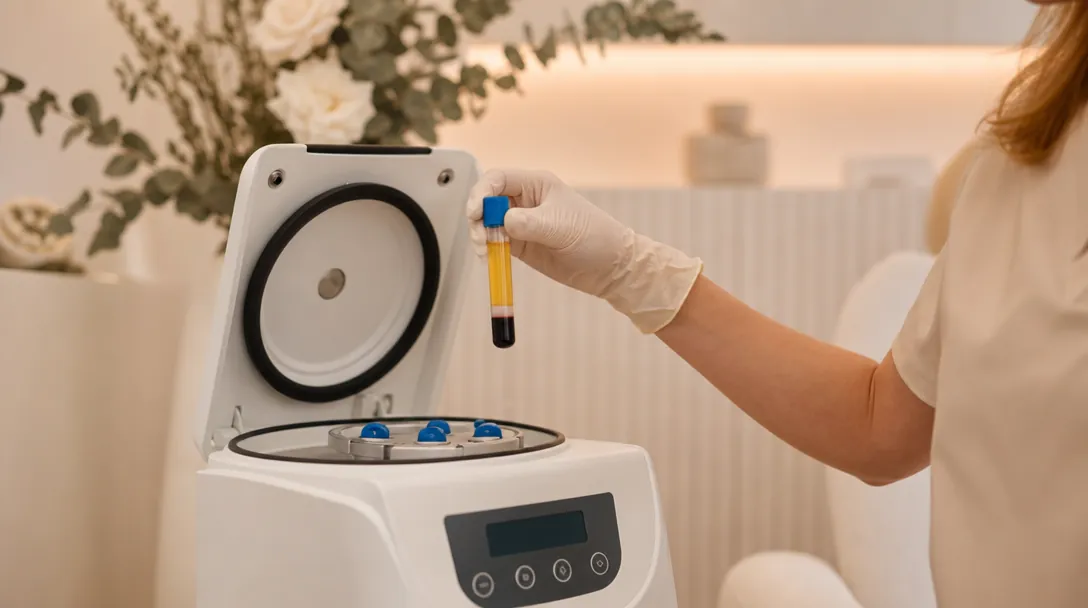
Yes, the randomised evidence supports it, though it works best as an addition to a medical plan rather than a replacement for one. PRP means platelet-rich plasma: your own blood is drawn, spun in a centrifuge to concentrate the growth factors, and injected across the thinning areas of the scalp.
A 2024 meta-analysis pooled 21 randomised controlled trials covering 628 women and found a significant increase in hair density in the PRP groups compared with controls, together with a measurable reduction in the number of hairs pulled during hair-pull testing. Side effects were mild and transient: scalp sensitivity, mild swelling and redness that settled within about 24 hours, with no significant difference in reported pain compared with control.
At CoLaz, PRP hair loss starts from £350 for a single Stage 1 session, and the typical course is 3 to 4 sessions four weeks apart, with maintenance every 6 months. Each session takes about an hour, most of which is the blood draw and the spin.
The honest framing is this: PRP slows and partly reverses miniaturisation in early-stage thinning. It does not regrow hair from follicles that have already closed down, and the result fades if maintenance stops.
What about mesotherapy for the scalp?
Scalp mesotherapy delivers a cocktail of vitamins, amino acids and peptides into the skin of the scalp through a series of very small injections, and the evidence base is promising but thinner than PRP’s. A systematic review in the Journal of Dermatological Treatment identified 27 studies covering six classes of injected agent, and concluded that the field is limited by heterogeneity and a shortage of large, high-quality trials.
That is a fair summary of where it sits. Most patients tolerate it well, the main reported side effect is discomfort during the session, and it is often used alongside PRP rather than instead of it.
Meso HairMax at CoLaz starts from £250 for a single Stage 1 session, with a typical course of 4 to 8 sessions two to four weeks apart. Worth knowing before you plan a journey: we currently offer it at our Reading and Hounslow clinics only.
What we learned from one patient at our Slough clinic
A patient came to our Slough clinic worried about thinning at her parting line. She was thirty-three and eight months past her last delivery. We sent her to her GP first to check ferritin, vitamin D and thyroid before we started any treatment, because those should be ruled out as factors before anyone moves to PRP.
Her bloods came back with low ferritin, which her GP corrected over three months with iron supplements. We then started PRP, one session every four weeks for three sessions, with a top-up at month six. By month nine her parting was visibly fuller.
The lesson is the one we repeat in every hair-loss consultation across our seven UK clinics. Aesthetic treatments work best when the medical basics are sorted first. We do not skip the GP, and we would rather delay a course by three months than sell one that was never going to work.

How long before you see a result?
Plan on four to six months before you can fairly judge any female hair loss treatment, whichever route you take. Hair grows roughly one centimetre a month, and every treatment here works by improving the quality of the next growth cycle rather than the hair already on your head.
A realistic timeline looks like this:
- Months 0 to 1. Bloods, diagnosis, and correction of anything reversible. Start topical minoxidil if your GP or pharmacist agrees it suits you.
- Months 1 to 3. Shedding often looks slightly worse before it looks better, particularly on minoxidil. That is normal and it is not a reason to stop.
- Months 4 to 6. The first honest assessment point. Photographs taken under the same light and the same parting are far more reliable than memory.
- Months 6 to 12. Maintenance. This is where most people quietly stop and lose the gain.
We photograph the scalp at the consultation and at each review for exactly this reason. Progress in hair is slow enough that it is genuinely hard to see day to day.
When we say no to a clinic hair-loss course
Some patients are better served by their GP or a dermatologist than by us, and we say so at the consultation. We do not treat with PRP or mesotherapy if you are pregnant or breastfeeding, taking blood-thinning medication, or living with certain blood conditions or autoimmune conditions.
We also decline when the picture does not look like pattern hair loss at all. Patchy round bald areas, a scaly or painful scalp, sudden total shedding, or scarring where the follicle openings have disappeared all need a medical diagnosis first. Those are dermatology questions, not aesthetic ones.
And if your thinning is advanced, with a parting that has widened across most of the crown, we will tell you that a clinic course is unlikely to give you the result you have in mind. Saying no early costs you far less than saying yes late.
What happens at a CoLaz consultation
Every consultation is free, and it starts with questions rather than a price list. We take medical history, current medication, family history, any recent pregnancy or illness, and we look at the scalp under good light with photographs for the file.
If bloods have not been done, that is the first thing we recommend, and no course gets booked until they are back. If they have, we talk through what the evidence supports for your stage of thinning and write the plan down: number of sessions, spacing, cost per session and what maintenance looks like afterwards. You take that away and decide in your own time.
One practical note on choosing anyone for injectable scalp treatment, including us. Check the practitioner is on a recognised register such as the JCCP, ask what happens if you have a reaction, and be wary of anyone quoting a fixed package before they have examined your scalp.
If you would like a proper look at what is happening to your hair, book a consultation at your nearest clinic, or read our companion guide on hair thinning to see how the treatments compare side by side.
Ready to begin
Book a free PRP Hair Loss consultation at your nearest CoLaz clinic
Time with a qualified clinician: a skin assessment, an honest recommendation and no obligation. Read about PRP Hair Loss at CoLaz, from £350 (Women Stage 1 or Male Stage 1, single session).
More on Hair loss
Keep reading
-

Hair loss treatment UK: a realistic 2026 guide to what actually works
Minoxidil, finasteride, PRP, scalp mesotherapy, laser therapy, exosomes and transplants. What the evidence actually shows for each, what they cost, and the combined pathway most clinicians recommend. Read the article -
PRP for hair loss: how many sessions and how long do results last?
Three to four initial PRP sessions, then a top-up every three to six months, is the standard protocol. Here is what the published trials show and how we plan a PRP course at CoLaz. Read the article -

Why is my hair thinning? Causes and the treatments that actually help
Hair thinning has more than one cause, and the right treatment depends on which cause is yours. Here is how the main types differ and the UK treatments that work for each. Read the article
Book a free consultation at your nearest CoLaz clinic
Time with a qualified clinician: a skin assessment, an honest recommendation and a written plan. No obligation.