
PRP and autoimmune conditions: 3 inflammation risks to weigh first
 Owner, CoLaz Aesthetics Clinic
The short version
- PRP is your own blood, concentrated and reinjected to prompt a healing response, so it interacts directly with your immune system.
- There is no single yes or no answer for autoimmune patients: some localised conditions may benefit, while systemic and actively flaring conditions carry real risk.
- The three inflammation risks to weigh are an active flare, a systemic condition like lupus or vasculitis, and high-dose immunosuppressant medication.
- Early evidence is cautiously positive for rheumatoid arthritis joints and alopecia areata, but the studies are small and PRP is never a replacement for your prescribed treatment.
- At CoLaz, PRP for anyone with an autoimmune history starts with a full medical review and only goes ahead when it is genuinely safe and sensible.
TL;DR
- PRP is your own blood, concentrated and reinjected to prompt a healing response, so it interacts directly with your immune system.
- There is no single yes or no answer for autoimmune patients: some localised conditions may benefit, while systemic and actively flaring conditions carry real risk.
- The three inflammation risks to weigh are an active flare, a systemic condition like lupus or vasculitis, and high-dose immunosuppressant medication.
- Early evidence is cautiously positive for rheumatoid arthritis joints and alopecia areata, but the studies are small and PRP is never a replacement for your prescribed treatment.
- At CoLaz, PRP for anyone with an autoimmune history starts with a full medical review and only goes ahead when it is genuinely safe and sensible.
PRP, autoimmune conditions, and inflammation are three words that are showing up together in more search bars every year, and for good reason. If your immune system already attacks your own tissue, it is fair to ask whether a treatment designed to trigger a healing response will help you or set off a flare. The honest answer is that it depends on your specific condition, how stable it is, and the medication you take.
This article breaks down how PRP interacts with the immune system, the three inflammation risks worth weighing before you book, where the current evidence points, and how a careful clinic screens autoimmune patients rather than treating everyone the same.
Can you have PRP if you have an autoimmune condition?
Sometimes, but only after a proper medical review, and never during an active flare or without your specialist’s input. There is no blanket yes or no. An autoimmune history is not an automatic ban on PRP, but it moves you into a group that needs individual assessment rather than a standard booking.
The reason is that autoimmune conditions vary enormously. A stable, localised issue is a very different picture from a systemic condition affecting several organs. A 2025 international consensus statement on PRP injections notes that decisions in patients with complicating conditions should be made case by case, weighing the specific diagnosis, disease activity, and current medication rather than applying one rule to everyone. That is exactly the approach a responsible clinic should take.
How does PRP work in the body?
PRP is a small amount of your own blood, spun in a centrifuge to concentrate the platelets, then injected back into a target area to prompt repair. Because it uses your own tissue, it does not carry the rejection risk of a foreign material, but it does deliberately switch on part of your immune response.
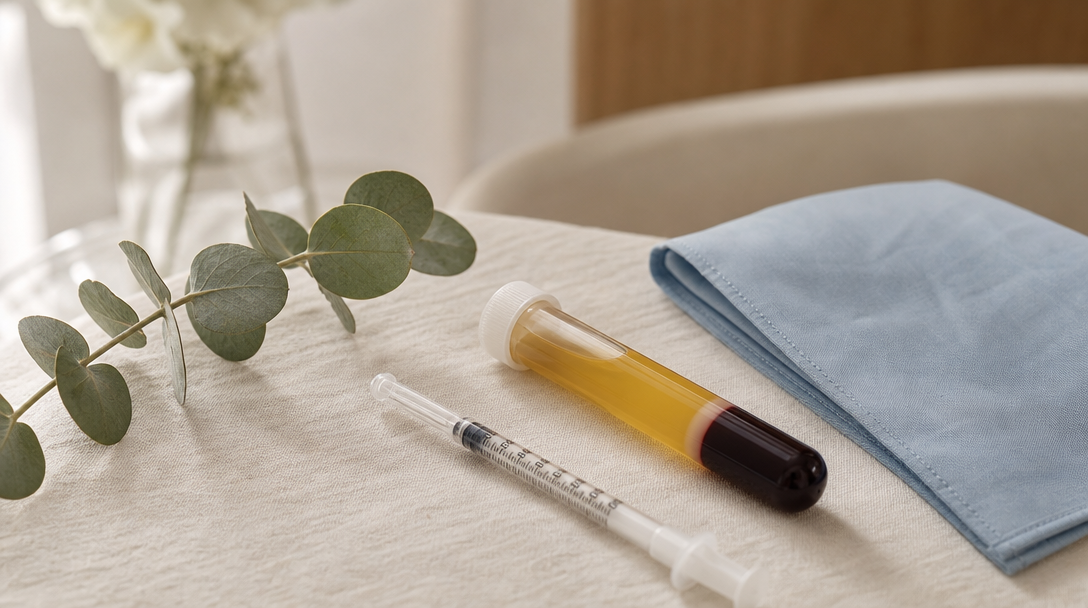
Platelets are far more than clotting cells. They store growth factors in tiny packets called alpha granules, and once activated they release a burst of signalling proteins including PDGF, TGF-beta, VEGF and EGF. As a detailed wound-healing review describes, these factors recruit repair cells, encourage new blood vessel growth, and drive the skin to rebuild itself. In a healthy person this is a controlled, temporary process.
The catch for autoimmune patients is the first stage of that process. Healing begins with a short inflammatory phase, usually lasting up to a week, during which immune cells are recruited to the area. In most people this settles quickly. In a body already prone to overreacting, that same signal is the part worth thinking carefully about.
Does PRP calm inflammation or trigger it?
It can do both, which is precisely why autoimmune patients need a considered plan rather than a quick decision. PRP starts with a mild, local inflammatory response to kick off healing, yet several studies also show it can lower certain inflammatory markers over time.
The dual nature is well documented. Research on leukocyte-rich PRP shows it releases molecules that modulate local immune and inflammatory cell behaviour, meaning it can nudge inflammation up or down depending on the preparation and the tissue. In knee osteoarthritis, cytokine profiling studies found PRP injections were linked to improved pain and function, with some formulations reducing pro-inflammatory activity in the joint.
For most people, the brief inflammation PRP creates is localised and temporary. For someone with an overactive immune system, even a small, controlled spark can, in theory, be amplified. This is not a reason to rule PRP out entirely, but it is the core reason the treatment cannot be treated as routine when autoimmunity is in the picture.
Which autoimmune conditions might PRP be considered for?
A few localised, stable conditions have early positive evidence, most notably rheumatoid arthritis joints and alopecia areata, but the research is limited and PRP remains an addition to, never a replacement for, prescribed care.
Here is where the evidence currently sits:
- Rheumatoid arthritis. A review of PRP in rheumatic disease found that in one trial only the PRP group showed sustained joint improvement at six months, alongside reductions in the inflammatory markers IL-1 beta and TNF-alpha. The authors are clear that trials are small and larger studies are needed before firm conclusions.
- Alopecia areata. This autoimmune form of hair loss has some of the more encouraging data. A systematic review and meta-analysis concluded that PRP is a promising steroid-free option for alopecia areata, while still calling for more high-quality randomised trials.
- Vasculitic ulcers. The same rheumatic-disease review reported PRP helping stubborn wounds heal in a small group of patients who had failed other treatments.
Even where results look positive, these are localised applications in carefully selected patients. The NHS notes that hair loss treatments are not always effective and are rarely available on the NHS, which is another reason to keep expectations realistic and evidence-led.
When is PRP a bad idea with an autoimmune condition?
PRP is best avoided when your condition is systemic, actively flaring, or controlled by high-dose immunosuppressants. These are the three inflammation risks that turn a maybe into a no, at least for now.
Risk one: an active flare. When your immune system is already running hot, adding a treatment that deliberately triggers a local inflammatory response is poor timing. The sensible move is to wait until your condition is stable and your specialist agrees.
Risk two: a systemic condition. Conditions like lupus and vasculitis affect the whole body rather than one joint or patch of skin. The NHS describes lupus as an autoimmune condition that flares and settles unpredictably, which makes it very hard to be sure that a healing stimulus will stay contained to the injection site.
Risk three: strong immunosuppressant medication. If your treatment plan deliberately dampens your immune system, it can change how you respond to PRP, and PRP’s mechanism partly relies on an immune response to work. Reported adverse effects of PRP are usually mild and short-lived, such as local swelling and tenderness, but the interaction with immunosuppression needs your prescribing team’s input, not guesswork.
The safest construction is simple: if any of these three apply, PRP is a conversation for another day, made jointly with the specialist who manages your condition.
Why does the clinic you choose matter so much here?
Because many clinics do not screen for autoimmune conditions at all, and the quality of the assessment decides whether PRP is safe for you. A treatment that is reasonable for one autoimmune patient can be the wrong choice for another, and only a thorough medical review can tell the two apart.

A careful clinic will review your full medical history, ask about your diagnosis and current medication, and be willing to say no or to defer to your specialist. At CoLaz, PRP treatments such as PRP for the face and PRP for hair loss always begin with a consultation and, where relevant, blood work, before anything is booked. We are registered to the standards set by the Joint Council for Cosmetic Practitioners, and that framework exists precisely so that complex cases are handled with proper caution rather than treated on demand.
For autoimmune hair loss specifically, the British Association of Dermatologists recommends taking a full personal and family history of autoimmune disease, which is the same principle we apply before recommending any regenerative treatment.
Should you try PRP if you have an autoimmune condition?
Only after an honest, individual assessment, and ideally alongside the specialist who already manages your condition. PRP may help certain localised, stable autoimmune symptoms, and it may be the wrong choice if your condition is systemic or unstable.
What we tell patients at consultation is straightforward:
- If your condition is well controlled and localised, PRP may be worth discussing, with realistic expectations and your specialist informed.
- If your condition is systemic, flaring, or managed with strong immunosuppressants, PRP waits until the picture is clearer and safer.
- Either way, PRP supports your care, it does not replace your prescribed treatment.
If you want a frank read on whether PRP suits your situation, book a free consultation at your nearest CoLaz clinic. If PRP is not the right answer, we will tell you plainly, and if hair loss is your concern, our hair thinning and loss hub sets out the alternatives worth considering.
Ready to begin
Book a free PRP Face consultation at your nearest CoLaz clinic
Time with a qualified clinician: a skin assessment, an honest recommendation and no obligation. Read about PRP Face at CoLaz, from £375 (face only, therapist single session).
More on Aesthetics
Keep reading
-

How to tell a qualified aesthetic clinician from a great one
Six checks you can run on a qualified aesthetic clinician in about 60 seconds, and six more that only show up once you are sitting in the consultation room. Read the article -

JCCP, Save Face and CQC: what each register actually checks
Three names come up when you try to check an aesthetic clinic, and they do three different jobs. A plain-English guide to what JCCP, Save Face and CQC each look at, what they leave out, and how to run the checks yourself. Read the article -

How much do dermal fillers cost in the UK? An honest 2026 price guide
Filler pricing in the UK swings from £150 to £600 per ml, and the gap is not random. Here is what you are actually paying for, which quotes should make you walk away, and how to price-check a clinic properly. Read the article
Book a free consultation at your nearest CoLaz clinic
Time with a qualified clinician: a skin assessment, an honest recommendation and a written plan. No obligation.