
Fat freezing for the stomach: what 8 weeks of results actually look like
 Owner, CoLaz Aesthetics Clinic
The short version
- Nothing much happens in the first fortnight. The stomach result builds from week 6 and is usually clearest between weeks 8 and 12.
- Published abdominal studies report fat-layer reductions of roughly 10 to 28 percent per treated area, measured by ultrasound rather than by the scales.
- Body weight does not change. One split-body trial recorded 69.88 kg at baseline and 69.49 kg at 12 weeks.
- Most stomach patients need 2 to 3 sessions per area, spaced 6 to 8 weeks apart. Fat freeze at CoLaz starts from £159 per single area.
- Numbness, redness and swelling are common and settle. Paradoxical adipose hyperplasia is rare, pooled at about 0.22 percent, and the lower abdomen is its commonest site.
TL;DR
- Nothing much happens in the first fortnight. The stomach result builds from week 6 and is usually clearest between weeks 8 and 12.
- Published abdominal studies report fat-layer reductions of roughly 10 to 28 percent per treated area, measured by ultrasound rather than by the scales.
- Body weight does not change. One split-body trial recorded 69.88 kg at baseline and 69.49 kg at 12 weeks.
- Most stomach patients need 2 to 3 sessions per area, spaced 6 to 8 weeks apart. Fat freeze at CoLaz starts from £159 per single area.
- Numbness, redness and swelling are common and settle. Paradoxical adipose hyperplasia is rare, pooled at about 0.22 percent, and the lower abdomen is its commonest site.
Fat freezing on the stomach is the single most requested body treatment across our seven UK clinics, and it is also the one where patients most often judge the result far too early. Somebody walks in at the two-week review, looks in the mirror, sees no change and decides the treatment has failed. It has not failed. It has not finished.
The honest answer is that the stomach takes 8 to 12 weeks to show what a session has done, because that is how long your body needs to clear the fat cells the cold damaged. Below is the week-by-week reality, the published numbers rather than the advertised ones, and the candidacy rules we use before we will book a course of fat freezing at CoLaz.
How long does fat freezing on the stomach take to show results?
Most patients see the first genuine change at around week 6, with the clearest result between weeks 8 and 12 after a session.
That timeline is not a clinic being cautious. It is the biology of the treatment. Cryolipolysis (the clinical name for fat freezing) does not remove anything on the day. It chills the fat layer enough to injure the fat cells, and then your own immune system spends the following weeks taking them away. Nothing about that process is fast, and nothing about it can be rushed.
This matters more on the stomach than anywhere else, because the abdomen is the area patients check daily. Flanks and the area under the chin get glanced at. The stomach gets inspected in the mirror every morning, which makes a slow result feel like no result.
Why does the stomach result take 8 weeks to appear?
Because the treated fat cells have to be broken down and carried away by immune cells, and that clearance runs over roughly 3 months.
The published mechanism is well described. Controlled cooling triggers cold-induced apoptosis of the fat cells, which sets off a local inflammatory response within about 3 days. Macrophages (the immune cells that clear damaged tissue) then move in, and their recruitment peaks at around 4 weeks. By roughly 12 weeks the inflammation has settled and the fat layer in that pocket is measurably thinner.
So the sequence on your stomach is: cold on day one, quiet inflammation through weeks 1 to 4, active clearance through weeks 4 to 8, and a visible contour change from week 8 onward. Cells cleared this way are not replaced, though the fat cells left behind in the area can still enlarge if your weight goes up.
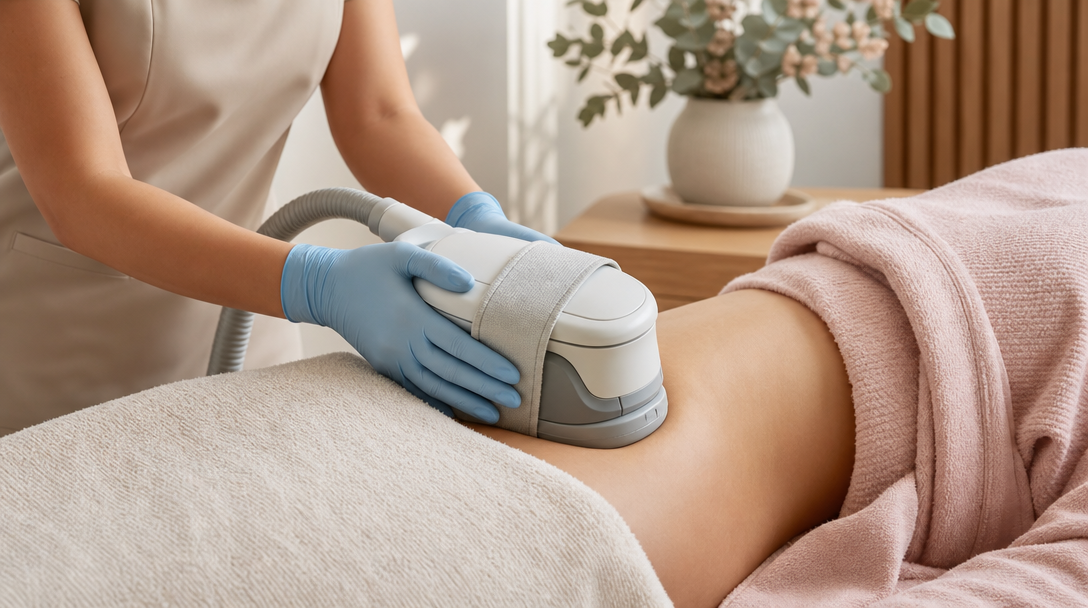
What does the week-by-week stomach timeline look like?
| When | What most patients notice |
|---|---|
| During the session | Strong cold and a firm pulling sensation for the first 5 to 10 minutes, then the area goes numb for the rest of the hour. |
| Day 0 to 3 | The treated area looks pink and feels swollen and firm. Some patients describe a deep ache or a pins-and-needles feeling. |
| Week 1 to 2 | Swelling settles. Numbness can linger. This is the point where the stomach often looks slightly larger, not smaller, and it is the commonest moment for patients to lose faith. |
| Week 3 to 5 | Numbness resolves. Clothes may start to sit differently before anything is visible in the mirror. |
| Week 6 to 8 | The first real contour change. This is when baseline photographs start earning their keep. |
| Week 8 to 12 | The settled result for that session. This is the point at which we review, re-photograph and decide whether a second session is worth booking. |
That temporary firmness and swelling in the first fortnight is normal and expected. The reason we photograph every stomach patient at baseline is that the eye adapts to a gradual change far too well to be trusted on its own.
How much fat does one stomach session actually remove?
Published abdominal studies report a fat-layer reduction of roughly 10 to 28 percent in the treated area per session, with the honest range depending heavily on how it was measured.
The strongest single-arm data comes from a prospective multicentre study of a three-dimensional cooling device, which reported 28.45 percent reduction in abdominal subcutaneous fat at 12 weeks and 31.13 percent at 16 weeks. Mean fat thickness in that group fell from 49.3 mm at baseline to 40.4 mm at 12 weeks. A broader review of the published clinical data puts the ultrasound range at 10.3 to 25.5 percent, with caliper measurements running a little higher.
A 2025 systematic review and meta-analysis pooling 30 studies and 3,158 participants found a mean fat-thickness reduction of 5.22 mm at 12-week follow-up, an abdominal circumference reduction of 3.56 cm, and a patient satisfaction rate of 80.4 percent.
Two things are worth holding onto from those figures. A percentage of a fat layer is not a dress size. And 5 mm is real, measurable and visible in a photograph, but it is not the result the more aggressive adverts in this industry imply.
Is the evidence for stomach fat freezing as strong as clinics claim?
No, and any clinic that tells you otherwise has not read the literature carefully.
The most useful corrective is a randomised controlled trial with a blinded assessor, which treated the lower abdomen of 34 healthy women and found no significant reduction in fat thickness at 90 days. The between-group difference was 0.04 cm, which is effectively zero. The authors concluded that a single application of the protocol they used does not produce a significant effect on fat thickness.
We do not hide that study from patients. We use it, because it explains something important: one session on the stomach is usually not enough, and results are protocol-dependent rather than automatic. Reviewers of the wider evidence base have made the same point, noting that variability in study designs, devices and outcome measures makes cross-study comparison difficult, and that it remains unclear which protocols work best.
The practical conclusion is not that fat freezing does nothing. It is that a stomach course needs the right candidate, the right applicator sizing, more than one session, and an honest 12-week review with photographs.
Is fat freezing on the stomach weight loss?
No. Fat freezing is contouring for a stubborn pocket, and it does not reduce your body weight.
The cleanest demonstration of this comes from a split-body trial in which one side of the abdomen was treated and the other was left as a control. The treated side showed a 15.6 percent reduction in one fat compartment at 12 weeks, while body weight went from 69.88 kg at baseline to 69.49 kg at the 12-week mark, a difference that was not statistically significant.
This is the conversation we have most often, and it is the one where saying no matters. A patient came into our Southall clinic asking for fat dissolving across her whole stomach. She was outside the weight range where that treatment can deliver what she actually wanted, so we declined the whole-stomach plan, offered a sensible single area instead, and pointed her towards general weight-management support for the wider goal.
If your goal is a smaller waist measurement overall rather than a specific pocket, the honest starting point is weight management rather than a body-contouring device. NICE also suggests keeping your waist to less than half your height as a practical measure of central adiposity, which is a more useful target than any percentage a clinic can quote you.
The stomach patients fat freezing actually suits
Candidacy on the abdomen comes down to one question we ask at every consultation: is there a defined, pinchable pocket here, in somebody already within a healthy weight range, that has not responded to diet and exercise. If the answer is no, a different treatment or a different approach will serve you better.
Good candidates typically have:
- A discrete fat pocket the clinician can draw a clear border around, usually on the lower abdomen.
- Reasonably firm skin over that pocket, so a smaller fat layer reads as a better contour rather than as looseness.
- A stable weight, and the willingness to keep it stable over the 12 weeks that the result takes to appear.
- Realistic expectations about the size of the change, confirmed in writing before anything is booked.
We will usually recommend something else if you have significant skin laxity over the stomach, because reducing fat under loose skin can make the laxity more obvious. In that situation a skin-tightening approach such as radio frequency is often the better starting point, either instead of or alongside contouring. If the fat is diffuse rather than pocketed, ultrasound cavitation across a broader area can suit better than an applicator cup.
We do not treat pregnant or breastfeeding patients. We also screen carefully for cold-related conditions, because cryoglobulinaemia, cold agglutinin disease, cold urticaria and paroxysmal cold haemoglobinuria are absolute contraindications, along with hernias at the treatment site. Raynaud’s phenomenon needs clinical judgement rather than an automatic yes.
What are the side effects and risks on the stomach?
Temporary numbness, redness, swelling and tenderness are common and settle within days to a few weeks. The one rare complication worth understanding properly is paradoxical adipose hyperplasia.
In the 2025 meta-analysis, the commonest reported effects were numbness in 49.5 percent of patients, redness in 44.5 percent, swelling in 30.5 percent, pain in 28.8 percent and tingling in 15.2 percent. None of that is pleasant, and all of it is expected and short-lived. Reduced sensation across the treated stomach for a couple of weeks is the most likely thing you will actually notice.
Paradoxical adipose hyperplasia (PAH) is the opposite of the intended result: the treated area grows a firm, well-demarcated mass of fat instead of shrinking. A 2025 systematic review and meta-analysis of 28 studies and 13,078 patients put the pooled incidence at 0.22 percent, roughly 1 in 455 patients, and found that PAH typically appears 2 to 4 months after treatment. Two details matter for anyone considering the stomach specifically. The lower abdomen was the most commonly affected site in the reported cases, and descriptive data suggests men make up a disproportionate share of them. PAH does not resolve on its own and is usually managed surgically with liposuction once the tissue has settled.
That risk is small, but it is not zero, and it belongs in your consent conversation rather than in the small print. Any clinic offering you stomach cryolipolysis should raise it before you ask. If yours does not, check whether the practitioner is on a register such as the JCCP before you book.
How we plan a stomach course at CoLaz
Every stomach patient starts with the same two steps: a free consultation with the clinician, and standardised photographs at baseline before a single session is booked. The written plan then covers the number of sessions, the spacing, the applicator area, the price per session and what we expect at each review.
For the stomach that plan is normally 2 to 3 sessions per area, spaced 6 to 8 weeks apart, with reviews at 8 and 12 weeks. Fat freeze starts from £159 for a single area in a single session, and the exact figure for your area is confirmed in writing at the consultation rather than quoted over the phone. You can see the anchor alongside every other treatment on our pricing page.
The reason we work this way is a patient at our London Paddington clinic who had a single session on her flanks and arrived at the two-week review disappointed that she did not look thinner. We had told her at the consultation, and written in her plan, that the body needs 8 to 12 weeks to clear the treated fat cells, and that a measurable result would take 2 to 3 sessions. We photographed her at 2 weeks, 8 weeks and 12 weeks. By week 12 she could see a clear contour change.
I have come to think timeline expectations matter as much as the treatment itself on body work. If a patient does not know when to expect the result, they will decide the result is not coming. That is why the plan is written down, and why the photographs are taken before the first applicator ever goes on.
If you want to know whether your stomach is a sensible candidate, book a free consultation at your nearest CoLaz clinic. The assessment costs nothing, baseline photographs are taken on the day, and if we do not think a course will give you a result worth the time and the cost, we will tell you so and suggest what would.
Ready to begin
Book a free Fat Freeze consultation at your nearest CoLaz clinic
Time with a qualified clinician: a skin assessment, an honest recommendation and no obligation. Read about Fat Freeze at CoLaz, from £159 (any single area, single session).
More on Body
Keep reading
-

Aqualyx vs Lemon Bottle: the safe and unsafe ends of fat dissolving
Aqualyx and Lemon Bottle are both sold as fat dissolving injections, but only one is regulated. A clinical, honest comparison of safety, evidence and who each suits. Read the article -
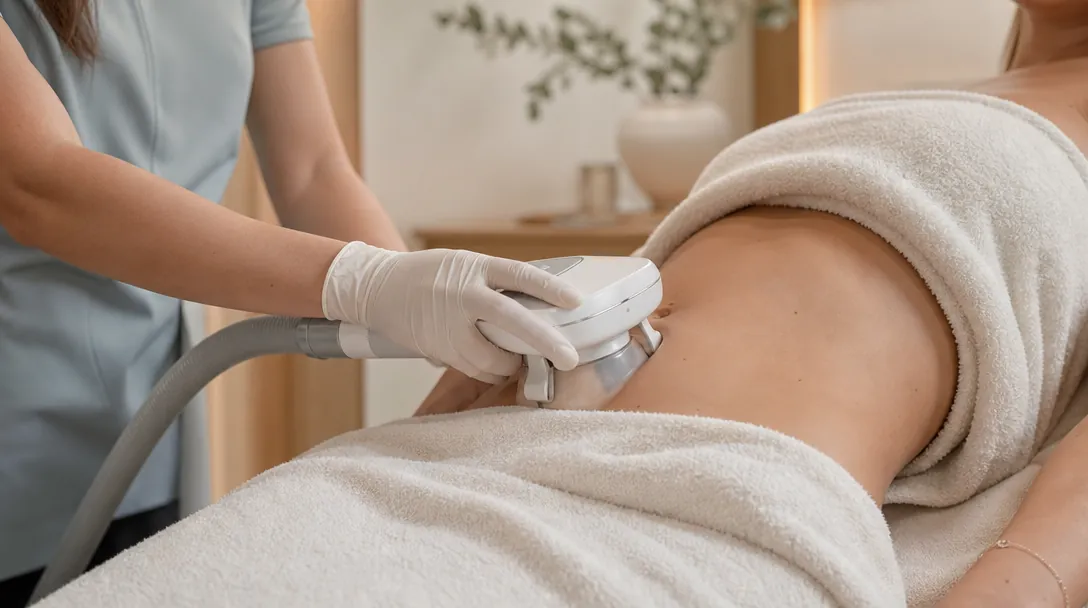
Does fat freezing actually work?
Cryolipolysis reduces a treated fat pocket by about 15 to 28% per cycle in published trials. It is contouring, not weight loss. Here is the honest evidence at CoLaz. Read the article -

How many ultrasound cavitation sessions for visible inch loss?
Six to ten sessions is the typical course for visible circumference change, but the result depends on the area, the technology and what you do between sessions. Here is how we plan ultrasound cavitation at CoLaz. Read the article
Book a free consultation at your nearest CoLaz clinic
Time with a qualified clinician: a skin assessment, an honest recommendation and a written plan. No obligation.