
Dermapen 0.5mm vs 1.0mm: which needle depth?
 Owner, CoLaz Aesthetics Clinic
The short version
- 0.5mm targets surface concerns: fine lines, large pores, light marks and overall tone, with only a day or two of redness.
- 1.0mm reaches deeper to work on acne scars, wrinkles, sun damage and stretch marks, with a little more downtime.
- Deeper is not automatically better; the right depth is matched to your concern, skin thickness and the area being treated.
- A professional adjusts depth across the face, often using shallower settings around delicate areas and deeper over thicker skin.
- Always have microneedling done by a trained practitioner, who selects depth safely rather than a one-size setting.
Dermapen microneedling creates tiny controlled punctures in the skin to trigger collagen production, and the needle depth largely determines what it can treat. The two most asked-about depths are 0.5mm and 1.0mm. The short version: 0.5mm is for surface concerns and 1.0mm reaches deeper issues, but the right answer is always matched to your skin, not chosen by default. Here is how they compare.
If you are considering Dermapen microneedling, this helps you understand what your practitioner is deciding and why.
How microneedling works
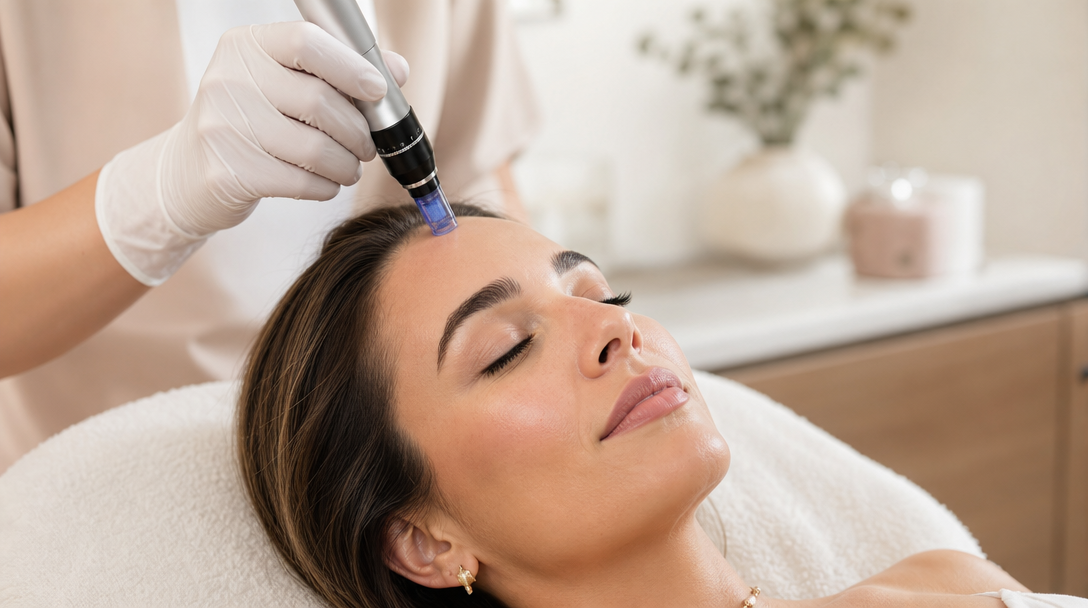
Each tiny channel the needles create prompts the skin to repair itself and lay down new collagen, which improves texture, softens scars and firms fine lines. The depth controls how far that stimulus reaches, as explained in this overview of microneedling. Shallower depths refresh the surface; deeper depths reach the layer where scars and wrinkles sit.
Dermapen 0.5mm: surface concerns
Best for: fine lines, large pores, uneven tone and light marks.
Typical areas: the whole face, neck and around the eyes.
Why people choose it: minimal discomfort, faster healing (often one to two days of redness), and a gentle option for thinner or more sensitive skin and for those newer to microneedling.
Dermapen 1.0mm: deeper concerns
Best for: deeper acne scars, wrinkles, sun damage and stretch marks. The AAD recognises microneedling as a useful option for acne scarring.
Typical areas: cheeks, forehead and body areas such as arms, stomach and thighs.
Why people choose it: more collagen stimulation and longer-lasting results for established scarring and ageing, at the cost of a little more downtime (often two to three days of redness and swelling).
The key differences at a glance
| Factor | 0.5mm | 1.0mm |
|---|---|---|
| Depth | Outer layer (epidermis) | Upper dermis |
| Best for | Pores, fine lines, mild texture | Deep scars, wrinkles, stretch marks |
| Comfort | Mild, like a light scratch | Stings more; numbing helps |
| Downtime | 1 to 2 days redness | 2 to 3 days redness and swelling |
| Spacing | Every 2 to 4 weeks | Every 4 to 6 weeks |
Deeper is not automatically better
It is tempting to assume the deeper needle gives better results, but that is not how it works. Using too deep a setting on thin or delicate skin adds downtime and irritation without benefit, and can risk marking. A skilled practitioner often varies the depth across a single treatment, going shallower around the eyes and over fine skin and deeper over thicker, scarred areas.
Choose a professional, not a home device
The biggest safety point is who holds the device. Professional Dermapen treatment uses sterile, single-use tips and depth selection matched to your skin, which home rollers and pens cannot match safely. Avoid strong actives such as retinol and acids for a few days before and after, moisturise, and protect from the sun. At CoLaz the depth is chosen for your concern at consultation, sometimes combined with PRP for added effect.
Ready to begin
Book a free Dermapen Microneedling consultation at your nearest CoLaz clinic
Time with a qualified clinician: a skin assessment, an honest recommendation and no obligation. Read about Dermapen Microneedling at CoLaz, from £149 (decolletage, inner thighs or breast, single session).
More on Skin
Keep reading
-

Acnelan treatment: the in-clinic peel for active, inflammatory acne
Acnelan is a professional acne peel system with a daily home routine. Here is what is in it, how the course runs, what results look like and when another route suits you better. Read the article -

Sunekos vs Profhilo: which skin booster is right for your skin?
Sunekos and Profhilo are both injectable skin boosters, but one is pure stabilised hyaluronic acid and the other adds amino acids. Here is how they differ and how to choose. Read the article -

PRP face treatment: what it actually does for your skin
PRP uses a small sample of your own blood to support collagen and skin repair. Here is what the research really shows, how many sessions most people need and what to expect on the day. Read the article
Book a free consultation at your nearest CoLaz clinic
Time with a qualified clinician: a skin assessment, an honest recommendation and a written plan. No obligation.