
Hair loss · 27 May 2026 · 8 min read
PRP for hair loss: how many sessions and how long do results last?
By Alaiyka Parvez
Owner, CoLaz Aesthetics Clinic
The short version
- • Three to four PRP sessions, spaced four to six weeks apart, is the standard initial course for early to moderate androgenetic alopecia.
- • Maintenance sessions every three to six months are needed to hold the result; PRP slows and partly reverses thinning, it does not cure it.
- • Published trials report hair density increases in the order of 17 to 39 hairs per square centimetre over a three to six month course, with visible thickness change earlier than density change.
- • PRP is best evidenced for genetic pattern hair loss; results are weaker for scarring alopecia and unconfirmed for stress and autoimmune-driven shedding.
- • At CoLaz, every PRP course starts with a blood test and a written plan, because PRP only suits some causes of hair thinning and a proper diagnosis matters.
Three to four sessions for the initial course, then a top-up every three to six months. That is the practical answer most of our patients want when they ask about PRP for hair loss. Underneath that simple number is a clinical picture that decides whether PRP will work for you at all: what is actually causing your thinning, how early you start, and how realistic the goal is.
This post walks through how PRP works on a hair follicle, what the published trials show for session counts and timelines, how long the result lasts, and how we plan a PRP course at CoLaz so the people who book it are the people likely to benefit.
How does PRP work on a hair follicle?
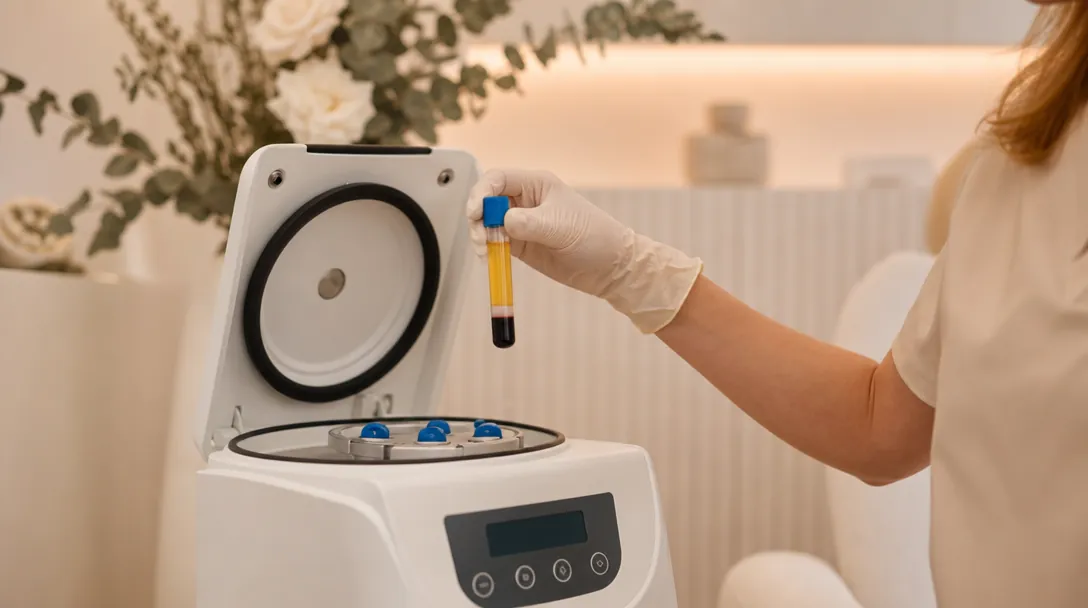
PRP, or platelet-rich plasma, is your own blood, spun in a centrifuge to concentrate the platelets, and injected back into the scalp at the level of the hair follicle. The concentrated platelets release growth factors that signal dormant follicles to restart producing fuller hair.
The biology is well described. Platelets contain dense and alpha granules packed with growth factors including PDGF, TGF-beta, VEGF and EGF. When the platelets are concentrated and injected into the dermal papilla layer of the scalp, those growth factors interact with the cells that drive the hair cycle. As Harvard Health explains it, the working theory is that the elevated platelet concentration (around five times normal blood) prompts the dermal papilla cells to push affected follicles back into the active growth phase.
The mechanism explains the limits as well as the promise. PRP works best where there are still living, miniaturised follicles to wake up. It cannot regenerate follicles that have already scarred over, which is why it is a poor fit for scarring alopecia and a strong fit for early to moderate genetic pattern hair loss.
How many PRP hair loss sessions do you actually need?
Three to four initial sessions, spaced four to six weeks apart, is the standard protocol in the published trials and the one most UK clinics including ours follow.
A 2019 clinical review of PRP for androgenetic alopecia used three sessions at six-week intervals and reported a mean overall improvement of 45.7% in hair parameters, with peak therapeutic response one month after the third injection. A 2022 systematic review of PRP for hair regrowth describes a typical protocol of monthly sessions for the first three months, followed by a top-up every three months across the first year.
The pattern at CoLaz mirrors that.
- Session one: bloods drawn, plasma prepared, scalp injected across a defined pattern. Mild scalp tenderness for 24 hours is normal. No visible change yet.
- Session two (four to six weeks later): same protocol. Some patients notice reduced shedding by this point.
- Session three (four to six weeks later): visible thickening of existing hair for most responders. Density change is still in the post.
- Session four (optional, four to six weeks later): consolidates the result and is recommended when the underlying pattern is more advanced.
After the initial course, maintenance is every three to six months. Patients who skip maintenance tend to lose part of the gain over six to twelve months. That is consistent with what the published reviews report when patients are tracked beyond the initial sessions.

What kind of results does PRP actually deliver?
Most published trials show measurable density gains in the range of 17 to 39 additional hairs per square centimetre over a three to six month course, with hair thickness changes appearing earlier than count changes.
The numbers are worth being specific about. A 2020 before-and-after study of intradermal PRP in men with androgenetic alopecia reported hair density rising from 172 to 206 hairs per square centimetre at six months, a 19% increase. The systematic review described above pooled results across multiple trials and reported mean differences in the range of 17 to 39 hairs per square centimetre versus placebo, depending on the protocol.
What that looks like in the mirror:
- Months 1 to 2: less shedding in the shower. Existing hairs feel slightly thicker between the fingers.
- Months 3 to 4: peak thickness gain. The parting line looks denser; the crown looks fuller.
- Months 5 to 6: peak density gain. New finer hairs are visible at the hairline and crown in good responders.
- Months 9 to 12 without maintenance: a slow regression starts as the growth-factor signal fades.
Results are not uniform. The same 2019 review found “mild” improvement (under 40% gain) in about 55% of patients and “moderate” improvement (40 to 80%) in about 44%. Roughly 40% of responders showed partial reversal of the gain by the six-month follow-up, which is precisely why the protocol calls for ongoing top-ups.
When does PRP work and when does it not?
PRP works best for early to moderate genetic pattern hair loss. It is poor for scarring alopecia, unconfirmed for stress-driven shedding, and not a substitute for treating an underlying cause.
The differentiator is whether the follicle is still alive. The British Association of Dermatologists describes the miniaturisation process in male pattern hair loss: DHT shrinks the follicle progressively until it stops producing hair, but the follicle is intact for a long time before it disappears completely. That window is the PRP window.
PRP is a sensible candidate for:
- Early to moderate male pattern hair loss (Norwood I to IV). The earlier in the pattern, the stronger the response.
- Early to moderate female pattern hair loss (Ludwig I to II), where the diffuse thinning sits on the top of the scalp.
- Mild diffuse thinning in patients who have already corrected an underlying nutritional or hormonal driver.
PRP is a weak fit or unsuitable for:
- Scarring alopecia including frontal fibrosing alopecia and lichen planopilaris. The follicle is destroyed; PRP cannot rebuild it.
- Active alopecia areata during an unstable flare. The autoimmune driver needs treating first.
- Telogen effluvium driven by an untreated cause such as iron deficiency, thyroid disease or a major stressor. Treat the cause and the hair often recovers without PRP.
- Advanced pattern hair loss (Norwood VI to VII). The follicles in the bald zone are gone; a hair transplant is the better discussion.
Both NHS and NHS Inform note that hair loss treatments are not always fully effective and rarely available on the NHS, which is why an honest screen at the start matters more than the brand of PRP kit.

How long do PRP results last?
PRP results are sustained for as long as the maintenance schedule is followed. A typical pattern is a three-to-four session initial course, then a top-up session every three to six months indefinitely.
The biology is the reason. PRP does not cure androgenetic alopecia; it pushes living follicles back into the active growth phase. The underlying DHT-driven miniaturisation process continues in the background. Without a maintenance injection, follicles drift back towards the resting state and the gain fades.
What we tell patients at consultation:
- Best case: a sustained 20 to 30% density gain on the crown or parting, maintained with two to four top-up sessions per year.
- Realistic case: visibly thicker hair and reduced shedding for the year of the protocol, with a clear answer at the twelve-month review on whether to continue, switch or add an adjunct.
- Honest case: about 15 to 25% of patients will respond minimally. We will have that conversation early rather than after four sessions.
PRP also pairs well with topical minoxidil in men and women, and with oral finasteride in men. The combination has stronger evidence in systematic reviews than either treatment alone, which is why we will often suggest a layered plan rather than PRP in isolation.
How does CoLaz plan a PRP course?
Every PRP hair loss patient at CoLaz starts with a structured screen: a blood test for iron, ferritin and thyroid function, a scalp examination, and a written plan that names the pattern, the realistic outcome and the maintenance schedule.
The reason for the screen is simple. A meaningful number of “hair loss” cases that come into our clinics turn out to be untreated iron deficiency or thyroid disease, both of which respond to medical treatment rather than to PRP. Injecting PRP into a scalp where the underlying issue is nutritional means you spend the money and only fix part of the problem.
Our PRP standards:
- A registered nurse or doctor draws blood and prepares the plasma in a closed-system centrifuge at every session.
- We use the same kit and protocol across all seven clinics so your results from session one to session four are comparable.
- The clinic is held to the same JCCP-registered and Save Face-accredited standards we apply to every injectable on the menu.
- The full course is confirmed in writing only after the consultation and the blood results are back, never before.
If you want a frank read on whether your thinning is the right pattern for PRP, the free consultation at your nearest CoLaz clinic covers it in full. If PRP for hair loss is not the right answer, we will tell you what is, including meso HairMax and the conditions that respond better to a referral than to an injection.
Ready to begin
Book a free PRP Hair Loss consultation at your nearest CoLaz clinic.
Thirty minutes with a qualified clinician. Skin assessment, candid recommendation, no obligation. Read about PRP Hair Loss at CoLaz, from £350 (Women Stage 1 or Male Stage 1, single session).
WhatsApp replies in minutes during opening hours
About the author
Alaiyka Parvez
Owner, CoLaz Aesthetics Clinic
Alaiyka Parvez bought the CoLaz franchise network in 2023, having joined the company as a Slough clinic employee in 2013 and gone on to open the Hounslow and Wembley franchises. She writes here on the treatments CoLaz delivers across its seven UK clinics.
Read more about Alaiyka and CoLaz →More on Hair loss
Keep reading.

6 August 2026 · 10 min
Hair loss treatment UK: a realistic 2026 guide to what actually works
Minoxidil, finasteride, PRP, scalp mesotherapy, laser therapy, exosomes and transplants. What the evidence actually shows for each, what they cost, and the combined pathway most clinicians recommend.

4 August 2026 · 9 min
Female hair loss treatment: realistic options in 2026
Female pattern hair loss looks nothing like the male version, and the pathway is different too. What the evidence supports in 2026, and why bloods come first.

27 May 2026 · 8 min
Why is my hair thinning? Causes and the treatments that actually help
Hair thinning has more than one cause, and the right treatment depends on which cause is yours. Here is how the main types differ and the UK treatments that work for each.
Begin
Book a free consultation
at your nearest CoLaz clinic.
Thirty minutes with a qualified clinician. Skin assessment, candid recommendation, written plan. No obligation.