
Hair removal · 18 November 2025 · 8 min read
Laser Hair Removal and Blood Thinners: Is It Safe?
By Alaiyka Parvez
Owner, CoLaz Aesthetics Clinic
The short version
- • Blood thinners do not stop laser hair removal working; they mainly raise the chance of bruising, redness or slower healing around a session.
- • Prescription anticoagulants such as warfarin and the DOACs carry more risk than low-dose aspirin, and several herbal supplements thin the blood too.
- • Never stop a prescribed blood thinner for a cosmetic treatment unless your GP or specialist tells you it is safe to do so.
- • Tell your clinic every medicine and supplement you take, so laser settings, timing and aftercare can be adjusted for you.
- • At CoLaz, a free consultation and a patch test 48 hours before your first session screen for this before any course is booked.
TL;DR
- Blood thinners do not stop laser hair removal working. They mainly raise the chance of bruising, redness or slower healing around a session.
- Prescription anticoagulants such as warfarin and the newer DOACs carry more risk than low-dose aspirin, and several herbal supplements thin the blood too.
- Never stop a prescribed blood thinner for a cosmetic treatment unless your GP or specialist confirms it is safe.
- Tell your clinic every medicine and supplement you take, so laser settings, timing and aftercare can be adjusted for you.
- At CoLaz, a free consultation and a patch test 48 hours before your first session screen for this before any course is booked.
Plenty of people take a blood thinner for heart health, clot prevention or after surgery, and still want smooth, hair-free skin. The short answer is reassuring: laser hair removal and blood thinners can usually go together, but they need extra care and full honesty about what you take. The medication does not change whether the laser removes hair. What it changes is how your skin bruises, oozes or heals around each session.
Below is how blood thinners work, which types carry more risk, whether you should ever pause them, and how we plan a safe course at every CoLaz laser hair removal clinic.
Can you have laser hair removal while taking blood thinners?
In most cases, yes, you can have laser hair removal while taking blood thinners, as long as your clinic knows about the medication and adjusts for it. Blood thinners do not stop the laser from doing its job, because the laser targets the pigment in the hair follicle, not your blood.
What the medication does is lower your blood’s ability to clot, so the small amount of heat and pressure a laser session puts on the skin is a little more likely to show up as bruising or a slower fade of redness. The Leeds Teaching Hospitals NHS Trust explains that after a normal session the skin usually looks pink with swelling like nettle rash that settles within a few hours. On a blood thinner, that ordinary reaction can be slightly stronger or last a little longer.
The decision is never one you make alone. It is made together by you, the doctor who prescribed your blood thinner, and the clinician planning your laser course. That is exactly why the consultation matters so much.
How do blood thinners actually work?
Blood thinners work by slowing down the clotting process, so it takes your blood longer to seal a wound or bruise. They do not literally make blood “thinner”, they interrupt one of the steps your body uses to form a clot.
There are a few different groups, and they matter because they carry different levels of bleeding risk:
- Anticoagulants. These include warfarin and the newer direct oral anticoagulants, or DOACs, such as apixaban, rivaroxaban, dabigatran and edoxaban, plus injected heparin. Warfarin works by blocking vitamin K, which your body needs to clot, while the DOACs block clotting factors directly. NHS guidance notes that on these medicines you are likely to bruise more easily and a simple cut takes longer to stop bleeding.
- Antiplatelets. These include low-dose aspirin and clopidogrel. They stop platelets sticking together. Even low-dose aspirin is linked to a modest, roughly two-fold increase in the risk of bleeding.
- Herbal and dietary supplements. Some natural products have a mild blood-thinning effect that people forget to mention. More on those below.
Knowing which group you are in helps your clinician judge how careful to be, and whether to space, adjust or occasionally postpone a session.
What are the risks of laser hair removal on blood thinners?
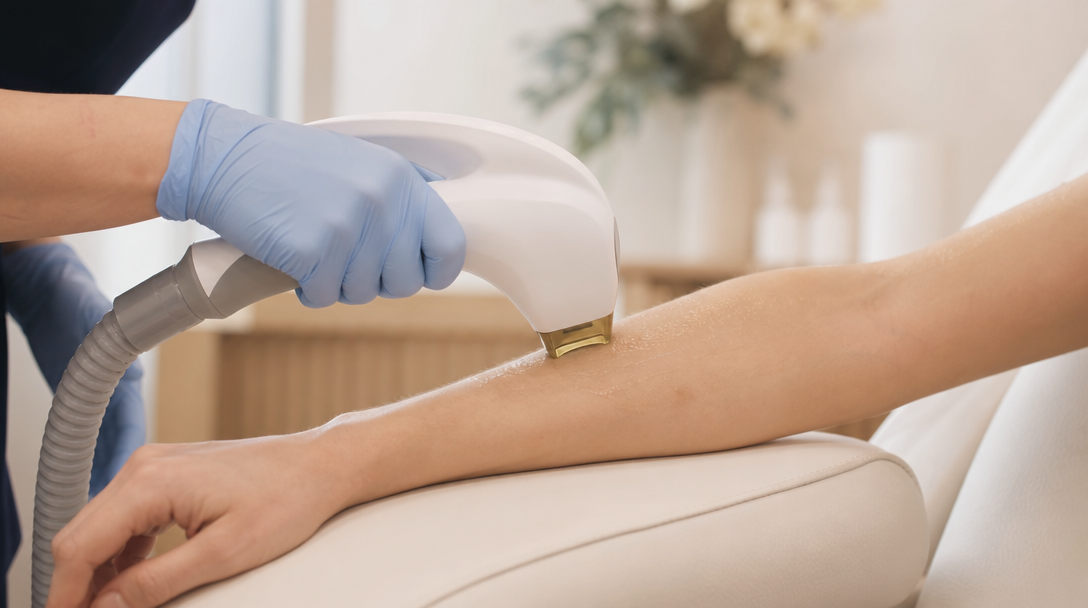
The main risks are cosmetic and short-lived: more bruising, small pinpoint marks called purpura, mild oozing, and redness that takes longer to fade. Serious bleeding from laser hair removal is very rare, even on blood thinners.
It helps to keep the risks in proportion. Adverse reactions to laser hair removal are uncommon in general, and blood thinners tip the odds towards the milder end of the scale rather than creating a new, dangerous problem. What you might notice on an anticoagulant:
- Bruising or purpura. Reduced clotting means the tiny vessels near a treated follicle can leak a little, showing as a bruise or a scatter of small dots.
- Mild oozing or spotting. Occasionally a follicle weeps slightly after a pulse. This settles quickly with gentle aftercare.
- Slower healing. Redness and swelling that would clear in a few hours on most people may linger a day or two.
- No change to your results. This is the key point. The medication affects healing and bruising, not how well the hair reduces over the course.
Your risk also depends on where you are being treated. Thin-skinned, delicate areas such as the upper lip carry a slightly higher chance of visible bruising than a sturdier area like the lower leg, which is worth planning around if you have an event coming up.
Which blood thinners carry the most risk?
Not all blood thinners are equal: full anticoagulants such as warfarin generally carry more bruising risk than low-dose aspirin, and herbal supplements sit at the gentle end. Your clinician weighs this up alongside the area being treated.
As a rough guide:
- Higher care needed: warfarin and the DOACs (apixaban, rivaroxaban, dabigatran, edoxaban), clopidogrel, and higher-dose aspirin. These have the clearest effect on clotting, and the NHS Specialist Pharmacy Service highlights that DOAC bleeding risk rises further when combined with other blood-thinning medicines.
- Lower care needed: low-dose aspirin taken for heart protection. It still counts, so your clinic should know, but the day-to-day bleeding effect is smaller.
- Easy to overlook: herbal and dietary supplements. A review of supplements and clotting found that products such as garlic, ginkgo biloba and fish oil can nudge platelet function and add to bleeding risk, especially alongside a prescribed anticoagulant. Ginger and high-dose vitamin E are sometimes mentioned too.
None of this means you cannot be treated. It means the honest, complete picture of what you take, prescription and non-prescription, lets your clinician set the right expectations and the right settings.
Should you stop your blood thinners before a laser session?
No, you should not stop a prescribed blood thinner for laser hair removal unless the doctor who prescribed it tells you to. Stopping an anticoagulant on your own can be far more dangerous than a bit of bruising.
This is the single most important rule in this article. Blood thinners are usually prescribed to prevent something serious, such as a stroke or a clot on the lung. NHS advice on warfarin and other anticoagulants is clear that you should keep taking them as directed and check with a healthcare professional before making any change. A cosmetic treatment is never a reason to pause them by yourself.
Because laser hair removal is low-risk to begin with, most people on blood thinners simply carry on their medication as normal and have their sessions with a few sensible precautions. If a prescriber does ever advise adjusting a dose around a procedure, that is their call to make with you, not something a beauty clinic should suggest. At CoLaz, we will always work around your medication rather than ask you to stop it.
How does CoLaz keep patients on blood thinners safe?
Every new patient starts with a free consultation where we take a full medical history, including every medicine and supplement you take, before any course is planned. Blood-thinning medication is one of the things we screen for by design.
Our standard process is built for exactly this situation:
- Full medication check. At the consultation we record your prescriptions, any antiplatelets, and any herbal or dietary supplements, and we ask about recent surgery and bleeding conditions.
- Patch test 48 hours before. For every laser and energy-device treatment, we patch test a small area first. On a blood thinner, this is a useful preview of how your skin bruises and settles before we treat a larger area.
- Adjusted settings and cooling. Our clinicians can tailor the laser settings and use skin cooling to keep each pulse comfortable and reduce the chance of marking.
- A written plan, no day-one pressure. We write the recommended course down, and you decide in your own time. We do not sell a fixed package before we have seen how your skin responds.
Every laser at CoLaz is run by a clinician who holds an Ofqual-regulated Level 4 laser qualification, and the UK aesthetic sector is overseen by standards bodies including the JCCP register and the Save Face scheme. If you would like a wider checklist for judging any clinic, our guide on choosing a clinic walks through what to look for.
What aftercare and pain relief work best on blood thinners?

Gentle aftercare and a careful choice of painkiller make the biggest difference to bruising if you are on a blood thinner. The aim is to calm the skin and avoid adding anything that thins the blood further.
Sensible steps around a session:
- Cool the area. A cold compress for 15 to 20 minutes helps settle redness and swelling. Keep it clean and gentle, never apply ice directly to the skin.
- Rest the treated area for 24 to 48 hours. Skip hot baths, saunas, steam rooms, swimming and intense exercise while the skin recovers.
- Protect from the sun. Treated skin is more sensitive, so use a high-factor SPF on any exposed area. Sun protection also lowers the risk of pigment changes.
- Keep skincare simple. Stick to mild, fragrance-free products for a couple of days.
For pain relief, paracetamol is usually the gentler choice. It has no effect on platelets or bleeding time, which is why the NHS suggests reaching for paracetamol instead of aspirin when you want a painkiller and are watching bleeding risk. Anti-inflammatory painkillers such as ibuprofen, naproxen and extra aspirin have their own blood-thinning effect and can interact with anticoagulants, so the NHS advises not taking aspirin or ibuprofen alongside a blood thinner unless a healthcare professional has told you to. Always follow your own prescriber’s advice, since your situation may differ.
What if laser is not the right option right now?
If your medical team would rather you avoid laser for a while, gentler hair-removal methods can bridge the gap until the timing is right. Shaving, threading and hair-removal creams do not rely on clotting and are generally fine to continue.
There is also a hair-removal option that suits people laser cannot help at all. Laser targets pigment, so it does not work on white, grey, blonde or very fine hair. For those hair types, or when you simply want an alternative, electrolysis treats one hair at a time with a fine probe and works on any hair colour. As with laser, tell your clinician about your medication first so the plan fits you.
Whichever route suits you, the starting point is the same. Book a free consultation at your nearest CoLaz clinic, bring a list of everything you take, and we will plan a safe course together. If you have more general questions before you come in, our FAQ page covers consultations, patch tests and candidacy in more detail.
Laser hair removal on blood thinners is usually a question of care and planning, not a closed door. With your prescriber’s blessing, an honest medication list and a clinic that adjusts for you, most people can enjoy the same smooth, long-term reduction as anyone else.
Ready to begin
Book a free Laser Hair Removal consultation at your nearest CoLaz clinic.
Thirty minutes with a qualified clinician. Skin assessment, candid recommendation, no obligation. Read about Laser Hair Removal at CoLaz, from £30 (upper lip, single session).
WhatsApp replies in minutes during opening hours
About the author
Alaiyka Parvez
Owner, CoLaz Aesthetics Clinic
Alaiyka Parvez bought the CoLaz franchise network in 2023, having joined the company as a Slough clinic employee in 2013 and gone on to open the Hounslow and Wembley franchises. She writes here on the treatments CoLaz delivers across its seven UK clinics.
Read more about Alaiyka and CoLaz →More on Hair removal
Keep reading.

2 September 2026 · 12 min
Is laser hair removal safe on dark skin? What the evidence says
Laser hair removal on dark skin works, but only when the wavelength matches your skin type. Here is the science behind why melanin matters, which lasers suit Fitzpatrick V and VI, and the questions to ask before you book.
1 July 2026 · 7 min
IPL vs laser hair removal: why the device you choose matters
The real difference between IPL and laser hair removal, why it changes your results and safety, and how CoLaz matches the right device to your skin and hair.

25 June 2026 · 8 min
Laser hair removal on the face: what women should know before booking
What women should know before booking facial laser hair removal: realistic session counts, the hormone link, matching the laser to your skin tone, and sun protection.
Begin
Book a free consultation
at your nearest CoLaz clinic.
Thirty minutes with a qualified clinician. Skin assessment, candid recommendation, written plan. No obligation.