
Hair removal · 12 March 2025 · 7 min read
Electrolysis hair removal at home: does it work, and is it safe?
By Alayika Parvez
Owner, CoLaz Aesthetics Clinic
The short version
- • Home electrolysis kits do exist, but they are far less effective than professional treatment and much harder to use safely.
- • Electrolysis works by inserting a fine probe into each follicle and passing a small current to destroy the hair root, so results depend almost entirely on precise technique.
- • Common estimates put electrolysis at around a quarter of treated hairs not regrowing per session, which is why a full result takes many sessions over months.
- • Done incorrectly, at home or in clinic, electrolysis can cause scarring, pigment changes and infection, and these are the main reasons dermatology bodies recommend a trained operator.
- • At CoLaz, electrolysis starts with a free consultation and is charged from £10 for a short timed session, with no fixed package on day one.
The honest answer is that you can buy home electrolysis kits, but they are far less effective than professional treatment and much harder to use safely, which is why most dermatology bodies steer people towards a trained operator. Electrolysis is the one hair removal method that works on every hair colour, including the white, grey, blonde and downy hairs that a laser cannot treat. That makes it appealing to try at home. It is also a technique that lives or dies on precise needle work, and that is exactly what a home device makes harder.
Below is a clear look at how electrolysis works, whether home devices actually deliver, the real risks of doing it yourself, and how we approach electrolysis hair removal at CoLaz.
Can you do electrolysis hair removal at home?
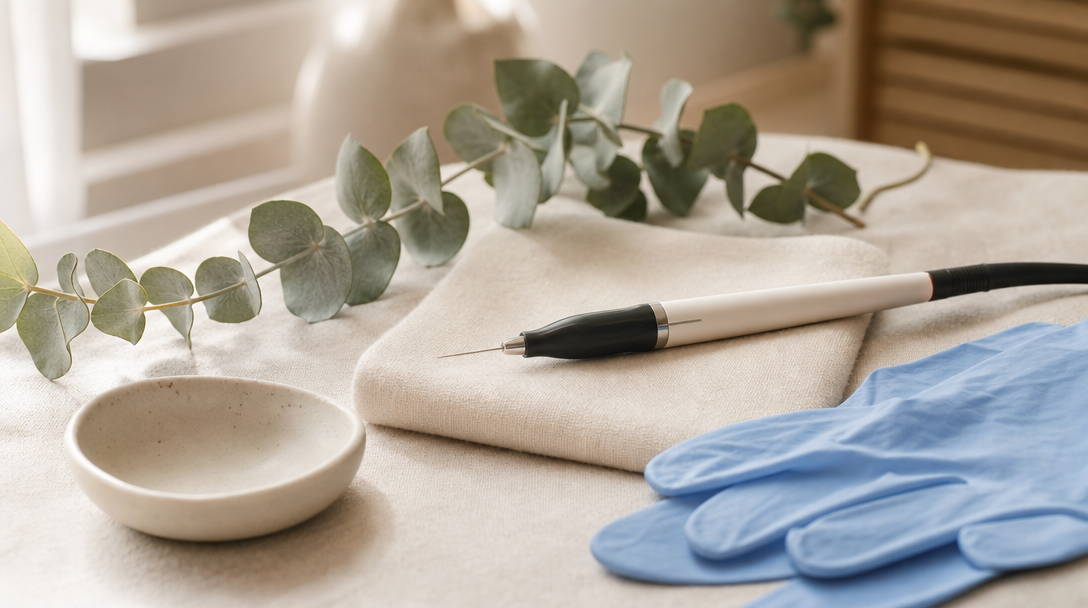
Yes, home electrolysis devices are sold, but they carry lower power, less precision and more risk than a clinic set-up, and they ask you to do skilled work on yourself. The device still relies on the same principle as professional electrolysis: a fine probe slides into the follicle and a small current damages the root. The problem is that inserting a probe at the right depth and angle, into a follicle you often cannot see clearly, is difficult even for trained hands.
Both the American Academy of Dermatology and the Cleveland Clinic advise having electrolysis performed by a trained professional rather than attempting it yourself, precisely because the margin for error is small. A home kit does not remove that skill requirement. It just moves the responsibility onto you.
How does electrolysis actually work?
Electrolysis destroys the hair root by passing a small electrical current down a fine probe placed inside the follicle, so the treated follicle stops producing hair. There are three ways to deliver that current, and reputable devices use one of them.
- Galvanic, which uses a direct current to trigger a chemical reaction inside the follicle.
- Thermolysis, which uses a high-frequency current to generate heat and cauterise the follicle, as DermNet describes.
- Blend, which combines the two.
Because the current is delivered one hair at a time, electrolysis is slow but indiscriminate about colour. Unlike laser, which needs the pigment in dark hair to work, electrolysis treats the follicle directly. That is why the British Skin Foundation lists it as an option for the fine or pale hair that laser leaves behind. The trade-off is that every result depends on the probe reaching the base of the follicle accurately, which is the hard part.
Do home electrolysis devices actually work?
Home devices can reduce some hair, but their results are modest and inconsistent, because electrolysis is one of the most technique-dependent treatments in aesthetics. Even in professional hands the numbers are humbling: the Cleveland Clinic notes a common estimate that around 25% of treated hairs do not regrow, which is why a full course runs to many sessions. A long-term clinical review of electrolysis published on PubMed underlines how much the outcome rests on the operator’s insertion technique and current settings.
A home device typically has lower power and a less refined tip than a clinic system, and you are working on yourself, often on areas you cannot easily see or reach. Put those together and the realistic outcome is patchy reduction, a lot of missed follicles, and hairs that regrow because the root was never properly reached. It is slow, fiddly work with a low success rate per attempt, and doing it on yourself does not improve the odds.
What are the risks of doing electrolysis at home?
The main risks of at-home electrolysis are scarring, changes in skin colour and infection, all of which trace back to a probe going in at the wrong depth or the wrong spot. DermNet lists the recognised complications of electrolysis as scarring and increased or reduced pigmentation (brown or white marks), along with local bacterial infection and reactivation of cold sores.
The AAD is blunt that in inexperienced hands, electrolysis can cause scarring and burns. A few things make home use riskier than a clinic:
- Depth and angle. Insert too deep or off-angle and you damage tissue around the follicle rather than the root, which is how scars form.
- Sterility. A clinic uses a new, disposable probe for every client. Reusing or poorly cleaning a home probe invites infection.
- Sensitive areas. The face, where most people want treatment, is exactly where pigment change and scarring show most.
- No one checking the skin first. A clinician screens for cold sores, active infection and skin conditions before treating. At home, nobody does.
This is not a reason to feel anxious about electrolysis as a treatment. It is a reason to have it done by someone trained to place the probe correctly, on skin they have assessed first.
If you still want to try at home, what does careful practice look like?
If you decide to use a home kit despite the limitations, the goal is to lower the risk of damage on small, low-stakes areas rather than to expect clinic results. Start by treating a tiny test patch and waiting a few days to see how your skin reacts before going further. Keep expectations low and stop at the first sign of persistent redness, marks or broken skin.
A sensible approach follows four stages:
- Prepare the skin. Clean the area with a gentle antibacterial wash, make sure it is fully dry, and trim the hair short so you can see the follicle openings. Do not treat broken, sunburnt or infected skin.
- Set up conservatively. Read the manual, use a fresh probe, and start on the lowest intensity. A weaker current that does less is safer than a strong one that burns.
- Insert gently, never force. The probe should follow the natural angle of the hair into the follicle without being pushed hard. If a hair resists after the current, leave it rather than digging, and never treat the same spot repeatedly in one sitting.
- Look after the skin afterwards. Soothe with a plain, alcohol-free gel such as aloe vera, avoid sun exposure and makeup on the area for a day, and let any scab heal on its own without picking.
None of this turns a home kit into a clinic treatment. It simply keeps the risk lower if you have already decided to try. For anything on the face, or any large or stubborn area, professional treatment is the sensible route.
Who is electrolysis the right choice for?
Electrolysis is best for the hair that laser cannot treat and for finishing off a small number of stubborn hairs. Laser targets the pigment in dark hair, so NHS guidance from the Bristol Laser Centre and the Leeds Teaching Hospitals NHS Trust both note that laser does not work on white or blonde hair. Electrolysis fills that gap.
It suits several situations well:
- White, grey, blonde or fine downy hair, where laser has nothing to target.
- Isolated stray hairs, such as a few on the chin, where a full laser course is overkill.
- Finishing after a laser course, clearing the last pale hairs the laser left behind.
- Hormone-driven facial hair, though this often needs a combined plan. If your facial hair keeps returning, our guide on hormonal facial hair explains why, and for most patients with dark hair, laser hair removal is the faster first step before electrolysis mops up what remains.
How do you choose a professional for electrolysis?
Choose a practitioner who is properly qualified, uses a new disposable probe every time, and works to a recognised standard. The British Skin Foundation advises checking that the operator is qualified and registered with the British Institute and Association of Electrolysis and uses new, disposable (not simply re-sterilised) needles. You can search the BIAE member directory to find registered practitioners.
More broadly, the UK aesthetics sector is overseen by voluntary registers such as the JCCP, and a good clinic will be happy to talk through its training, hygiene and aftercare before you book. Our wider guide on choosing a clinic walks through the questions worth asking. The core point is simple: electrolysis is a skilled procedure, and the person holding the probe matters more than the machine.
How does CoLaz approach electrolysis?
Every new electrolysis patient at CoLaz starts with a free consultation, and treatment is booked in short timed sessions rather than sold as a fixed package on day one. We assess your skin and hair, explain what is realistic, and price the work from £10 for a short session, so you only pay for the time you need. Electrolysis does not require the 48-hour patch test that our laser treatments do, but the same honesty applies: we will tell you if laser would be the better first step for your hair type, and we will say so rather than sell you the wrong course.
Because electrolysis is slow and hair-by-hair, we are realistic about timelines. Most areas need a series of sessions spaced a few weeks apart over several months, and we plan that with you in writing rather than guessing on the first visit.
If you have pale, grey or stubborn hair that other methods have not solved, book a free consultation at your nearest CoLaz clinic and we will talk you through whether electrolysis, laser, or a combination of the two fits you best.
Ready to begin
Book a free Electrolysis Hair Removal consultation at your nearest CoLaz clinic.
Thirty minutes with a qualified clinician. Skin assessment, candid recommendation, no obligation. Read about Electrolysis Hair Removal at CoLaz, from £10 (up to 5 minutes, single session).
WhatsApp replies in minutes during opening hours
About the author
Alayika Parvez
Owner, CoLaz Aesthetics Clinic
Alaiyka Parvez bought the CoLaz franchise network in 2023, having joined the company as a Slough clinic employee in 2013 and gone on to open the Hounslow and Wembley franchises. She writes here on the treatments CoLaz delivers across its seven UK clinics.
Read more about Alaiyka and CoLaz →More on Hair removal
Keep reading.

2 September 2026 · 12 min
Is laser hair removal safe on dark skin? What the evidence says
Laser hair removal on dark skin works, but only when the wavelength matches your skin type. Here is the science behind why melanin matters, which lasers suit Fitzpatrick V and VI, and the questions to ask before you book.
1 July 2026 · 7 min
IPL vs laser hair removal: why the device you choose matters
The real difference between IPL and laser hair removal, why it changes your results and safety, and how CoLaz matches the right device to your skin and hair.

25 June 2026 · 8 min
Laser hair removal on the face: what women should know before booking
What women should know before booking facial laser hair removal: realistic session counts, the hormone link, matching the laser to your skin tone, and sun protection.
Begin
Book a free consultation
at your nearest CoLaz clinic.
Thirty minutes with a qualified clinician. Skin assessment, candid recommendation, written plan. No obligation.