

Skin · 29 May 2025 · 6 min read
Does your face feel prickly after dermaplaning? Why it happens
By Alaiyka Parvez
Owner, CoLaz Aesthetics Clinic
The short version
- • A prickly or tingly feeling after dermaplaning is common and usually harmless: it comes from freshly exfoliated skin and the blunt tips of regrowing vellus hair.
- • Mild tingling in the first 24 to 48 hours settles quickly; the slightly prickly feel of regrowth tends to appear around days five to seven as peach fuzz returns.
- • Soothe it with a fragrance-free moisturiser and daily broad-spectrum SPF, and skip retinoids, acids and scrubs for a few days.
- • Dermaplaning does not make facial hair grow back thicker or darker; the blunt cut end only feels coarser for a short time.
- • See your clinician if redness, swelling, burning or breakouts last beyond 48 hours, because that is not part of normal healing.
TL;DR
- A prickly or tingly feeling after dermaplaning is common and usually harmless: it comes from freshly exfoliated skin and the blunt tips of regrowing vellus hair.
- Mild tingling in the first 24 to 48 hours settles quickly; the slightly prickly feel of regrowth tends to appear around days five to seven as peach fuzz returns.
- Soothe it with a fragrance-free moisturiser and daily broad-spectrum SPF, and skip retinoids, acids and scrubs for a few days.
- Dermaplaning does not make facial hair grow back thicker or darker; the blunt cut end only feels coarser for a short time.
- See your clinician if redness, swelling, burning or breakouts last beyond 48 hours, because that is not part of normal healing.
Yes, it is common and normal for your face to feel a little prickly or tingly after dermaplaning, and the feeling almost always settles on its own. The sensation comes from two things happening at once: your skin has just been exfoliated, so the fresh surface is briefly more sensitive, and a few days later the fine vellus hair (the soft peach fuzz on the face) starts to grow back with a blunt tip that feels slightly rougher than before.
Below is the plain explanation we give dermaplaning patients across our seven UK clinics: why the prickliness happens, how long it lasts, how to soothe it, and the point at which it is worth a phone call rather than a wait.
Why does your face feel prickly after dermaplaning?
Your face feels prickly after dermaplaning because the treatment removes both the outer layer of dead skin and the fine surface hair, leaving a fresher, more responsive surface underneath. That change in what your skin is used to is what registers as tingling or prickliness.
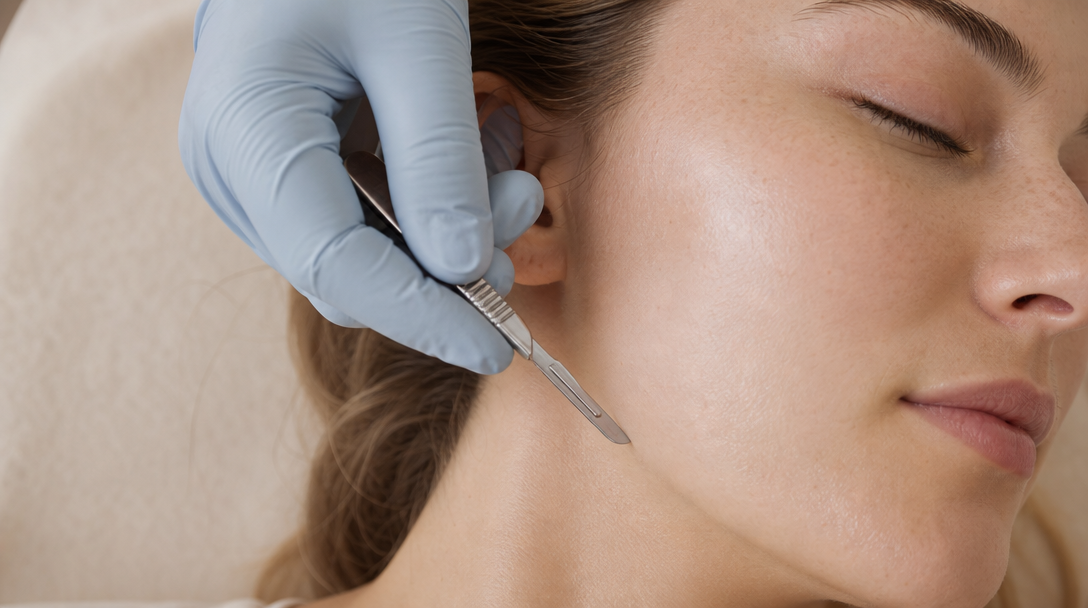
Dermaplaning uses a sterile blade held at an angle to scrape away the outermost layer of dead skin cells (the stratum corneum) along with vellus hair. Research describes the stratum corneum as the skin’s primary barrier, the part that holds moisture in and keeps irritants out. When a thin amount of that layer is buffed away, the newer skin beneath is briefly more permeable, so it reacts a little more to touch, air, temperature and skincare products for a short while.
There are usually three overlapping reasons for the feeling:
- Freshly exfoliated skin. The new surface is more exposed, so wind, water or a moisturiser can feel more noticeable than usual.
- Blunt-tipped regrowth. When vellus hair is cut flush with a blade, the regrowing tip is flat rather than tapered, so it can feel stubbly for the first week.
- Temporary dryness. Removing surface dead skin can leave the face feeling slightly tight until hydration is restored, and dry skin reads as rough or prickly.
None of this means anything has gone wrong. A systematic review of dermaplaning and other non-invasive resurfacing treatments notes that the benefit is immediate but the effect is temporary, which fits the pattern most patients feel: a smooth glow first, then a normal, short-lived adjustment as the skin and hair recover.
Is a tingly feeling after dermaplaning normal?
A mild tingly or prickly feeling after dermaplaning is normal and expected, not a sign of damage. It sits alongside the other minor, short-lived responses we tell patients to anticipate.
In the hours after a session, most people notice one or more of the following, all of which settle quickly:
- Light tingling or a warm, tight feeling across the treated area.
- Mild pinkness, similar to the flush after a brisk walk.
- Skin that feels smoother but slightly more reactive to your usual products.
Dermaplaning is a surface treatment that does not break the skin, which is part of why it has no real downtime. The general NHS guidance on cosmetic procedures is to follow the aftercare your clinician gives you closely, especially in the first week, and that advice is what keeps the tingling brief rather than turning it into irritation.
How long does the prickly feeling last?
For most people the prickly feeling is short-lived, easing within a day or two after the session and fully settling within about a week. It tends to come in two small waves rather than one steady sensation.
Here is the timeline we describe to patients:
- First 24 to 48 hours. Mild tingling or tightness as the freshly exfoliated skin adjusts. This is the most common phase and it fades quickly with a simple moisturiser.
- Around days five to seven. A slightly prickly or stubbly feel as vellus hair begins to grow back. The hair is not thicker, it simply has a blunt tip. Regrowing facial hair typically returns over a few weeks.
- After roughly a week. The prickliness usually settles as the surface evens out and the barrier restores. Because the stratum corneum takes around a month to fully renew, many patients book dermaplaning every four to six weeks.
If the feeling lasts noticeably longer than a week, or it is getting worse rather than better, check in with your clinician rather than pushing through it.
What can you do to soothe prickly skin after dermaplaning?
The fastest way to calm prickly skin after dermaplaning is to keep the surface hydrated, protected and free of strong actives for a few days. Gentle beats busy here.
What helps:
- Fragrance-free moisturiser. A simple ceramide or hyaluronic acid cream supports the barrier and takes the edge off any tightness or dryness.
- Daily broad-spectrum SPF. Freshly exfoliated skin is more exposed to UV, so protection matters. NHS sunscreen guidance recommends at least SPF 30 with a high UVA rating, reapplied when you are outdoors.
- A cool, calm approach. A chilled soothing gel and a break from heat, saunas and hot workouts for 48 hours all reduce redness and prickliness.
What to skip for three to five days:
- Retinoids, glycolic, lactic and salicylic acids, and vitamin C in high strengths.
- Physical scrubs, exfoliating cloths and face brushes.
- Strong fragrances and essential-oil “actives”.
The reasoning is simple: your skin has just had a mechanical exfoliation, so stacking a chemical one on top only doubles the irritation. Dermatologists at the American Academy make the same point about over-exfoliating, noting it can leave skin red and irritated, and that darker skin tones in particular should avoid aggressive exfoliation because it can trigger dark spots.
Does dermaplaning make facial hair grow back thicker?
No. Dermaplaning does not make facial hair grow back thicker, darker or faster. The regrowth only feels coarser for a short time because the cut tip is blunt instead of tapered.
This is the single most common worry we hear, and the science is settled. Hair thickness, colour and texture are set at the follicle, deep in the skin. A blade passing across the surface trims the hair flush; it does not reach or change the follicle below. A dermoscopic study comparing regrowth after cutting hair found the regrowing hair was not thicker, it simply had a blunt end that can feel different to the touch. Vellus hair also cannot turn into coarse terminal hair from a surface treatment.
If the feel of regrowing fuzz genuinely bothers you between sessions, there are two sensible routes:
- Regular dermaplaning every four to six weeks, in step with your natural hair cycle, to keep the surface smooth.
- Electrolysis for longer-term removal of individual hairs, which works on fine, pale or grey hair that light-based methods struggle with.
Laser hair removal is usually not the answer for peach fuzz, because there is too little pigment in vellus hair for the laser to target. We would tell you that at the consultation rather than sell you a course that will not deliver.
When should the prickly feeling worry you?
Mild prickliness is normal, but a few signs mean the reaction has gone beyond ordinary healing and should be checked. The rule of thumb is that discomfort should be fading by day two, not building.
Contact your clinic if you notice:
- Redness or swelling lasting beyond 48 hours, which can point to irritation or a reaction to a product used on the day.
- Burning or increasing pain rather than a settling tingle. A short-lived tingle is fine; sustained burning is not.
- New bumps or breakouts. Freshly exfoliated skin plus heavy or non-comedogenic-free products can clog pores, and sweat on the new surface can lead to spots, similar to the way ingrown hairs and irritation show up after other hair-removal methods.
- Any sign of infection, such as heat, spreading redness or yellow discharge.
A quick check is always better than three days of guessing at home. Most of the time it is nothing, and a five-minute look under a treatment lamp will confirm that.
How CoLaz keeps dermaplaning comfortable
At CoLaz, every dermaplaning session starts with a free consultation and ends with clear aftercare, so a normal prickly feeling never turns into a worry. We would rather over-explain the first week than leave you guessing.
That means a single-use sterile blade every time, a check that your skin is a good candidate (we reschedule for active acne, cold sores or recent sunburn), and written aftercare covering exactly what to use and what to avoid. If you want the fuller routine, our guide to dermaplaning aftercare sets out the products and the timeline day by day.
We hold to the same standard the NHS recommends for cosmetic procedures: a qualified practitioner on a Professional Standards Authority-accredited register such as the JCCP or Save Face, with proper training and insurance. If you are new to dermaplaning, or you are weighing it against another route for facial fuzz, the free consultation is the place to talk it through and get the plan in writing.
Ready to begin
Book a free Dermaplaning consultation at your nearest CoLaz clinic.
Thirty minutes with a qualified clinician. Skin assessment, candid recommendation, no obligation. Read about Dermaplaning at CoLaz, from £65 (full face, single session).
WhatsApp replies in minutes during opening hours
About the author
Alaiyka Parvez
Owner, CoLaz Aesthetics Clinic
Alaiyka Parvez bought the CoLaz franchise network in 2023, having joined the company as a Slough clinic employee in 2013 and gone on to open the Hounslow and Wembley franchises. She writes here on the treatments CoLaz delivers across its seven UK clinics.
Read more about Alaiyka and CoLaz →More on Skin
Keep reading.

11 August 2026 · 10 min
HIFU treatment results: month by month, what is realistic
HIFU tightens skin gradually rather than instantly. Here is the honest month-by-month results timeline, how long the effect lasts, and who is a good candidate.

28 July 2026 · 10 min
Types of chemical peels: glycolic, salicylic, TCA and Jessner explained
Glycolic for dull and sun-damaged skin, salicylic for oily and acne-prone, lactic for sensitive, mandelic for pigmentation in deeper skin tones, TCA for resurfacing with downtime. A clear decision guide to the main types of chemical peels.

14 July 2026 · 7 min
Microneedling aftercare day by day: the realistic 7-day timeline
What to expect after microneedling, day by day, plus the simple aftercare that protects your skin and your results across the first week.
Begin
Book a free consultation
at your nearest CoLaz clinic.
Thirty minutes with a qualified clinician. Skin assessment, candid recommendation, written plan. No obligation.