
Hair removal · 15 November 2025 · 8 min read
Laser Hair Removal and Thyroid Disorders: Is It Safe?
By Alayika Parvez
Owner, CoLaz Aesthetics Clinic
The short version
- • Laser hair removal is considered safe for people with hypothyroidism or hyperthyroidism, and studies show it does not change T3, T4 or TSH levels.
- • The laser only reaches the hair follicle near the skin surface, not the thyroid gland deep in the neck.
- • A thyroid imbalance can slow or speed up your hair cycle, so a well-controlled thyroid gives the most predictable results.
- • Hormone-driven hair often needs a longer course, commonly eight to twelve sessions rather than the usual six to eight.
- • At CoLaz, treatment starts with a free consultation and a patch test, and we ask that your thyroid levels are stable before we begin.
TL;DR
- Laser hair removal is considered safe for people with hypothyroidism or hyperthyroidism, and a study measuring hormone levels found no change in T3, T4 or TSH after treatment.
- The laser only reaches the hair follicle near the skin surface. It does not touch the thyroid gland, which sits deep in the neck.
- A thyroid imbalance can slow down or speed up your hair cycle, so a well-controlled thyroid gives the most predictable results.
- Hormone-driven hair often needs a longer course, commonly eight to twelve sessions rather than the usual six to eight.
- At CoLaz, treatment starts with a free consultation and a patch test, and we ask that your thyroid levels are stable before we begin.
If you have an underactive or overactive thyroid, laser hair removal is generally safe, and the laser does not affect your thyroid hormones or the gland itself. What a thyroid condition can change is your hair cycle, which in turn affects how many sessions you need and how quickly you see results. Below is the clinical picture in plain terms, and how we plan treatment for thyroid patients at a CoLaz laser hair removal clinic.
How do thyroid disorders change the way your hair grows?
Thyroid hormones help control the hair cycle, so when they fall out of balance your hair can thin, shed, or grow in places you did not expect. The thyroid gland releases hormones that guide how quickly cells renew, and hair follicles are sensitive to that signal.
Your hair grows in cycles, moving through anagen (active growth), catagen (transition) and telogen (resting), as set out in dermatology research on the hair cycle. A thyroid imbalance disrupts that rhythm. A review on the impact of thyroid dysfunction on hair reports that an underactive thyroid pushes follicles into the resting phase and delays their return to active growth, while an overactive thyroid can trigger diffuse shedding, affecting roughly a third of hypothyroid patients and around half of hyperthyroid patients.
In practice, that shows up as:
- Thin, dry or brittle hair, and sometimes loss of the outer third of the eyebrows, with an underactive thyroid.
- Finer hair and more widespread shedding with an overactive thyroid.
- Coarser or darker hair in new areas when hormone shifts affect follicles elsewhere on the face and body.
Both conditions are common, more so in women, and both are usually managed with medication such as levothyroxine for an underactive thyroid, which helps steady the hair cycle over time. If shedding on the scalp is your main worry, our guide to hair thinning covers when to see a GP first.
Is laser hair removal safe if you have a thyroid disorder?
Yes, laser hair removal is widely considered safe for people with well-managed thyroid conditions, and it does not alter your thyroid hormones. The laser targets pigment in the hair follicle just under the skin surface. It does not reach the thyroid gland, which sits much deeper in the neck.
The reassuring part is that this has been measured. A study assessing the effects of laser hair removal on thyroid hormones took blood samples from women before and after facial laser treatment with diode and Alexandrite systems, and found no significant change in T3, T4 or TSH levels afterwards. In other words, the treatment did not disturb thyroid function.
There is also no evidence linking laser hair removal to thyroid damage or dysfunction. If you already manage your condition with medication, you can usually continue laser treatment without any effect on your thyroid health. As with any patient, the key safety steps are a proper consultation, a patch test and treatment by a qualified practitioner.
Does a thyroid condition affect how well laser hair removal works?
A thyroid imbalance does not stop laser hair removal working, but it can change the pace and the number of sessions you need. The laser works best on follicles that are in their active growth phase, and thyroid hormones influence how many follicles sit in that phase at any time.
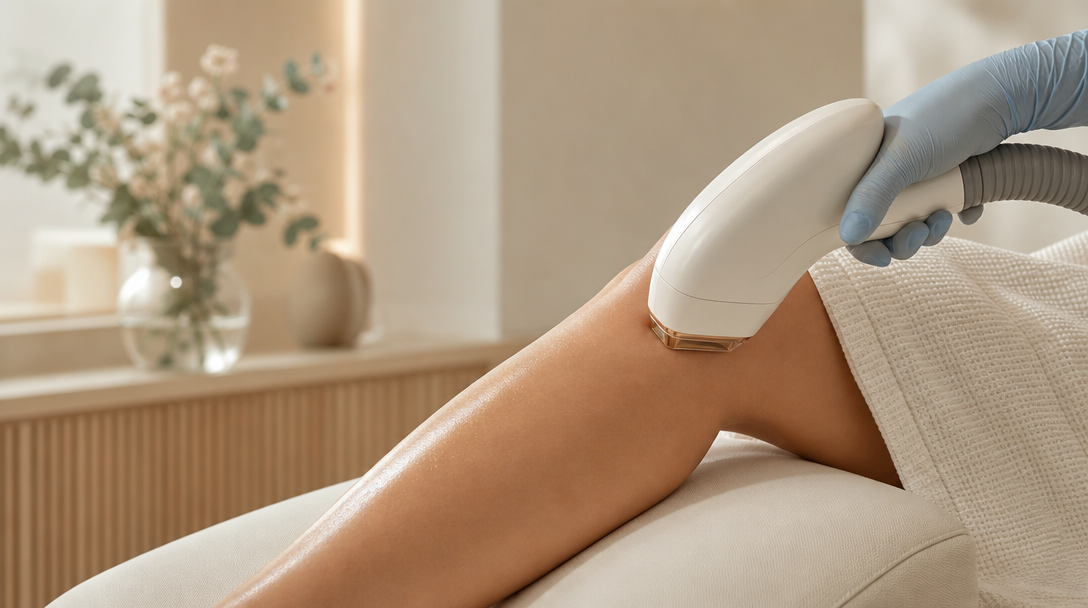
With an underactive thyroid, more follicles rest for longer, so some may respond slowly and you might need a few extra sessions. With an overactive thyroid, faster hair growth can mean treating an area more often to keep up. In both cases the treatment still reduces hair, it simply asks for a little more patience.
The single most useful thing you can do is keep your thyroid well controlled. When hormone levels are steady, hair patterns are more predictable, and your course tends to track closer to a standard timeline. Regular blood tests to check your dose, which the NHS recommends anyway for anyone on thyroid medication, help keep things stable during your treatment.
How many laser sessions do thyroid patients usually need?
Thyroid patients often need a slightly longer course than average, commonly around eight to twelve sessions, compared with the usual six to eight. The extra sessions account for a hair cycle that has been slowed or sped up by hormones.
Sessions are still spaced four to six weeks apart so each visit catches a fresh batch of follicles in active growth. The American Academy of Dermatology notes that most people need several laser treatments because only follicles in the growth phase respond, and thyroid-driven hair is no different in that respect. It simply cycles at its own rate.
We do not sell a fixed package up front. At CoLaz we plan the course after your patch test, review it as we go, and adjust the number of sessions to what your skin and hair actually do rather than a number promised on day one.
Why does a thyroid imbalance cause extra facial or body hair?
Hormonal changes linked to thyroid disorders can tip the balance of androgens, the hormones that drive coarse hair growth, leading to unwanted hair on the chin, jaw, chest or back. This often builds up gradually and becomes more noticeable over months.
According to the NHS, most excess hair growth, known as hirsutism, is linked to a rise in androgen levels or increased sensitivity to them. The British Skin Foundation explains that the most common cause in younger women is polycystic ovary syndrome, and that other hormonal disorders can contribute too. Thyroid problems and PCOS can occur together, which is why some patients notice both scalp thinning and new coarse hair at the same time.
Laser hair removal is a good fit here because it reduces the visible hair while your medication addresses the hormones underneath. The NHS lists laser and IPL among the options for managing hair growth in PCOS, used alongside medical treatment. A combined approach, steady hormone control plus a planned laser course, gives the most durable everyday result. Our post on chin hair that keeps returning after waxing explains why this hormonal hair behaves the way it does.
What should thyroid patients do before starting?
Before your first session, make sure your thyroid is stable and share your full medical picture at the consultation. Stable hormone levels support consistent, predictable laser results, so this step matters more for thyroid patients than most.

Helpful things to bring or mention:
- Your thyroid diagnosis and any medication you take, such as levothyroxine or anti-thyroid medicine. Neither is a barrier to laser treatment.
- Confirmation that your levels are currently well controlled, ideally with a recent blood test.
- Any supplements you take, including iodine.
- Any recent change in your dose, since a shifting dose can also shift your hair cycle.
If your thyroid is not yet settled, it is usually worth waiting until it is, so your course starts on a stable footing. If you are unsure, your GP or endocrinologist can confirm whether your levels are in a good range before you book.
When might electrolysis suit you better than laser?
Electrolysis can be the better choice when the hair is too light or too fine for a laser to detect, since laser relies on pigment and electrolysis does not. It treats one follicle at a time using a fine probe and a small current, which makes it well suited to white, grey or downy hair.
Some thyroid-related hair is pale or very fine, and in those cases laser has little pigment to target. The British Skin Foundation lists electrolysis as an established option for the kind of stubborn hair that other methods struggle with. It is slower per area than laser, so we tend to suggest it for smaller or scattered patches rather than large zones.
At your consultation we will look at your hair colour, thickness and skin tone and recommend the approach that fits, whether that is laser, electrolysis, or a combination of the two across different areas.
How does CoLaz support patients with thyroid conditions?
CoLaz plans laser hair removal around your thyroid condition rather than treating it as an afterthought. Our clinicians understand how hormonal conditions change hair growth, and they build your course to match.
That means a consultation that reviews your medication, symptoms and hormone control, medical-grade laser systems suitable for a range of skin tones, and practitioners qualified to run laser and IPL treatment. The UK aesthetic sector is guided by JCCP-registered standards and the Save Face accreditation scheme, both recognised by the Professional Standards Authority, and we work to those standards across our seven UK clinics. Where it helps, we are happy for you to check timing with your GP or endocrinologist first.
Laser hair removal is best understood as long-term hair reduction rather than permanent removal, and for hormone-driven hair a top-up session once or twice a year keeps regrowth in check. If you would like to know what your specific course might look like, the free consultation includes a patch test and a written plan, with no fixed package sold up front. Book at your nearest CoLaz clinic and we will map it out together.
Ready to begin
Book a free Laser Hair Removal consultation at your nearest CoLaz clinic.
Thirty minutes with a qualified clinician. Skin assessment, candid recommendation, no obligation. Read about Laser Hair Removal at CoLaz, from £30 (upper lip, single session).
WhatsApp replies in minutes during opening hours
About the author
Alayika Parvez
Owner, CoLaz Aesthetics Clinic
Alaiyka Parvez bought the CoLaz franchise network in 2023, having joined the company as a Slough clinic employee in 2013 and gone on to open the Hounslow and Wembley franchises. She writes here on the treatments CoLaz delivers across its seven UK clinics.
Read more about Alaiyka and CoLaz →More on Hair removal
Keep reading.

2 September 2026 · 12 min
Is laser hair removal safe on dark skin? What the evidence says
Laser hair removal on dark skin works, but only when the wavelength matches your skin type. Here is the science behind why melanin matters, which lasers suit Fitzpatrick V and VI, and the questions to ask before you book.
1 July 2026 · 7 min
IPL vs laser hair removal: why the device you choose matters
The real difference between IPL and laser hair removal, why it changes your results and safety, and how CoLaz matches the right device to your skin and hair.

25 June 2026 · 8 min
Laser hair removal on the face: what women should know before booking
What women should know before booking facial laser hair removal: realistic session counts, the hormone link, matching the laser to your skin tone, and sun protection.
Begin
Book a free consultation
at your nearest CoLaz clinic.
Thirty minutes with a qualified clinician. Skin assessment, candid recommendation, written plan. No obligation.