Is laser hair removal safe on dark skin? What the evidence says
 Owner, CoLaz Aesthetics Clinic
The short version
- Laser hair removal on dark skin is safe when the wavelength matches your skin type. The risk comes from the wrong device, not from having dark skin.
- Long-pulsed Nd:YAG at 1064 nm is the first choice for Fitzpatrick V and VI, because less of its energy is absorbed by the melanin in your skin.
- Alexandrite at 755 nm and most IPL platforms are built around lighter skin and carry a higher burn and pigmentation risk on deeper skin tones.
- The most common complication on deeper skin tones is temporary hyperpigmentation, reported by one NHS laser centre in 17 of every 100 patients treated. Scarring is rare at around 1 in 800.
- At CoLaz we Fitzpatrick-type every patient at the free consultation, patch test 48 hours before the first session, and put the course in writing before anything is booked.
TL;DR
- Laser hair removal on dark skin is safe when the wavelength matches your skin type. The risk comes from the wrong device, not from having dark skin.
- Long-pulsed Nd:YAG at 1064 nm is the first choice for Fitzpatrick V and VI, because less of its energy is absorbed by the melanin sitting in your skin.
- Alexandrite at 755 nm and most IPL platforms are built around lighter skin and carry a higher burn and pigmentation risk on deeper skin tones.
- The most common complication on deeper skin tones is temporary hyperpigmentation, reported by one NHS laser centre in 17 of every 100 patients treated. Scarring is rare at around 1 in 800.
- At CoLaz we Fitzpatrick-type every patient at the free consultation, patch test 48 hours before the first session, and put the course in writing before anything is booked.
If you have deep-brown or Black skin and you have been told laser hair removal is not for you, that advice is about twenty years out of date. It is also the reason a lot of people with darker skin tones still get turned away, or worse, get treated on a machine that was never designed for their skin.
The honest position is more useful than a straight yes or no. Laser hair removal on dark skin is safe and effective, but only on the right wavelength, at the right settings, with a proper patch test first. Get that combination wrong and the same treatment that clears hair on Fitzpatrick II skin can leave a Fitzpatrick V patient with burns and pigmentation that takes months to settle.
Here is what actually decides the outcome, what the clinical evidence shows, and the questions worth asking before you hand over a deposit for laser hair removal.
Is laser hair removal safe on dark skin?
Yes, laser hair removal is safe on dark skin when the clinic uses a long-wavelength laser, lower fluences and longer pulse durations, and cools the skin properly during treatment. The safety question is really a device-and-settings question, not a skin-colour question.
The American Academy of Dermatology puts it plainly: laser hair removal is now a treatment option for patients with dark skin, and it must be performed very carefully in these patients. That second half matters as much as the first.
Clinical guidance for darker phototypes is consistent. Dermatology reference material on laser recommendations by skin type advises longer-wavelength lasers, lower fluences, longer pulse durations and epidermal cooling for Fitzpatrick IV to VI, because deeper penetration raises the temperature at the hair bulb without cooking the surface of the skin.
A clinic that treats every patient on the same machine at broadly the same settings is not doing any of that. It is the single biggest cause of pigmentation injury we see referred in from elsewhere.
Why does melanin make laser hair removal on dark skin harder?
Melanin is the target the laser is aiming for, and dark skin has plenty of it in the wrong place. The laser cannot tell the difference between the melanin in the hair follicle you want to treat and the melanin in the skin surface you want to protect.
Laser hair removal works by sending light into the skin at a wavelength that melanin absorbs well. The melanin inside the hair shaft converts that light into heat, and the heat damages the follicle so it produces less hair. On pale skin with dark hair, the contrast is high and the laser has an easy target.
On Fitzpatrick V and VI skin, the epidermis is rich in melanin too. That surface melanin acts as a competing chromophore, soaking up laser energy before it reaches the follicle and increasing the risk of epidermal injury.
Two things follow from that:
- Less energy reaches the follicle, so results can stall if the settings are simply copied from a lighter-skin protocol.
- More energy is absorbed at the surface, so the burn, blister and pigmentation risk rises.
The fix is not to give up on laser. The fix is to choose a wavelength that skin melanin absorbs less strongly.
Which laser is best for Fitzpatrick V and VI skin?
Long-pulsed Nd:YAG at 1064 nm is the first-choice laser for Fitzpatrick V and VI skin, with a long-pulsed diode laser as the main alternative on Fitzpatrick IV and some V patients.
The physics is simple. Longer wavelengths are absorbed less by melanin in the epidermis and travel deeper into the skin, so more of the energy arrives at the hair bulb rather than being spent at the surface. Nd:YAG at 1064 nm is the longest wavelength in routine hair-removal use, which is why it became the standard for deeply pigmented skin.
| Device | Wavelength | Suits deep skin tones? |
|---|---|---|
| Nd:YAG | 1064 nm | Yes, the first choice for Fitzpatrick V and VI |
| Diode | 800 to 1060 nm depending on platform | Often, at low fluence and high repetition rate |
| Alexandrite | 755 nm | Generally no, better suited to Fitzpatrick I to III |
| IPL | broad spectrum, filtered | Generally no on Fitzpatrick V and VI |
Published work supports the ranking. A study of long-pulsed Nd:YAG hair removal in Fitzpatrick IV to VI patients found it safe and effective in dark-skinned individuals, with satisfactory results in most patients. A 2025 study of 55 Sudanese women with Fitzpatrick IV to VI skin treated with a 1064 nm Nd:YAG at 25 to 40 J/cm² with sapphire contact cooling reported no adverse events and no paradoxical hair growth.
Diode lasers earn their place too, particularly in the low-fluence, high-repetition “in motion” style of delivery. A trial of an 810 nm diode in 71 Indian patients with skin types IV to VI recorded excellent results in 84.5 per cent of cases after an average of 5.2 sessions, with no burns, hyperpigmentation or hypopigmentation reported. Optical modelling comparing the two shorter wavelengths found the 810 nm diode penetrates dark skin better than 755 nm alexandrite, which is the same principle at work.
Why are alexandrite and IPL usually the wrong choice on dark skin?
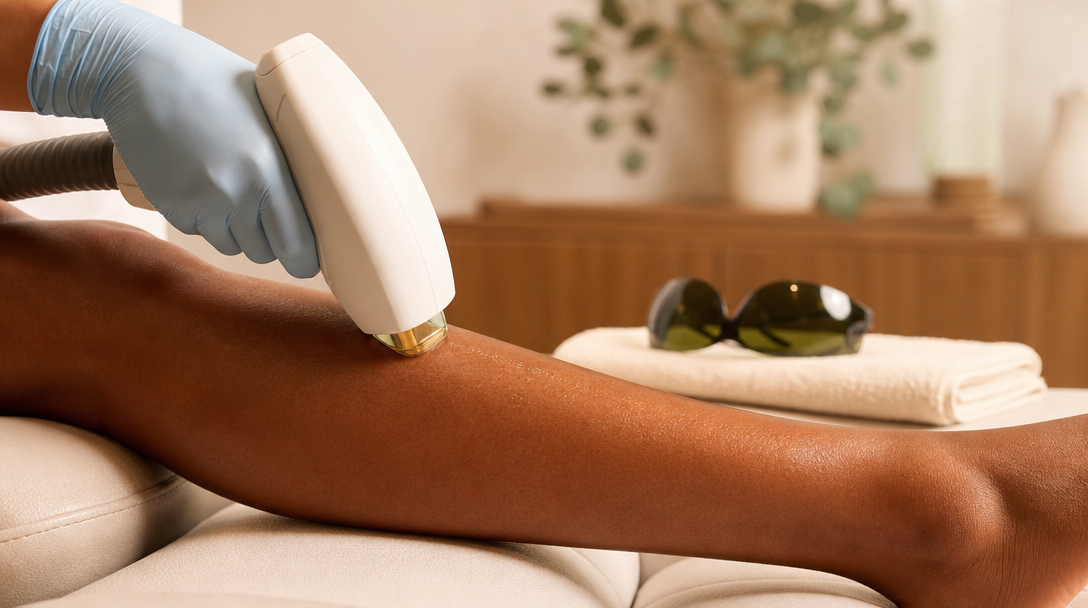
Alexandrite at 755 nm and standard IPL are absorbed strongly by the melanin in the skin surface, so on Fitzpatrick V and VI they deliver more heat to the epidermis and less to the follicle. That is the opposite of what you want.
Alexandrite is an excellent laser. On Fitzpatrick I to III skin with coarse dark hair it is fast, comfortable and efficient, which is why so many UK clinics run it. The problem is that its strength on pale skin is exactly its weakness on deep skin: high melanin absorption.
IPL is not a laser at all. It is a broad-spectrum light source with filters, and even a well-filtered IPL head spreads energy across a range of wavelengths that pigmented skin absorbs readily. A comparative study of Nd:YAG and IPL on skin types IV to VI concluded that the longer-wavelength laser was preferable for hair removal in this group.
There is a practical version of this that has nothing to do with physics. A clinic that only owns an alexandrite or an IPL platform has a commercial reason to tell you that it is fine on your skin. A clinic that owns both wavelengths does not. At CoLaz our hair-removal platform is the GentleMAX Pro, which carries alexandrite at 755 nm and long-pulsed Nd:YAG at 1064 nm on the same system, so the choice of wavelength is a clinical one made at your consultation.
The Fitzpatrick scale, and why we ask about it
The Fitzpatrick scale is a six-point classification of how skin responds to sun exposure, and it is the standard tool clinicians use to pick laser settings. Types I and II burn easily and rarely tan, types III and IV tan more than they burn, and types V and VI are brown and deeply pigmented skin that very rarely burns in the sun.
We Fitzpatrick-type every patient at the free consultation. It takes a couple of minutes and it decides three things: which wavelength we use, what fluence we start at, and how cautious the patch test needs to be.
Worth knowing: your Fitzpatrick type is about your baseline skin, not your current tan. A Fitzpatrick III patient who has just come back from two weeks in the sun is temporarily behaving like a higher type, which is why we reschedule anyone with a fresh tan or recent sunburn rather than treating through it. Advice from NHS laser services is the same, recommending daily SPF 30 or above on the treatment site throughout a course and for at least six weeks after the last session.
What can go wrong, and how likely is it?
The most common complication on deeper skin tones is temporary hyperpigmentation, where the treated area darkens for a period after treatment. It usually fades, but it can take six months or longer.
Concrete numbers help more than reassurance. The Birmingham Regional Skin Laser Centre’s patient leaflet on hair removal reports hyperpigmentation as a complication in 17 in 100 patients treated, notes that it occurs especially in black and Asian skin or skin that tans easily, and puts scarring at 1 in 800. Pigment loss (hypopigmentation) is described as rare, but it can be lasting.
The realistic list of what can happen:
- Redness and mild swelling for up to 24 hours after each session. This is normal and expected.
- Blistering in the first three days, uncommon, and usually linked to sun exposure or products left on the skin.
- Hyperpigmentation, the main risk on Fitzpatrick IV to VI, typically settling over weeks to months.
- Hypopigmentation, rare, and sometimes lasting.
- Scarring, very rare on laser and less common than with electrolysis.
- Paradoxical hypertrichosis, where fine hair increases rather than reduces at the border of a treated area. Published estimates put the overall incidence at roughly 0.6 to 10 per cent.
If pigmentation does develop, it is usually manageable. A systematic review of post-inflammatory hyperpigmentation in skin of colour places topical agents first line, with laser reserved for cases that do not respond. Sun protection while the pigment settles does most of the work. If you would like to read more on that, our pigmentation page covers the treatments we use.

What a proper assessment looks like before your first session
This is the part that decides whether the next six months work, and it is where most disappointing courses go wrong.
A patient walked into our Reading clinic last spring with a course of laser hair removal half-finished from another provider. She had paid for ten sessions up front, had four left, and the results had stalled at session three. We did a free consultation, looked at her skin and hair carefully, and saw that her previous practitioner had used a wavelength suited to lighter skin. She is Fitzpatrick V. Once we patch-tested her on long-pulsed Nd:YAG at 1064 nm and switched her over, the next four sessions completed the result. She now comes in for a top-up every twelve months on her chin and upper lip.
Two things stand out from that case. Her skin had not been properly typed, and she had been sold a fixed ten-session package before anyone knew how her skin would respond.
At every CoLaz clinic the sequence is the same:
- Free consultation. Medical history, medication, current skincare, Fitzpatrick skin type, hair colour and coarseness, treatment goals and contraindications.
- Patch test 48 hours before the first session. We will not deliver a first session without it. On Fitzpatrick V and VI the patch test is what confirms the starting fluence is safe on your skin, not just on paper.
- Written treatment plan. Number of sessions, spacing, device used, price per session and maintenance, written down and handed to you.
- You decide. You take the plan away. There is no day-one pressure to commit to a course.
We also say no when the answer is no. Laser targets pigment in the hair, so very light, grey, white or downy hair will not respond regardless of your skin tone. NHS laser guidance says the same thing: white, blonde, ginger, red and grey hair will not respond. For those patients we recommend electrolysis, which treats each hair individually with a fine probe and works on any hair colour.
How many sessions will you need, and is the result permanent?
Most areas take six to eight sessions spaced four to six weeks apart, and hormonal facial hair usually takes eight to ten. The result is long-term hair reduction rather than permanent removal, so plan for a maintenance session every six to twelve months.
The session count is driven by the hair growth cycle rather than your skin tone. Only follicles in the active growth phase respond to the laser, so each visit catches a different batch. Our guide to laser sessions goes through the cycle in detail.
Skin tone does affect the pace. On Fitzpatrick V and VI we often start at a more conservative fluence and build up as the skin proves it tolerates the treatment, which occasionally adds a session or two to the course. The 810 nm diode study above averaged 5.2 sessions on skin types IV to VI, and the AAD’s general guidance describes most patients needing several treatments plus maintenance to keep an area clear. Both are consistent with the six-to-eight range we plan for.
We do not describe any of this as permanent, and no reputable UK clinic should. Long-term reduction is the honest description of what laser does to a hair follicle.
How do you choose a clinic if you have Fitzpatrick V or VI skin?
Ask what wavelength they will use on your skin and why, and be wary of any answer that does not name a number. A clinic treating deep skin tones well should be able to say “long-pulsed Nd:YAG at 1064 nm” without hesitating.
Five questions worth asking before you book:
- Which laser will you use on my skin, and what wavelength is it? If the answer is alexandrite or IPL and you are Fitzpatrick V or VI, ask what else they have.
- Will I get a patch test, and how long before the first session? Forty-eight hours is the standard. A clinic that offers to patch test and treat on the same day is skipping the point of the test.
- What qualification does the person operating the laser hold? The Joint Council for Cosmetic Practitioners sets Level 4 as the minimum for non-medical practitioners delivering laser and IPL. Every CoLaz practitioner delivering laser, IPL and energy-device treatments holds a VTCT or Ofqual Level 4 qualification.
- Will I get the plan in writing before I pay? A written plan lets you compare, think and walk away.
- What happens if my skin reacts? You want a named contact and a review appointment, not a shrug.
Regulation in England is still catching up. The government’s consultation response on licensing non-surgical cosmetic procedures confirms laser hair removal sits inside the scope of the planned scheme, taken forward through secondary legislation. Until that lands in full, the practitioner’s qualification and the clinic’s own standards are doing most of the protecting.
When we say no, and why that matters
Some patients should not have laser regardless of skin tone, and a good consultation finds this out before you have paid for anything.
We do not treat patients who are pregnant or breastfeeding, and we reschedule anyone with an active skin infection, a cold sore in the treatment area, recent sunburn or a fresh tan. We screen carefully for blood-thinning medication, autoimmune conditions, recent surgery and isotretinoin use within the last six months, and in some cases we will decline or ask you to speak to your GP first. Very light, grey, white or downy hair is a no for laser at any skin type.
If you have a history of keloid scarring or post-inflammatory hyperpigmentation, tell us at the consultation. It does not automatically rule laser out, but it changes how conservatively we start and how closely we review you between sessions.
Booking a consultation
If you have Fitzpatrick V or VI skin and you have been putting laser off, a free consultation costs you nothing and gives you a written plan you can take away and think about. We will type your skin, look at your hair, tell you honestly whether laser is the right technology for you, and book a patch test before anything else happens.
You can book a consultation at any of our seven UK clinics in Derby, Wembley, London Paddington, Slough, Reading, Southall and Hounslow.
Ready to begin
Book a free Laser Hair Removal consultation at your nearest CoLaz clinic
Time with a qualified clinician: a skin assessment, an honest recommendation and no obligation. Read about Laser Hair Removal at CoLaz, from £30 (upper lip, single session).
More on Hair removal
Keep reading
-
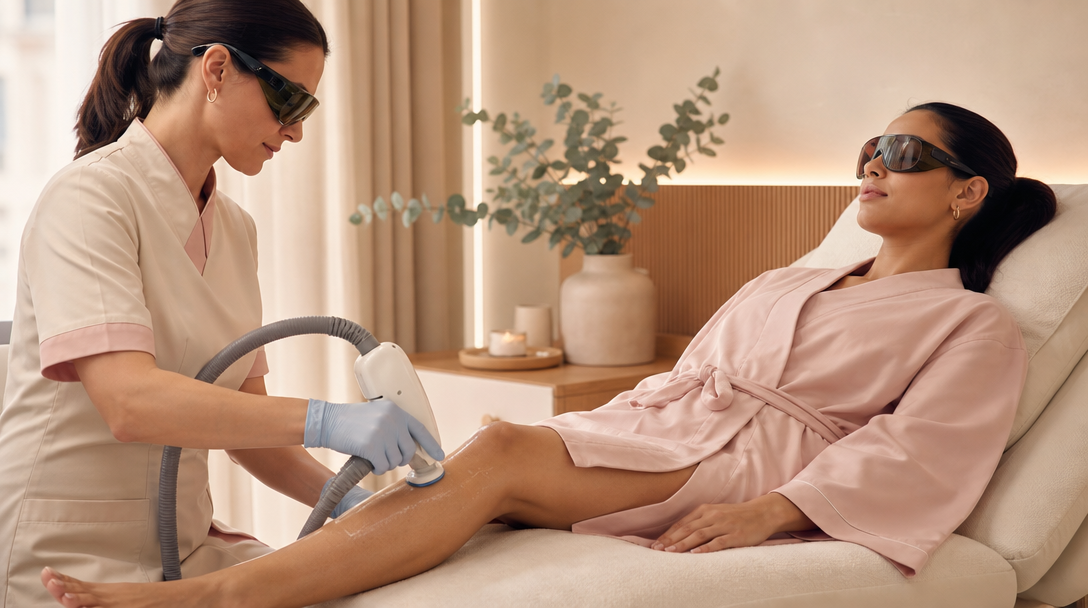
Does laser hair removal hurt? Laser hair removal pain by body area
Laser hair removal is uncomfortable, not painful, and the level depends almost entirely on the area. Here is our honest area-by-area rating, what the evidence says about cooling, and the one thing not to do before a session. Read the article -
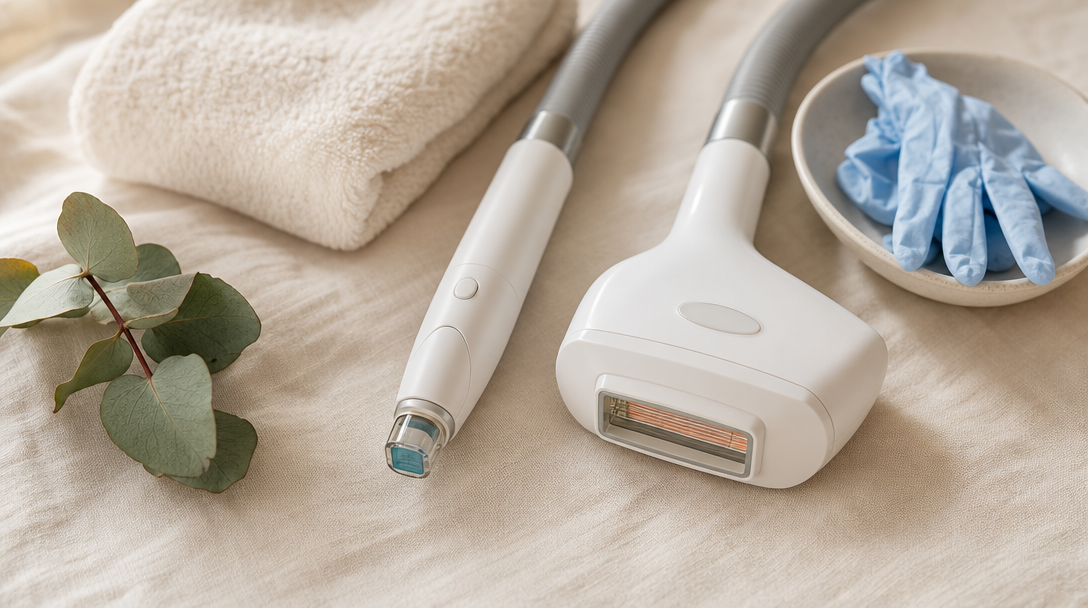
IPL vs laser hair removal: why the device you choose matters
The real difference between IPL and laser hair removal, why it changes your results and safety, and how CoLaz matches the right device to your skin and hair. Read the article -

Laser hair removal on the face: what women should know before booking
What women should know before booking facial laser hair removal: realistic session counts, the hormone link, matching the laser to your skin tone, and sun protection. Read the article
Book a free consultation at your nearest CoLaz clinic
Time with a qualified clinician: a skin assessment, an honest recommendation and a written plan. No obligation.