

Skin · 29 November 2025 · 8 min read
Hydrafacial Before or After Laser Hair Removal: How to Time It

By Alayika Parvez
Owner, CoLaz Aesthetics Clinic
The short version
- • You can pair a Hydrafacial with laser hair removal, but keep them on separate days so the skin is not exfoliated and heated at once.
- • A Hydrafacial first is the flexible option: leave about 48 hours before laser if the skin looks calm.
- • Laser first needs a longer rest, usually 7 to 10 days before a Hydrafacial on the same area, so the skin barrier can settle.
- • Same-day scheduling on the face is best avoided, as it stacks two forms of irritation and makes any reaction hard to trace.
- • At CoLaz we plan the order at your consultation based on your skin type, the area treated and how your skin reacts.
Planning a Hydrafacial around your laser hair removal course is a common request, and the good news is you can usually have both. The question of whether to book a Hydrafacial before or after laser hair removal comes down to one thing: giving the skin enough time between an exfoliating facial and the heat of the laser so it stays calm rather than sore.
In most cases a Hydrafacial can come first, with a short gap before your laser session. When laser comes first, the skin needs a longer rest before any exfoliating treatment. Below is the safe order, how long to leave between them, and the simple timelines we use across our clinics.
Can you have a Hydrafacial and laser hair removal together?
Yes, you can have both a Hydrafacial and laser hair removal, but not in the same appointment and not without a sensible gap between them. The two treatments do very different things to the skin, and stacking them too closely is what causes redness and irritation.
A Hydrafacial is a gentle facial. It cleanses, lightly exfoliates with mild acids, uses soft suction to clear pores, then infuses a hydrating serum. Laser hair removal is more intense: it uses a focused light that heats and disables the hair follicle, which the NHS confirms can leave the skin red and a little sore for a while afterwards.
The key points to hold in mind:
- A Hydrafacial is mild, so it rarely interferes with a future laser session.
- Laser hair removal is more intense, so recovery time between treatments matters more.
- Your clinician may adjust the timing based on your skin type and the area being treated.
Because a Hydrafacial is a face treatment, this timing question matters most when you are having laser on the face, chin or upper lip. If your laser is on your legs or underarms and your Hydrafacial is on your face, the two areas are separate and the scheduling is far more relaxed.
Should you book a Hydrafacial before or after laser hair removal?
Booking the Hydrafacial before laser hair removal is usually the more flexible order, because a calm, freshly cleansed skin tolerates the laser well and only needs a short gap. Laser first is the option that needs more patience.
The reasoning is straightforward. A Hydrafacial leaves the skin lightly exfoliated but hydrated and intact. Once any mild pinkness has faded, the skin can face the laser comfortably. Laser first is different: freshly treated skin is warm, slightly inflamed and should not be exfoliated or stimulated straight away.
For most people the safe default is:
- Hydrafacial, then laser: leave roughly 48 hours if there is no lingering redness.
- Laser, then Hydrafacial: leave 7 to 10 days, longer if the skin is sensitive.
This order also works neatly within a laser course. Many people use a Hydrafacial as a maintenance facial that slots into the middle of their laser plan, as long as the skin is settled when they return for the next laser session.
What happens when the Hydrafacial comes first?
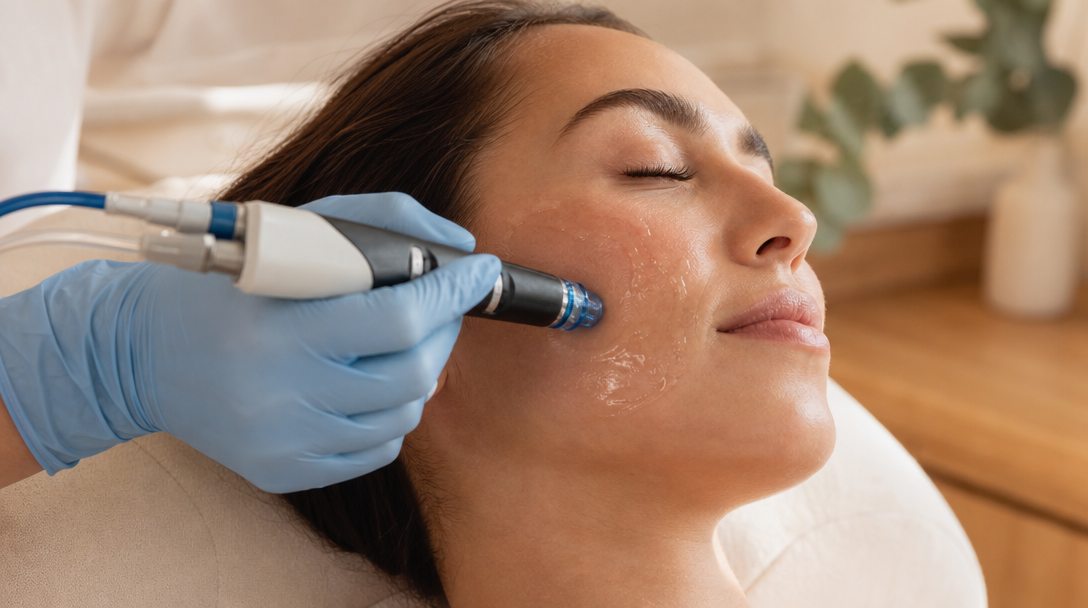
When the Hydrafacial is first, the skin ends up smooth, clean and hydrated, which many people find makes the laser session more comfortable. The treatment still needs a brief break before the heat of the laser, though.
The mild acids in a Hydrafacial do real work at the surface. Salicylic acid is fat-soluble and clears oil inside the pore, and a salicylic acid review describes it as keratolytic, meaning it loosens dead skin. That gentle turnover is helpful before laser, but it also means the very top layer is freshly renewed, so a short rest lets it normalise.
Most clinics recommend:
- A 48-hour gap if there is no redness or irritation after the facial.
- A longer wait if you had extra exfoliation, a stronger peel add-on or booster serums.
If your skin still looks flushed two days later, wait until it is fully calm. There is no benefit to rushing the laser onto skin that has not settled.
How long should you wait after laser hair removal before a Hydrafacial?
Wait at least 7 to 10 days after laser hair removal before having a Hydrafacial on the same area, and up to two weeks if your skin is sensitive or the settings were strong. Even when the surface looks fine, the skin underneath is still recovering.
Laser creates temporary heat and low-grade inflammation. The American Academy of Dermatology notes that redness and swelling after treatment often look like mild sunburn and usually last one to three days, but full barrier recovery runs beyond that visible phase. Adding exfoliation too early can undo that healing.
Clinics commonly advise:
- Waiting 7 to 10 days before a Hydrafacial on a lasered area.
- Allowing up to two weeks if the skin is sensitive or the laser was on a higher setting.
- Checking for any lingering redness first, as leftover irritation means you need more time.
NHS aftercare guidance backs this cautious approach. The Leeds Teaching Hospitals NHS Trust advises treating lasered skin delicately for the first few days and avoiding heat, saunas and friction for around a week, which is exactly the window in which an exfoliating facial would be too much.
Why is same-day scheduling not a good idea?
Same-day scheduling is best avoided because it combines exfoliation and laser heat on skin that has no time to recover between them, which raises the risk of irritation. It also makes any reaction much harder to trace back to a cause.
People understandably ask about doing both in one visit to save time, but most clinicians steer away from it, especially on the face. The problems stack up:
- The skin may be too sensitive to handle two treatments back to back.
- Heat from the laser combined with acid exfoliation increases the chance of a flare-up.
- If a reaction does appear, you cannot tell which treatment caused it.
On small areas, or where the skin shows no redness or peeling, a clinician might allow a short 24 to 48 hour gap rather than a full week. That is a judgement made in the room, not a rule to apply yourself. When in doubt, spacing the two treatments out is always the safer call.
Simple scheduling timelines you can follow
A clear plan makes this much easier to manage. These two patterns cover almost everyone, and you can repeat them through a laser course.
Option A: Hydrafacial, then laser
- Day 0: Hydrafacial.
- Day 2 or later: laser hair removal on the same area, as long as the skin is calm.
Option B: Laser, then Hydrafacial
- Day 0: laser hair removal.
- Day 7 to 10 or later: Hydrafacial once the skin feels settled and any irritation has gone.
If your Hydrafacial and your laser are on completely different areas, for example a facial while you have laser on your legs, you do not need to stagger them at all. The timing only matters when both treatments land on the same patch of skin.
The skin barrier science behind the wait

The waiting periods are not arbitrary. They map onto how long the outer skin layer, the stratum corneum, needs to rebuild after it has been exfoliated or heated.
Research on barrier recovery shows the skin repairs itself in stages. A study on barrier recovery after mechanical exfoliation found the outer layer reforms over roughly a day in ideal conditions, but human skin, and skin that has also been through laser, takes longer. A wider expert review explains that when the barrier is disrupted, water loss through the skin rises and the surface becomes more reactive until it recovers, which is why layering treatments too closely tends to sting and flake.
There is a payoff to getting the spacing right. A clinical study of clarifying Hydrafacial treatments in mild-to-moderate acne, also published on PMC, ran six sessions two weeks apart and saw the proportion of clear or almost-clear skin rise from 20 per cent to 65 per cent, with side effects staying mild throughout. A calm, well-spaced schedule is what lets a course like that work without irritating the skin.
How CoLaz plans laser and Hydrafacial together
Every patient at CoLaz starts with a short consultation, and this is where the order of your treatments gets decided rather than guessed. Your skin type, the area being treated and how your skin has reacted before all change the ideal gap.
If you want smoother, clearer skin and long-term hair reduction at the same time, we map both into a single plan. Usually that means a Hydrafacial either a couple of days before a laser session or comfortably after it has healed, and we build the laser hair removal course around your skin’s response rather than a fixed calendar. If your skin is on the sensitive side, we lean towards the longer waits.
UK aesthetics is governed through voluntary accreditation by JCCP and the Save Face register, both recognised by the Professional Standards Authority. Choosing a clinic where trained clinicians plan the sequence for you is the simplest way to get both treatments working together safely.
If you would like a plan for pairing the two, a free consultation at your nearest CoLaz clinic is included with no obligation. Bring a note of any recent treatments and your current skincare, and we will set out the right order and timing for your skin.
Ready to begin
Book a free Hydrafacial consultation at your nearest CoLaz clinic.
Thirty minutes with a qualified clinician. Skin assessment, candid recommendation, no obligation. Read about Hydrafacial at CoLaz, from £99 (Express, 30 minutes).
WhatsApp replies in minutes during opening hours
About the author
Alayika Parvez
Owner, CoLaz Aesthetics Clinic
Alaiyka Parvez bought the CoLaz franchise network in 2023, having joined the company as a Slough clinic employee in 2013 and gone on to open the Hounslow and Wembley franchises. She writes here on the treatments CoLaz delivers across its seven UK clinics.
Read more about Alaiyka and CoLaz →More on Skin
Keep reading.

11 August 2026 · 10 min
HIFU treatment results: month by month, what is realistic
HIFU tightens skin gradually rather than instantly. Here is the honest month-by-month results timeline, how long the effect lasts, and who is a good candidate.

28 July 2026 · 10 min
Types of chemical peels: glycolic, salicylic, TCA and Jessner explained
Glycolic for dull and sun-damaged skin, salicylic for oily and acne-prone, lactic for sensitive, mandelic for pigmentation in deeper skin tones, TCA for resurfacing with downtime. A clear decision guide to the main types of chemical peels.

14 July 2026 · 7 min
Microneedling aftercare day by day: the realistic 7-day timeline
What to expect after microneedling, day by day, plus the simple aftercare that protects your skin and your results across the first week.
Begin
Book a free consultation
at your nearest CoLaz clinic.
Thirty minutes with a qualified clinician. Skin assessment, candid recommendation, written plan. No obligation.