Skin imperfections
Skin tag removal at CoLaz clinics
Send a photo of your skin tag to your nearest CoLaz clinic on WhatsApp. A qualified clinician reviews it, confirms whether removal is suitable, and replies with a fixed price within one working day. Most patients clear a tag in a single in-clinic session using advanced electrolysis, a thermolysis current sent through a fine needle that cauterises the tag at its base.
Photo quote
Send us a photo on WhatsApp.
Snap the area you'd like assessed and send it to your nearest CoLaz clinic on WhatsApp. A qualified clinician reviews the photo, confirms whether the treatment is suitable, and replies with a price within one working day. No price guesswork, no wasted trip.
- Reply
- Within 1 working day
- Cost
- No charge to quote
- Privacy
- Photo stays with clinic
- Locations
- 7 UK clinics
Quote and go/no-go within 1 working day
Prefer to come in? Book a consultation →How the photo-quote works
Three steps, no surprises.
-
01
Send a photo
Tap the WhatsApp button above. Choose your nearest clinic. Attach a clear, well-lit photo of the area you'd like assessed and send it.
-
02
Get a quote
A qualified clinician reviews your photo, confirms whether the treatment is suitable, and replies with a price within one working day. If it isn't suitable, we tell you why and what to do next.
-
03
Book if happy
If the price works for you, book in for a short appointment. Most treatments are done in one session. No pressure, no commitment to book on the day.
Good for
Who books this treatment.
- Small benign skin tags on the neck, underarms, eyelids, chest or groin
- Tags that catch on clothing, jewellery or razors and bleed when knocked
- Clusters of tags in skin folds where rubbing has made them uncomfortable
- Cosmetic skin tags around the eye area where careful precision is essential
- Patients wanting a quick same-day in-clinic removal rather than ligation at home
- Tags that have stayed stable in colour, size and shape over many months
Aftercare
For the first forty-eight hours.
- Keep the treated area clean and dry for the first forty-eight hours
- Do not pick at the scab that forms over the treated site, let it fall away naturally
- Apply the antiseptic balm provided twice daily for seven to ten days
- Avoid saunas, steam rooms, swimming pools and intense exercise for forty-eight hours
- Apply SPF 50 to the treated area daily for at least four weeks once healed to reduce pigment change
What to expect
From your first consultation onwards.
-
01
Consultation with a clinician to confirm the lesion is a benign skin tag and not a mole or wart that needs different management
-
02
Photographs taken for the clinical record and pre and post treatment comparison
-
03
Area gently cleansed and a numbing cream applied if requested, especially around the eyes or neck
-
04
Advanced electrolysis applied: a thermolysis current sent through a fine needle cauterises the tag at its base in a few seconds; the procedure itself usually takes five to ten minutes per tag
-
05
Soothing barrier balm applied in clinic, with written aftercare confirmed before you leave
Skin tags are very common, very benign and very easy to remove in clinic with the right tools. At CoLaz, a qualified clinician reviews a photo of the area you’d like treated, confirms whether the lesion is a benign skin tag (and not something that needs a GP referral instead), and replies with a firm price within one working day. Most patients clear a single tag in one short in-clinic session using advanced electrolysis, a thermolysis current sent through a very fine needle that cauterises the tag at its base in seconds.
What a skin tag actually is
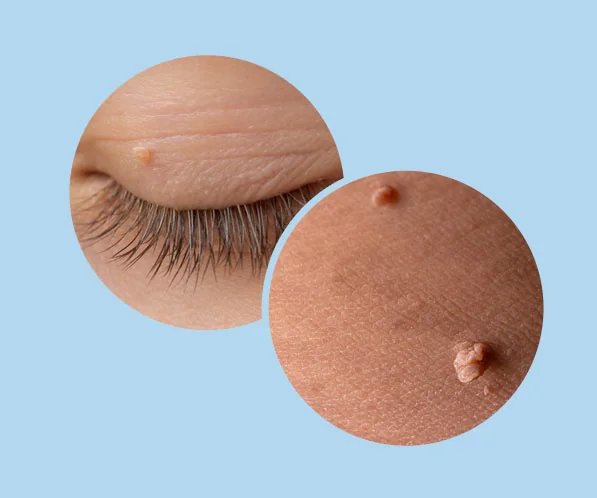
A skin tag, known clinically as an acrochordon, is a small soft growth attached to the skin by a thin stalk. They are entirely benign, do not turn into anything more serious, and are not contagious. Most appear in areas where skin rubs against skin or clothing, such as the neck, underarms, eyelids, under the breasts and in the groin.
They tend to become more common with age, with weight gain and during pregnancy. Most are painless until they catch on a necklace, a bra strap or a razor, at which point they can bleed or twist on the stalk and become tender. That is usually the moment patients ask about removal.
We only remove lesions confirmed as benign at consultation. Anything that has changed in colour, size or shape, or anything pigmented or unclear, is referred back to a GP for assessment before we proceed.
How removal works in clinic
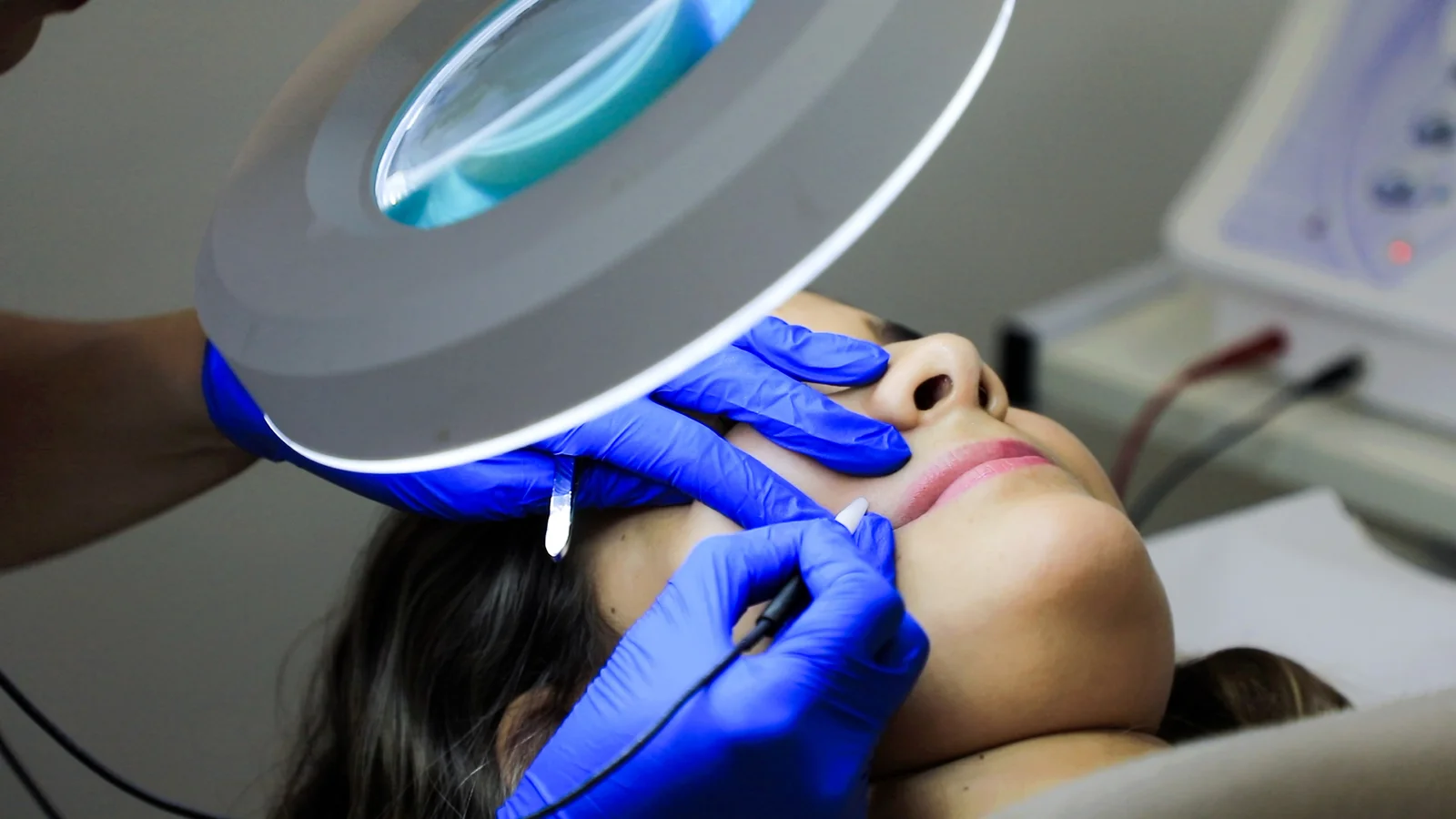
We use advanced electrolysis, the same method recommended for benign skin tags by experienced UK aesthetic practitioners. A thermolysis current is sent through a very fine needle that touches the base of the tag, cauterising it in a few seconds. The current stays at the needle tip so the surrounding skin is left calm and untouched.
The clinician first marks the tags to be treated. Each tag takes only a few seconds of active treatment; the procedure itself usually runs five to ten minutes, with the full appointment 15 to 30 minutes depending on the number and size of tags. Larger tags lift away on the same day; smaller ones dry and drop off within a few days. No stitches, no follow-up surgery, no downtime worth speaking of.
A topical numbing cream is available on request for sensitive areas or for patients having several tags treated in one visit. Most patients describe the sensation as a brief cold or warm pinch on each tag.
After your appointment
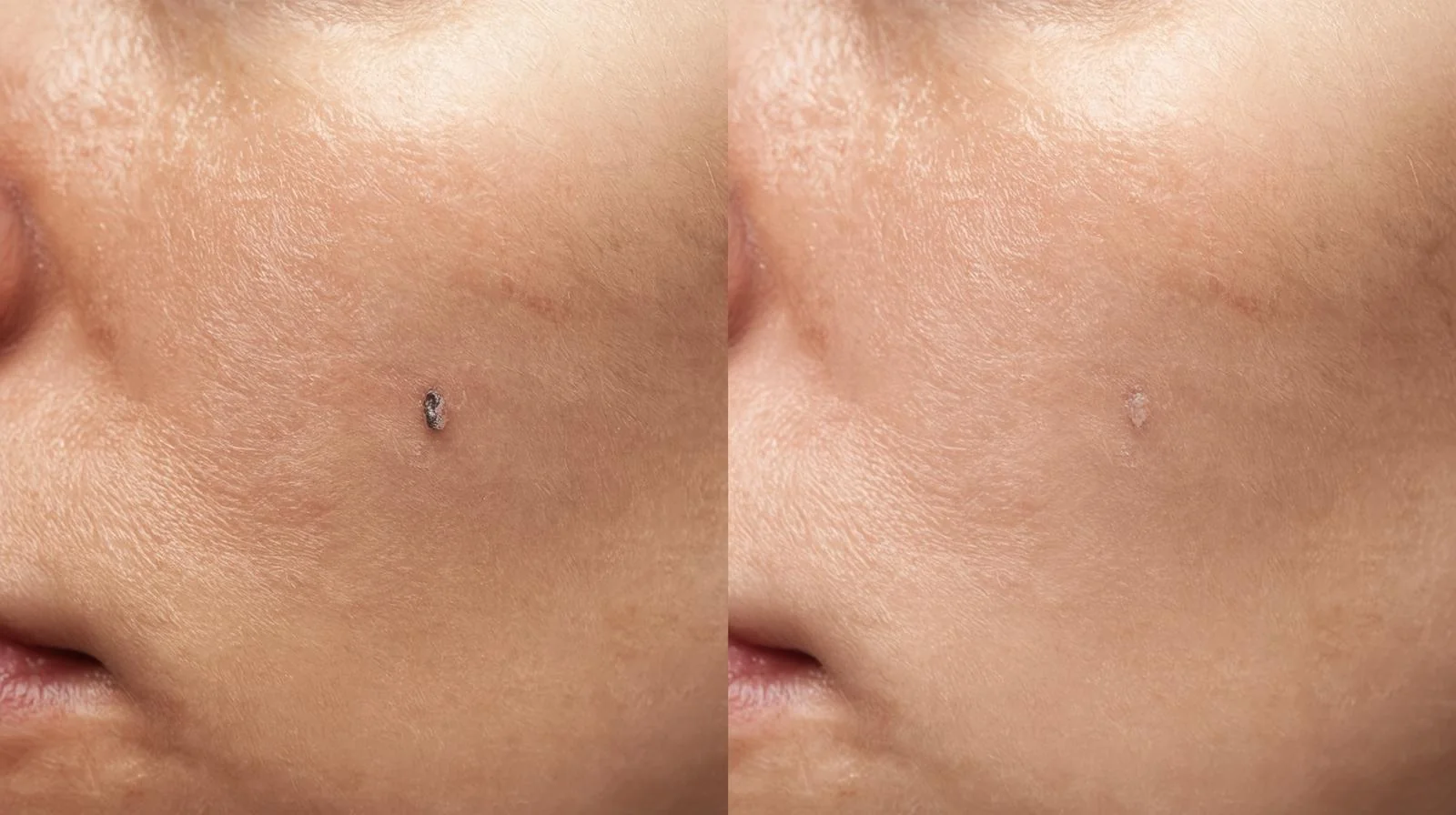
A small scab forms over the treated site within twenty-four hours. Keep the area clean and dry for the first forty-eight hours, apply the antiseptic balm we provide twice daily for seven to ten days, and let the scab fall away naturally rather than picking it. Picking is the single biggest cause of a longer healing time or a pigment mark.
Avoid saunas, steam rooms, swimming pools and intense exercise for forty-eight hours. Most patients return to normal activities, including work and gentle exercise, the same day.
Once the area has healed, usually by ten to fourteen days, apply SPF 50 to the treated spot every morning for at least four weeks. The new skin underneath is more photosensitive while it settles, and unprotected sun exposure during this window is the most common cause of a darker or lighter mark at the site.
Available across selected CoLaz clinics
Skin tag removal is delivered at our CoLaz Derby, Wembley, Slough, Reading, Southall and Hounslow clinics by qualified clinicians. Use the clinic finder to choose the location that suits your postcode and schedule, or send a WhatsApp message, most clinics reply within five minutes during opening hours.
Often considered alongside
Patients booking skin tag removal often consider mole removal when a benign mole has been cleared by their GP, milia removal for tiny white cysts around the eyes, seborrhoeic keratosis removal for waxy age-related growths, and age spot removal for brown sun-induced patches on the face and hands.
Common questions
What patients ask first.
What is a skin tag? +
A skin tag, or acrochordon, is a small soft benign growth that hangs from the skin by a thin stalk. They are very common, harmless and tend to appear in areas where skin rubs against skin or clothing, such as the neck, underarms, eyelids, under the breasts and in the groin. They are not contagious and do not turn into anything more serious. We only remove lesions confirmed as benign skin tags at consultation.
How does skin tag removal work at CoLaz? +
We use advanced electrolysis. A thermolysis current is sent through a very fine needle that touches the base of the tag, cauterising it in a few seconds. The procedure itself usually takes five to ten minutes per tag, with the full appointment running 15 to 30 minutes depending on size. Larger tags come away on the same day; smaller ones can dry and drop off within a few days. There are no stitches and the surrounding skin is left untouched.
How many sessions will I need? +
One session is usually enough for a single tag or a small cluster. Larger tags, very thick stalks or stubborn growths sometimes need a second top-up session four to six weeks later once the first treatment has healed. We confirm the likely number of sessions in your photo quote reply, so you know what to expect before you book.
Will it leave a scar? +
Scarring is rare with advanced electrolysis on small skin tags in trained hands because the thermolysis current is delivered through a very fine needle directly at the base of the tag, so the heat stays at the lesion rather than spreading to surrounding skin. A small pink or pale mark can stay for several weeks while the skin remodels and usually fades by three months. Patients with a personal or family history of keloid scarring should mention this at consultation so we can adjust the plan or decline treatment.
When should I see a GP first instead of booking removal? +
Book a GP appointment first if the growth has changed in colour, size or shape, if it bleeds without being knocked, if it is dark brown, black or multicoloured, if it itches persistently, or if you are unsure whether it is a tag or a mole. We only remove lesions confirmed as benign skin tags at consultation, and we will refer you back to your GP for assessment if anything about the lesion is uncertain. Pigmented or changing lesions should never be cosmetically removed without dermatology assessment first.
What is the aftercare? +
Keep the treated area clean and dry for forty-eight hours, apply the antiseptic balm we provide twice daily for seven to ten days, and let the small scab that forms fall away naturally rather than picking it. Avoid saunas, steam rooms, swimming pools and intense exercise for forty-eight hours. Once the area has healed, apply SPF 50 daily for at least four weeks to reduce the risk of a darker or lighter mark at the treated site.
How much does skin tag removal cost at CoLaz? +
Skin tag removal is priced per tag, and the price depends on the size, location and number of tags. A single small tag is at the lower end of the range; clusters or larger tags scale up. We do not publish a fixed price because the variation between cases is genuinely large and we would rather quote you accurately than under-quote and renegotiate at the till. Send a photo on WhatsApp and we reply with a firm price for your specific case within one working day, with no obligation to book.
How do I send a photo for a quote? +
Tap the Send a photo on WhatsApp button at the top of this page. Choose your nearest CoLaz clinic. WhatsApp opens with a pre-filled message; attach a clear, well-lit photo of the area you'd like assessed and send. We may ask one or two follow-up questions (how long it has been there, whether it has changed, whether it bleeds when knocked) so we can quote you accurately.
What if my photo shows something that isn't a skin tag? +
If the photo shows something that looks like a mole, a wart, a cyst or a lesion that has changed in colour or shape, the clinician will tell you, decline to quote, and recommend you see your GP first. We treat benign skin tags only. Pigmented or changing lesions need dermatology assessment before any cosmetic removal, and we will not bypass that for any patient.
What causes skin tags, and can I remove one myself? +
Skin tags are small, soft, harmless growths that tend to form where skin rubs against skin or clothing, such as the neck, underarms, eyelids and groin. They are more common with age, during pregnancy, in people carrying extra weight and in those with diabetes, and there is often a genetic tendency. We do not recommend removing a skin tag yourself with home kits, creams or by tying it off, because of the risk of bleeding, infection, scarring and, importantly, removing something that was never a simple skin tag. A quick clinical assessment confirms what it is and removes it safely.
Still deciding
WhatsApp your nearest clinic. Reply within five minutes.
Often considered alongside
Related treatments.
First to consider
Mole Removal
Send a photo of your mole to your nearest CoLaz clinic on WhatsApp.
Skin imperfections
Skin imperfections
Milia Removal
Send a photo of your milia to your nearest CoLaz clinic on WhatsApp.
Skin imperfections
Seborrhoeic Keratosis (Wart) Removal
Send a photo of your seborrhoeic keratosis (SK wart) to your nearest CoLaz clinic on WhatsApp.
Skin imperfections
Age Spot Removal
Send a photo of your age spots to your nearest CoLaz clinic on WhatsApp.
Begin
Book a free consultation,
without obligation.
Tell us what you would like to change. Your clinician will recommend a plan, confirm the price in writing, and leave the booking to you.
Book a free consultation →