Injectables
Anti-wrinkle injections at CoLaz clinics
Anti-wrinkle injections at CoLaz soften the dynamic lines that form on the forehead, between the brows and around the eyes by relaxing the small muscles that pull the skin into those creases. From £199 for one area with a qualified clinician, across our UK clinics, with a free consultation and a two-week review built into every plan.
From
£199 per session
one area, qualified therapist tier.
- Session time
- ~20 min
- Downtime
- Minimal
- Consultation
- Free
- Locations
- 7 UK clinics
Reply typically within 5 minutes
Or book by email form →Good for
Who books this treatment.
- Horizontal forehead lines that deepen when you raise your brows
- Frown lines, the 'elevens', between the eyebrows when you concentrate
- Crow's feet around the eyes when you smile or squint
- A heavy or downturned brow that needs a subtle lift
- Bunny lines that appear on the bridge of the nose when you smile
- Patients in their late twenties or thirties starting preventative treatment before lines become static
Aftercare
For the first forty-eight hours.
- Stay upright for four hours after treatment, no lying down or face-down massages
- Avoid touching, rubbing or massaging the treated areas for the rest of the day
- Skip saunas, steam rooms, intense workouts and alcohol for twenty-four hours
- Animate the treated areas gently for two hours by frowning and raising the brows to help product settle
- Drink plenty of water and pat the face dry with a soft towel for the first forty-eight hours
What to expect
From your first consultation onwards.
-
01
Free consultation to review facial movement, photograph the resting and animated face, and agree the dose and areas
-
02
Skin cleansed with a chlorhexidine solution to minimise infection risk before any injection
-
03
Several small injections per area using a fine needle, each one feeling like a quick pinch
-
04
Aftercare instructions reviewed in clinic and confirmed in writing before you leave
-
05
Two-week review with photographs to assess the result and top up if needed
Anti-wrinkle injections are one of the most common aesthetic treatments in the UK, which means a wide range of providers offer them and the quality varies more than patients realise. At CoLaz, every dose is drawn and delivered by a qualified clinician, the consultation comes before the syringe every time, and pricing starts at £199 for a single area without any compromise on the product, the protocol or the review.
How anti-wrinkle injections work
The active ingredient is a purified form of botulinum toxin type A. Injected in small doses into specific muscles of facial expression, it temporarily blocks the signal from the nerve to the muscle, so the muscle relaxes. When the muscle relaxes, the skin above it stops folding into the dynamic lines that the muscle would otherwise create.
The effect is targeted. Inject the muscle that pulls the brows together and the frown lines soften; the rest of the face moves normally. Inject the muscle that pulls the corner of the eye down on a smile and the crow's feet relax; you can still smile and look happy.
Dynamic lines, the kind that appear when you make an expression, respond first. Static lines that are already visible at rest soften gradually over the following weeks because the skin above the resting muscle is no longer being folded eight hundred times a day. Very deep static lines may also benefit from a skin-quality treatment such as Profhilo or microneedling alongside the injections.
What a CoLaz appointment looks like
Every anti-wrinkle injection at CoLaz is given by a qualified clinician who holds the medical qualifications the procedure legally requires. Botulinum toxin type A is a prescription-only medicine in the UK, and we hold to that standard without exception. We do not allow salon-trained therapists to deliver injectables, and we use an Allergan-manufactured formulation that is one of the most clinically researched on the market.
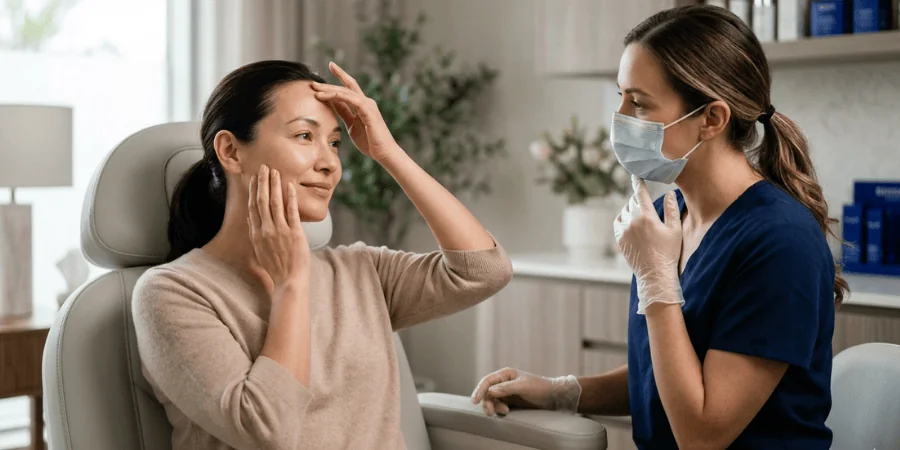
The consultation comes first. The clinician will look at your face at rest, ask you to raise your brows, frown, smile and squint, then photograph each expression. From those photographs they identify which muscles to treat and at what dose, and they walk you through the plan, the cost and the realistic outcome before any product is drawn up.
We dose conservatively at the first session. It is much easier to add a small top-up at the two-week review than to wait out an over-treated muscle, and the conservative approach is also why patients keep coming back. The first session for a single area takes around twenty minutes from greeting to goodbye.


After your treatment
There is no downtime. You can return to work straight after the appointment. The only restrictions are practical: stay upright for four hours so the product stays where it was placed, avoid touching or rubbing the treated areas for the rest of the day, and skip saunas, steam rooms, intense workouts and alcohol for twenty-four hours.
Small raised bumps stay at each injection point for about an hour, then settle. Mild bruising on one or two points is possible and fades over two to three days, easily covered with light concealer the next morning. A small number of patients notice a brief headache on the day of treatment, which usually clears within a few hours.
The first softening shows at two to five days, the full effect at two weeks. We book a two-week review with photographs so you can see the before-and-after side by side, and so we can add a small top-up to any muscle that has stayed more active than expected. Most patients return at twelve to sixteen weeks for their next session.
Available across selected CoLaz clinics
Anti-wrinkle injections is delivered at our CoLaz Derby, Wembley, Slough, Reading, Southall and Hounslow clinics by qualified clinicians. Use the clinic finder to choose the location that suits your postcode and schedule, or send a WhatsApp message, most clinics reply within five minutes during opening hours.
Often considered alongside
Patients booking anti-wrinkle injections often consider dermal fillers for volume restoration in the cheeks, tear trough or jawline, Profhilo to address overall skin laxity and bio-remodel the tissue, microneedling to improve static lines through collagen induction, and a PDO thread lift when a more lifted look is the goal.
Common questions
What patients ask first.
What are anti-wrinkle injections and which areas can be treated? +
Anti-wrinkle injections use a purified form of botulinum toxin type A to relax the muscles responsible for dynamic facial lines, the lines that appear when you raise your brows, frown or smile. The most commonly treated areas are the horizontal lines across the forehead, the frown lines between the brows often called the elevens, and the crow's feet around the eyes. Less common but still routine areas include a subtle brow lift, bunny lines on the bridge of the nose, a gummy smile, downturned corners of the mouth, smoker's lines, a dimpled chin and masseter slimming for a softer jawline. We confirm which areas to treat at your free consultation, and we never treat areas you have not specifically agreed to.
When will I see results and how long do anti-wrinkle injections last? +
The first signs of softening appear at around two to five days after treatment, with the full effect visible at two weeks. We book a two-week review with photographs to assess the result and add a small top-up if any muscle is still active. The full effect typically lasts three to four months for first-time patients, and four to six months for patients on a regular maintenance schedule because the muscles slowly retrain over time. We never recommend a faster booking cadence than every twelve weeks because there is no clinical benefit and a small risk of resistance building up.
Do anti-wrinkle injections hurt? +
The needle used is very fine and most patients describe the sensation as a quick pinch or a sharp prick that lasts about half a second per injection point. The forehead and brow are the most comfortable areas; the crow's feet area is slightly more sensitive because the skin is thinner. We can apply a topical anaesthetic cream on request, though most patients do not need it. There is no recovery pain afterwards, only a brief stinging sensation at the moment of injection that fades immediately.
Will anti-wrinkle injections make my face look frozen or expressionless? +
Done well, no. A frozen look is the result of too much product, treatment given without an understanding of facial anatomy, or a patient asking for an erased look rather than a softened one. At CoLaz our clinicians dose conservatively at the first session, see how your muscles respond at the two-week review, and only build up from there. The goal is for your friends to comment that you look rested or fresh, not to wonder what you have had done. If you have had a frozen result elsewhere, tell your clinician at consultation and we will plan around that experience.
What side effects should I expect after anti-wrinkle injections? +
Typical short-term effects include small raised bumps at the injection points that settle within an hour, mild redness at each point for a few hours, occasional mild bruising on one or two points that fades over two to three days, and a light headache on the day of treatment for a small number of patients. Less common effects include a temporary heavy or droopy feeling in the brow if a muscle responds more than expected, which fully resolves as the product wears off. Anything more significant is rare and is reviewed in detail at consultation before treatment is agreed.
Who should not have anti-wrinkle injections? +
We do not treat patients who are pregnant or breastfeeding, who have a known hypersensitivity to botulinum toxin or to any of the formulation ingredients, who have an active skin infection at the planned injection site, or who have certain neuromuscular conditions such as myasthenia gravis or Lambert-Eaton syndrome. Patients on aminoglycoside antibiotics or on blood-thinning medication need a specific discussion at consultation. We always review medical history in detail before agreeing to proceed, and we will decline treatment if it is not safe for you.
How much do anti-wrinkle injections cost at CoLaz? +
One area with a qualified therapist starts at £199, two areas at £250, three areas at £350, with additional units priced per unit if a stronger dose is clinically agreed. Treatment by one of our doctors is available at a slightly higher rate, with one area at £250, two at £360 and three at £470. Specialist protocols such as masseter slimming, hyperhidrosis for underarm sweating, and chronic migraine treatment are priced separately and confirmed in writing at consultation. There are no upsells in the chair and no hidden charges, and the consultation fee is redeemable against any treatment you book.
What is the aftercare for anti-wrinkle injections? +
For the first four hours, stay upright and avoid lying down, rubbing or massaging the treated area, so the product settles where it was placed. For the first twenty-four hours, skip strenuous exercise, saunas, steam rooms, hot baths and alcohol, as heat and raised blood flow can increase bruising. Avoid facials, facial massage and other skin treatments for around two weeks. Gentle movement of the treated muscles in the first hour is fine. Mild redness or small bumps usually settle within an hour, and we give you written aftercare before you leave.
Are anti-wrinkle injections safe? +
Anti-wrinkle injections have been used in aesthetics for decades and have a strong safety record when given by a qualified medical professional. At CoLaz they are administered only by trained clinicians who assess your medical history and facial anatomy first. Temporary effects such as small bruises, mild swelling or a slight headache can occur and settle quickly. Serious problems are rare and are far less likely in trained hands using genuine, regulated product. We talk through the risks and what to expect at your free consultation so you can decide with confidence.
Can anti-wrinkle injections treat the under-eye area? +
In some cases, yes. A small dose can soften fine crinkling under the eyes or a pronounced muscle roll when you smile, but it is used carefully because the area is delicate. Under-eye hollows and dark shadows are usually better treated with other options such as dermal fillers or skin boosters rather than anti-wrinkle injections. The right choice depends on what is causing the concern, which is exactly what your clinician assesses at consultation before recommending a treatment.
Still deciding
WhatsApp your nearest clinic. Reply within five minutes.
Where to book
Available at all seven UK clinics.
Start here
Derby
DE23 6PZ · 07533 030599
Visit clinic page
Wembley
HA9 8AF
Paddington
W2 1JQ
Slough
SL1 4XP
Reading
RG30 1AD
Southall
UB1 1NF
Hounslow
TW5 0BY
From the CoLaz blog
Related reading.
10 min read
Non-surgical rhinoplasty: what nose filler can and cannot change
Nose filler adds volume, it never removes it. What a non-surgical rhinoplasty can realistically change, what it cannot, why the nose is the highest-risk area on the face for filler, and how to check a clinic before you book.
10 min read
Lip filler styles: what Russian lips vs natural actually look like
The two lip filler styles patients ask for most, side by side: what the Russian lip technique actually does, what a natural result looks like, and how to tell if lips have been overfilled.
8 min read
JCCP, Save Face and CQC: what each register actually checks
Three names come up when you try to check an aesthetic clinic, and they do three different jobs. A plain-English guide to what JCCP, Save Face and CQC each look at, what they leave out, and how to run the checks yourself.
9 min read
How much do dermal fillers cost in the UK? An honest 2026 price guide
Filler pricing in the UK swings from £150 to £600 per ml, and the gap is not random. Here is what you are actually paying for, which quotes should make you walk away, and how to price-check a clinic properly.
9 min read
The 5 most common anti-wrinkle injection areas, explained
The forehead, the frown lines between the brows, crow's feet, bunny lines and the masseter. Here is what anti-wrinkle injections do in each area, the typical dose, and how a clinician balances them so your face still moves.
8 min read
10 aesthetic clinic red flags: when to walk out of the consultation
Non-surgical treatments are still largely unregulated in England. These are the ten warning signs worth knowing before you book, and the ones that should make you leave.
Often considered alongside
Related treatments.
First to consider
Dermal Fillers
Dermal fillers at CoLaz restore lost volume, redefine contours and rebalance proportion using hyaluronic acid, the same sugar molecule the skin produces naturally.
Injectables
Injectables
Profhilo
Profhilo at CoLaz is an injectable hyaluronic acid treatment that hydrates and bio-remodels the skin from within, improving firmness, tone and elasticity rather than adding volume.
Skin rejuvenation
Microneedling
Microneedling at CoLaz is a collagen-induction treatment that uses a Dermapen device to create thousands of microscopic channels in the skin, triggering the body to lay down new collagen and elastin in response.
Injectables
PDO Thread Lift
PDO thread lift at CoLaz is a non-surgical face lift that uses dissolvable polydioxanone threads, inserted under the skin to lift sagging tissue and stimulate the body's own collagen production.
Begin
Book a free consultation,
without obligation.
Tell us what you would like to change. Your clinician will recommend a plan, confirm the price in writing, and leave the booking to you.
Book a free consultation →