
The 5 most common anti-wrinkle injection areas, explained
 Owner, CoLaz Aesthetics Clinic
The short version
- The five most requested anti-wrinkle injection areas are the forehead, the frown lines between the brows (glabella), crow's feet, bunny lines on the nose and the masseter muscle at the jaw.
- The upper three areas are treated as one unit, because relaxing the frown muscles without balancing the forehead is what causes a heavy brow or a tense, over-lifted look.
- Masseter treatment is different: it slims a square jawline and eases teeth grinding, and it builds gradually over several weeks rather than days.
- Upper-face results usually appear within a few days, settle at about two weeks and last three to four months.
- Botulinum toxin is a prescription-only medicine in the UK, so a prescriber must assess you in person before any dose is agreed.
TL;DR
- The five most requested anti-wrinkle injection areas are the forehead, the frown lines between the brows (glabella), crow’s feet, bunny lines on the nose and the masseter muscle at the jaw.
- The upper three areas are treated as one unit, because relaxing the frown muscles without balancing the forehead is what causes a heavy brow or a tense, over-lifted look.
- Masseter treatment is different: it slims a square jawline and eases teeth grinding, and it builds gradually over several weeks rather than days.
- Upper-face results usually appear within a few days, settle at about two weeks and last three to four months.
- Botulinum toxin is a prescription-only medicine in the UK, so a prescriber must assess you in person before any dose is agreed.
When people talk about anti-wrinkle injections, they usually have one line in mind: the frown, the forehead creases, or the crinkles at the corner of the eye. In practice there are five anti-wrinkle injection areas that make up almost every treatment we plan, and the skill is rarely in any single one. It is in how they work together.
This guide walks through each of the five, what the injection actually does to the muscle underneath, the typical dose range from the evidence, and how a clinician keeps the result looking like you. If you want the dose detail on its own, our companion guide on how many units goes deeper on that.
One thing to say first. In the UK, botulinum toxin is a prescription-only medicine, so under advertising rules set by the Committee of Advertising Practice, we cannot promote it by brand name. This article talks about anti-wrinkle injections and botulinum toxin type A generically, not any particular product.
What are the most common anti-wrinkle injection areas?
The five most common anti-wrinkle injection areas are the forehead, the frown lines between the brows (the glabella), crow’s feet, bunny lines on the nose, and the masseter muscle at the angle of the jaw.
The first four are all about softening lines caused by muscle movement in the upper and mid face. The fifth, the masseter, is a bit different: it is a chewing muscle, and treating it changes the shape of the lower face and eases jaw tension rather than smoothing a wrinkle. That is why we plan it separately.
Across the evidence, dosing is described by muscle and by injection point rather than by a single flat number. A widely cited dosing review sets out standard ranges for each upper-face area, and expert consensus recommendations describe where the injections sit. The ranges below come from that literature. Your own plan is confirmed in person, not from a chart.
How do anti-wrinkle injections treat forehead lines?
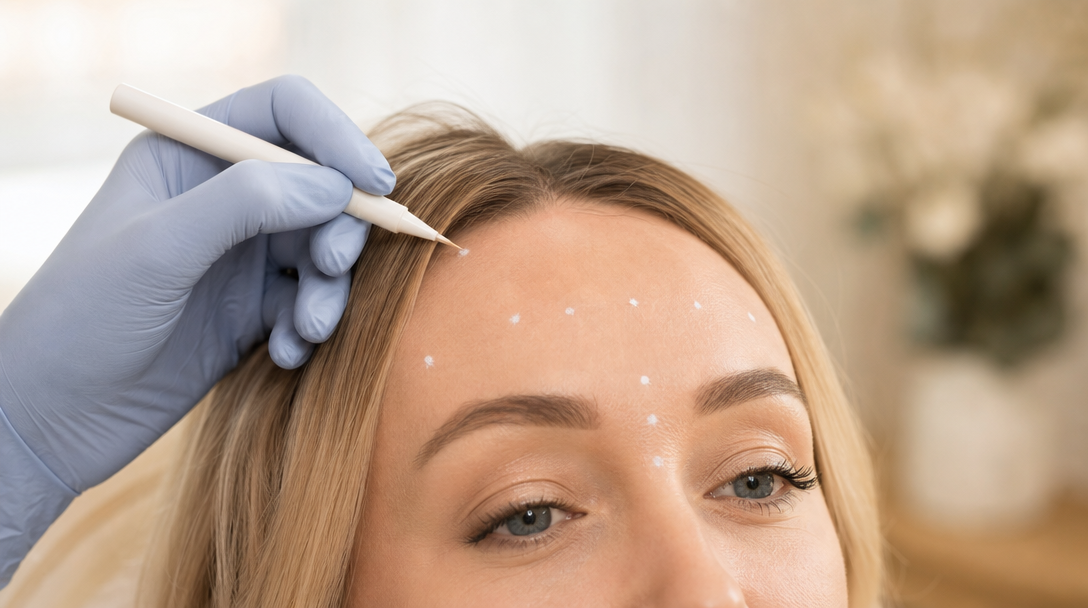
Anti-wrinkle injections soften forehead lines by relaxing the frontalis, the broad flat muscle that lifts your eyebrows and, in doing so, creases the skin into horizontal lines.
The typical dose across the forehead is modest, often in the region of 8 to 25 units placed across several points, according to the dosing review. The reason the range is wide is that the frontalis does an important job: it holds your brow up. Over-treat it and the brow can feel heavy or drop, which is the effect most first-time patients are quietly worried about.
The forehead is never dosed in isolation. It is balanced against the frown muscles below it. If we relax the frown strongly but leave the forehead untouched, the brow can be pushed into a tense, over-arched look. Getting the two to sit comfortably together is the whole point, and it is why an honest clinician will assess your entire upper face before quoting a forehead-only plan.
What about the frown lines between the eyebrows?
The frown lines between the eyebrows, known as the glabella or the ”11s”, are treated by relaxing the procerus and corrugator muscles that pull your brows together when you concentrate or squint.
This is the most studied area in injectable aesthetics, and the dosing review describes a range of roughly 12 to 40 units spread across three to seven points. Most women sit around the lower half of that range; men usually need more, because the procerus and corrugator muscles are larger and stronger. We assess this by asking you to frown hard while we watch and feel how the muscle behaves, rather than assuming a number.
The glabella responds well because the lines here are almost entirely movement-driven. Soften the pull, and the skin between the brows has less reason to fold. Deeper lines that are already etched at rest improve more slowly, and sometimes need skin-quality support alongside, which is a conversation for the consultation rather than a promise.
Do anti-wrinkle injections work on crow’s feet?
Yes. Crow’s feet, the fan of lines at the outer corner of each eye when you smile, are one of the most reliable areas to treat, and they respond to a small dose.
The muscle here is the orbicularis oculi, which is thin and sits just under the skin. The dosing review describes around 6 to 15 units per side across two to five points. Because the muscle is superficial and the dose is light, the result comes on quickly and the risk of affecting how the eye opens or closes is low when the injector keeps to the standard points.
Duration here is dependable too. A pair of controlled crow’s feet trials found the effect lasted at least four months for most people. The main variable is how animated your smile is: a bigger smile creates deeper lines and often needs the upper end of the range.
What are bunny lines, and can they be treated?
Bunny lines are the small diagonal wrinkles that appear on the sides of the nose when you scrunch it, and yes, they can be softened with a very small, carefully placed dose.
They come from the nasalis muscle across the upper nose. This is a precision area. A recent bunny lines study recommends tiny amounts, in the region of 1 to 2 units per point along the muscle border, specifically because too much product, or placement that is too low or too wide, can spread to the muscles that lift the lip and create an uneven smile. It is a good example of an area where more is not better.
Bunny lines are often treated at the same visit as the frown and forehead, as a finishing touch rather than a headline treatment. Many patients only notice them once the areas around them are softened, which is another reason we look at the whole upper third of the face together.
The masseter: jaw slimming and easing teeth grinding
People choose masseter injections for two reasons: to soften a strong, square jawline, and to ease the jaw tension and teeth grinding of bruxism. It is the one area on this list that changes shape rather than smooths a line.
The masseter is a powerful chewing muscle. Relaxing part of it reduces its bulk over time, which slims the lower face, and it lowers the clenching force that wears teeth and aches the jaw. In a clinical masseter study, patients given around 10 units per side saw masseter thickness fall from about 13.4 mm to 10.2 mm, bite force drop, and pain scores improve steadily across 12 weeks. A separate study on facial volume reduction confirmed a measurable slimming effect on the lower face.
Two honest points. The masseter builds slowly: you will not see the jaw change in a few days the way you might notice a softer frown. And because it is a functional muscle, dosing and placement need care, so this is not an area to rush or to treat lightly. If jaw slimming is your goal, the jawline and double chin route is worth discussing at consultation, because it is not always the right first step.
How long do anti-wrinkle injections take to work, and how long do they last?
Upper-face anti-wrinkle injections usually begin to work within a few days, reach their full effect at around two weeks, and last three to four months before the muscle gradually returns.
The duration of the effect depends on the dose, the muscle treated and how strong that muscle is, which is why the frown can outlast a lighter forehead dose in the same person. The masseter, being large, often holds its result longer, but it also takes longer to show. This is why we book a two-week review as standard, so we can see how the treatment settled before deciding on any small top-up.
We never present the result as lasting for good. Anti-wrinkle injections are a repeatable treatment, and knowing the three-to-four-month rhythm up front is what stops the disappointment of expecting a result to simply stay.

Balancing the areas so your face still moves
An experienced clinician balances the areas by treating the upper face as a single unit and dosing for movement, not for a frozen result. The goal is a face that still moves, minus the deep lines.
In my experience, most patients who ask for “the maximum” do not actually want a frozen face. I remember a first-time patient at our Wembley clinic who asked for exactly that, having copied a look from social media. We spent a longer consultation than usual talking through what a natural result looks like: softening the frown and forehead to a moderate dose while keeping controlled movement. She booked one area, came back at her two-week review still able to raise her eyebrows, and has stayed on a sensible three-to-four-month cycle since.
The lesson I pass to every clinician we train is that more units is not the same as a better result. The result is the patient looking like herself, refreshed. That is a skill question, not a unit-count question, and it is why we assess the whole upper face before we plan any single area.
Is it safe, and who can inject anti-wrinkle injections in the UK?
Anti-wrinkle injections are safe when they are prescribed and delivered properly, which in the UK means a registered prescriber assesses you in person before any toxin is drawn up, using a licensed product.
That last part matters more than most patients realise. In 2025, a cluster of iatrogenic botulism cases in North East England was linked to cosmetic injections, with the investigation pointing to unlicensed product and practitioners working below basic safety standards. It is a stark reminder that the risk is rarely the treatment itself; it is who is holding the needle and what is in the vial.
The safeguards are straightforward to check. Look for a practitioner listed on an accredited register such as the JCCP or Save Face, both recognised by the Professional Standards Authority. Regulation is also tightening: the Government’s licensing scheme for England will bring in tighter oversight of who can deliver these treatments and how.
How CoLaz plans your anti-wrinkle injection treatment
Every anti-wrinkle injection patient at CoLaz starts the same way: a free consultation with the prescribing clinician, an assessment of your muscle strength and the areas that concern you, and a written plan that sets out the proposed dose for each area before anything is prescribed.
If it is your first treatment, we usually start at the lower end of the range for each area. It is easier to add a small top-up at your two-week review than to wait out a heavy dose. If your main concern is skin quality rather than movement lines, we will talk about Profhilo or skin-boosting options instead, because anti-wrinkle injections soften expression but do not change the texture of the skin.
To see what your own plan across these five areas would look like, book a free consultation at your nearest CoLaz clinic. The assessment is free, the plan is written down before anything is prescribed, and we will not inject on day one unless the prescriber has confirmed the dose with you.
Ready to begin
Book a free Anti-Wrinkle Injections consultation at your nearest CoLaz clinic
Time with a qualified clinician: a skin assessment, an honest recommendation and no obligation. Read about Anti-Wrinkle Injections at CoLaz, from £199 (one area, qualified therapist tier).
More on Injectables
Keep reading
-

Non-surgical rhinoplasty: what nose filler can and cannot change
Nose filler adds volume, it never removes it. What a non-surgical rhinoplasty can realistically change, what it cannot, why the nose is the highest-risk area on the face for filler, and how to check a clinic before you book. Read the article -

Lip filler styles: what Russian lips vs natural actually look like
The two lip filler styles patients ask for most, side by side: what the Russian lip technique actually does, what a natural result looks like, and how to tell if lips have been overfilled. Read the article -

Lip filler aftercare: what to do and avoid in the first 48 hours
A clinical, honest guide to lip filler aftercare in the first 48 hours: managing swelling and bruising, what to avoid, the day-by-day timeline, and when to call your clinic. Read the article
Book a free consultation at your nearest CoLaz clinic
Time with a qualified clinician: a skin assessment, an honest recommendation and a written plan. No obligation.