

Aesthetics · 11 December 2025 · 9 min read
Names and maps of wrinkles on the face: 14 areas explained

By Alayika Parvez
Owner, CoLaz Aesthetics Clinic
The short version
- • Facial wrinkles split into two groups: dynamic lines that show during expression, and static lines that stay visible when your face is at rest.
- • Each named line links to a specific muscle or to volume loss, so the forehead, brows, eyes, nose, cheeks, mouth and chin all age in their own pattern.
- • Dynamic lines respond best to muscle-relaxing anti-wrinkle injections, while static lines and folds usually need volume support or collagen-building treatments.
- • Sun exposure drives a large share of facial lines, so daily sun protection is the single most useful prevention step.
- • At CoLaz, a clinician maps your lines at a free consultation and matches each area to the right treatment rather than treating the whole face the same way.
TL;DR
- Facial wrinkles split into two groups: dynamic lines that show during expression, and static lines that stay visible when your face is at rest.
- Each named line links to a specific muscle or to volume loss, so the forehead, brows, eyes, nose, cheeks, mouth and chin all age in their own pattern.
- Dynamic lines respond best to muscle-relaxing anti-wrinkle injections, while static lines and folds usually need volume support or collagen-building treatments.
- Sun exposure drives a large share of facial lines, so daily sun protection is the single most useful prevention step.
- At CoLaz, a clinician maps your lines at a free consultation and matches each area to the right treatment rather than treating the whole face the same way.
Most people notice their first fine lines long before they expect to, and those lines can seem random. They are not. Each wrinkle forms in a predictable place, links to a specific muscle or to natural volume loss, and has a name. The names and maps of wrinkles on the face describe where lines appear, why they form, and which treatments soften them best.
This guide walks through 14 areas across the upper, middle and lower face, explains what each line is called, and sets out the treatment options at CoLaz that suit each one. By the end you will have a clear facial wrinkle map and a sense of what actually helps.
What are the two main types of facial wrinkles?
Facial wrinkles fall into two groups: dynamic wrinkles, which appear when you make an expression, and static wrinkles, which stay visible even when your face is resting. Knowing which type you have is the single most useful thing before choosing a treatment.
Dynamic lines come from repeated muscle movement. Every time you frown, smile or raise your brows, the muscle underneath folds the skin above it. Static lines are what those creases become over time. As the skin’s collagen thins with age and sun exposure, and as elastic fibres break down, the temporary crease sets into a line you can see at rest. The National Institute on Aging notes that loss of collagen and elastin is a core driver of this shift, and that sun damage speeds it up.
This matters because the two types respond to different treatments. Dynamic lines respond to relaxing the muscle. Static lines and folds usually need volume support or collagen stimulation. Mapping the face accurately is what guides that choice, which is why a good consultation starts by watching your face both moving and at rest.
How do the upper-face wrinkles form and what are they called?
The upper face has four main named lines: forehead lines, glabellar (frown) lines, crow’s feet and bunny lines. All four are classic dynamic wrinkles, driven by muscles that sit close to the skin.
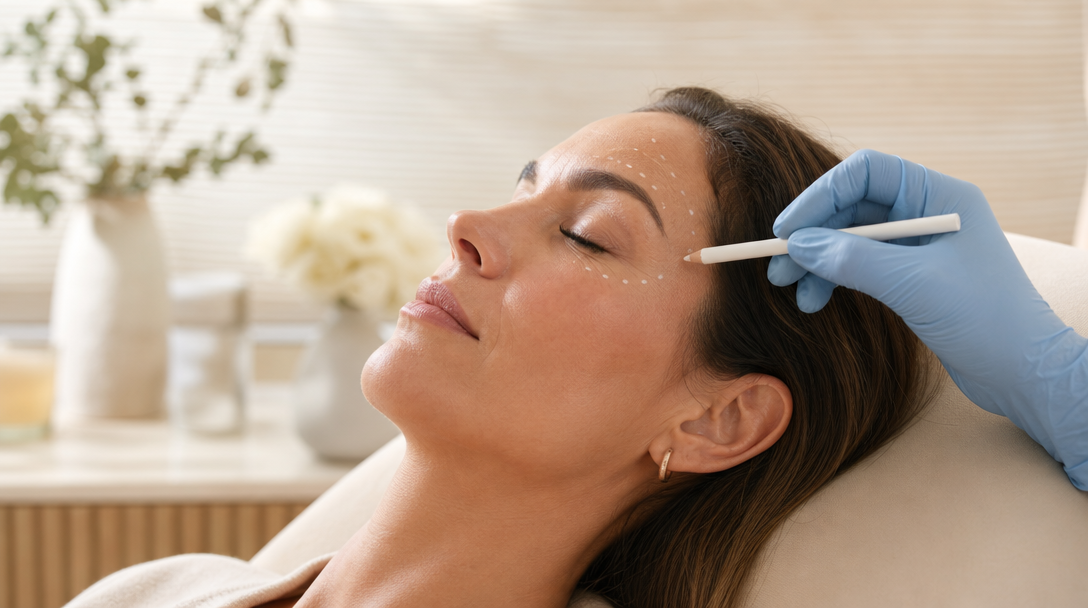
Forehead lines. These run horizontally across the upper face. They form as the frontalis muscle lifts the brows, producing transverse forehead creases. They often appear early and deepen with repeated raising of the brows, and can create a tired or worried look.
Glabellar lines. These are the vertical or V-shaped creases between the eyebrows, often called frown lines or the “11 lines”. They come from the corrugator and procerus muscles pulling the brows inward when you frown or concentrate. The glabella is one of the most treated areas on the face because these lines can make someone look stern even when relaxed.
Crow’s feet. These fan out from the outer corners of the eyes. The skin here is thin with almost no fat beneath it, so the orbicularis oculi muscle that closes the eye creases the surface easily. That is why crow’s feet are often among the first lines to appear, showing when you smile or squint.
Bunny lines. These are the small lines along the sides and upper bridge of the nose that appear when you scrunch your nose. They come from the nasalis muscle and can become more obvious if the areas around them are treated and this spot is left out.
What are the mid-face and lower-face lines called?
The middle and lower face show folds and lines driven more by volume loss than by muscle movement alone: nasolabial folds, marionette lines, perioral lip lines, corner-of-mouth lines, cheek lines and chin changes. These often need a different approach from the upper-face lines.
Nasolabial folds. These are the grooves running from the sides of the nose to the corners of the mouth. They deepen as cheek volume drops, so they are as much a volume issue as an expression one, and they can cast shadows that make the face look tired.
Marionette lines. These run down from the corners of the mouth toward the chin and can give a downturned look. They often link to early jowl changes and to the depressor muscles pulling the mouth corners down.
Perioral and lip lines. These are the fine vertical lines around the lips, sometimes called smoker’s lines or barcode lines. They come from repeated movement of the muscle that circles the mouth, the orbicularis oris, combined with thinning skin, and they can let lipstick bleed into the border.
Corner-of-mouth lines. These are the fine creases right at the mouth corners. They are separate from marionette lines but often appear alongside them, and makeup can settle into them early.
Cheek lines. These can be dynamic smile lines or static creases from volume loss and sun exposure, sometimes giving the cheeks a crepey look.
Chin lines and dimpling. The chin may show a horizontal crease or an orange-peel dimpling pattern from an overactive mentalis muscle and natural structural change.
Which facial muscles cause which wrinkles?
Most named wrinkles trace back to one overused muscle, which is why understanding the muscle map guides treatment. Research on facial anatomy for injectable treatments sets out these links clearly, and StatPearls summarises the common ones: crow’s feet from the orbicularis oculi, frown lines from the corrugator, bunny lines from the nasalis, and smoker’s lines from the orbicularis oris that circles the mouth.
When a line is driven mainly by a muscle, relaxing that muscle softens the line and can slow it from setting into a static wrinkle. When a line is driven mainly by lost volume or thinning skin, calming the muscle alone will not be enough. That is the core logic behind matching a treatment to a wrinkle rather than offering one option for the whole face.
What does a simple facial wrinkle map look like?
A facial wrinkle map groups each zone by its typical line type and the treatment focus that usually suits it. Here is a simple version to guide what to expect at a consultation.
| Face zone | Line name | Usual type | Typical treatment focus |
|---|---|---|---|
| Upper forehead | Forehead lines | Dynamic | Muscle relaxation, then skin texture support |
| Between brows | Glabellar / frown lines | Dynamic, sets static | Muscle relaxation, collagen support if deep |
| Outer eyes | Crow’s feet | Dynamic | Muscle relaxation, gentle skin support |
| Sides of nose | Bunny lines | Dynamic | Targeted muscle relaxation |
| Nose to mouth | Nasolabial folds | Static, volume | Volume support, collagen stimulation |
| Mouth to chin | Marionette lines | Static, volume | Volume support, selective muscle relaxation |
| Around lips | Perioral / lip lines | Mixed | Soft volume, skin texture treatments |
| Cheeks | Cheek lines | Mixed | Volume support, collagen stimulation |
| Chin | Chin crease and dimpling | Dynamic, structural | Muscle relaxation, structural support |
This map is a starting point, not a prescription. Faces are individual, and lines rarely sit in tidy boxes, so a clinician confirms the plan in person.
Which treatments suit which wrinkles?
The right treatment depends on whether the line is dynamic, static or a mix, so matching treatment to line type is the whole point of the map. Here is how the main options line up.

Anti-wrinkle injections for dynamic lines. Anti-wrinkle injections use botulinum toxin to relax the specific muscle creating a line, which softens forehead lines, frown lines, crow’s feet and bunny lines. The American Academy of Dermatology notes the effect is temporary, lasting roughly three to four months, and that it can also delay dynamic lines from becoming static. Botulinum toxin is a prescription-only medicine in the UK, so it must be prescribed by a suitable healthcare professional after a face-to-face assessment, as the NHS sets out.
Dermal fillers for static folds. Dermal fillers use hyaluronic acid to restore lost volume and support folds such as nasolabial folds and marionette lines. Reviews of combined approaches describe muscle relaxation and volume support working together, one calming the dynamic component and the other addressing the static component. Filler results are temporary, typically lasting several months to a year or more, depending on the product and area.
Collagen-building treatments for texture. Microneedling and similar skin treatments encourage the skin to build collagen, which helps with crepey texture, fine lines and overall skin quality rather than a single deep crease. These suit the mixed lines around the cheeks and lips, and pair well with the injectable options above.
Prevention comes first. No treatment replaces protecting the skin in the first place. Sun exposure drives a large share of facial lines, so daily broad-spectrum sun protection remains the most useful long-term step, alongside not smoking and a steady skincare routine. If you want a broader overview of the options, our ageing skin hub brings them together by concern.
How does CoLaz plan wrinkle treatment?
At CoLaz, a clinician maps your lines at a free consultation, watching your face both moving and at rest, then matches each area to the treatment that suits it. There is no single package sold to every face.
The consultation covers which lines are dynamic and which have set static, what is realistic for your skin, and where prevention will do more than treatment. Because botulinum toxin is a prescription-only medicine, any injectable plan involves a proper assessment first. When choosing where to have any cosmetic treatment, the NHS advises checking that your practitioner is trained, qualified and insured, and that you have time to decide before going ahead. Research on treatment preference also underlines that both the clinician’s judgement and the patient’s priorities shape a good plan.
If you are unsure where your lines fall on the map, that is exactly what the consultation is for. A clinician can talk you through your own facial wrinkle map and the options that fit it, with no pressure to book anything on the day.
Ready to begin
Book a free Anti-Wrinkle Injections consultation at your nearest CoLaz clinic.
Thirty minutes with a qualified clinician. Skin assessment, candid recommendation, no obligation. Read about Anti-Wrinkle Injections at CoLaz, from £199 (one area, qualified therapist tier).
WhatsApp replies in minutes during opening hours
About the author
Alayika Parvez
Owner, CoLaz Aesthetics Clinic
Alaiyka Parvez bought the CoLaz franchise network in 2023, having joined the company as a Slough clinic employee in 2013 and gone on to open the Hounslow and Wembley franchises. She writes here on the treatments CoLaz delivers across its seven UK clinics.
Read more about Alaiyka and CoLaz →More on Aesthetics
Keep reading.

20 August 2026 · 8 min
JCCP, Save Face and CQC: what each register actually checks
Three names come up when you try to check an aesthetic clinic, and they do three different jobs. A plain-English guide to what JCCP, Save Face and CQC each look at, what they leave out, and how to run the checks yourself.

13 August 2026 · 9 min
How much do dermal fillers cost in the UK? An honest 2026 price guide
Filler pricing in the UK swings from £150 to £600 per ml, and the gap is not random. Here is what you are actually paying for, which quotes should make you walk away, and how to price-check a clinic properly.

21 July 2026 · 8 min
10 aesthetic clinic red flags: when to walk out of the consultation
Non-surgical treatments are still largely unregulated in England. These are the ten warning signs worth knowing before you book, and the ones that should make you leave.
Begin
Book a free consultation
at your nearest CoLaz clinic.
Thirty minutes with a qualified clinician. Skin assessment, candid recommendation, written plan. No obligation.