
Skin imperfections
Dermatosis Papulosa Nigra removal at CoLaz clinics
Send a photo of your DPN cluster to your nearest CoLaz clinic on WhatsApp. A qualified clinician experienced in darker skin tones reviews the image, confirms whether removal is suitable, and replies with a fixed price within one working day.
How the photo quote works
Three steps, no surprises
- 01
Send a photo
Tap the WhatsApp button and choose your nearest clinic. Attach a clear, well-lit photo of the area you would like assessed.
- 02
Get a quote
A qualified clinician checks the photo, confirms whether the treatment suits you and replies with a price within one working day. If it is not suitable, we tell you why and what to do next.
- 03
Book if happy
If the price works for you, book a short appointment. Most are done in one session, and there is no pressure to book on the day.
Good for
Who books Dermatosis Papulosa Nigra (DPN) Removal
- Small dark benign papules across the cheeks, temples and neck on Fitzpatrick 4 to 6 skin
- Clusters of DPN that have built up gradually from young adulthood
- DPN inherited along family lines (often described as 'they run in my family')
- Patients who have been told by other clinics that their skin tone is 'too dark' for in-clinic removal
- Adults wanting a specialist who treats DPN regularly and understands the pigment risk
- Cosmetic DPN that has stayed stable in colour, size and shape for many months
What to expect
From your first consultation onwards
- 01
Send a photo of the cluster on WhatsApp to your nearest CoLaz clinic that offers the treatment (Derby or Reading), or attach the image during a free in-clinic assessment
- 02
Photo reviewed by a qualified clinician experienced in darker skin tones within one working day, with a careful pigment risk discussion
- 03
We reply with a fixed price for the session length needed and outline how many staged sessions are likely
- 04
If you would like to proceed, book in for your treatment session, starting with a test patch on a small area to see how your skin responds before any wider treatment
- 05
Treatment is performed using advanced electrolysis: a very fine probe delivers a brief current into each papule, which is then gently lifted away; the skin appears grazed and tiny scabs form, sloughing away naturally over a few days to reveal clear skin underneath
- 06
Soothing barrier balm applied in clinic with written aftercare confirmed before you leave
Dermatosis Papulosa Nigra (DPN) is benign, common on Fitzpatrick 4 to 6 skin, and very treatable when the clinician treating you actually understands darker skin tones. At CoLaz a qualified clinician experienced in darker skin reviews a photo of the cluster on WhatsApp, walks through the pigment risk with you, and replies with a fixed price within one working day. Treatment is performed using advanced electrolysis (always preceded by a test patch) at our Derby and Reading clinics.
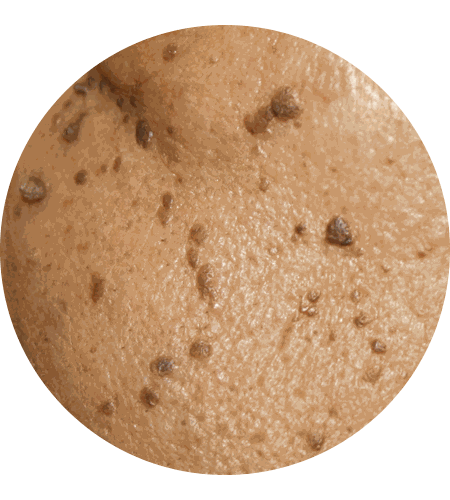
What DPN is
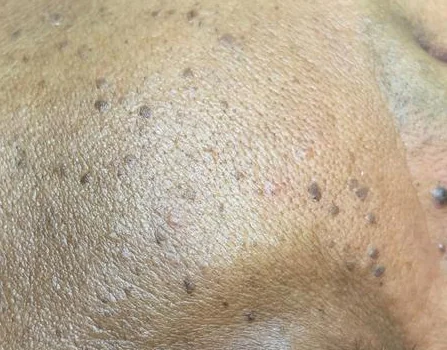
Dermatosis Papulosa Nigra, or DPN, is a benign skin condition where small dark brown or black raised papules develop on the face, neck and upper chest, most commonly on Fitzpatrick skin types 4 to 6. They typically start appearing in late adolescence or early adulthood and increase in number gradually with age, and they often run in families along clearly inherited lines.
DPN is entirely benign and does not turn into anything more serious. Clinically it is closely related to seborrhoeic keratoses; the two conditions are often described as the same underlying process expressed differently on different skin tones.
We only remove lesions confirmed as benign DPN at photo review. Any individual papule that has changed in colour, size or shape, or that looks different from the rest of the cluster, is referred back to a GP for the standard ABCDE check before we proceed.
Why specialist experience matters here
Many in-clinic devices were originally calibrated for lighter skin tones, and they carry a real pigment risk on darker skin if used by an inexperienced operator. Post-inflammatory hyperpigmentation (a darker mark at the treated site) and hypopigmentation (a paler mark) are the main risks on Fitzpatrick 4 to 6 skin, rather than scarring.
At CoLaz our team treats DPN regularly. We always start with a test patch on a small area to see how your skin responds before any wider treatment. We use advanced electrolysis, which can be tuned for darker skin tones in trained hands: a very fine probe delivers a brief current into each papule, and the lesion is then gently lifted away.
We treat in stages across two to three sessions spaced six to eight weeks apart, rather than clearing a whole cluster in one aggressive visit. The photo review and any in-clinic conversation are a frank discussion about your skin, your pigment risk and what is realistic for you.
Healing and long-term care
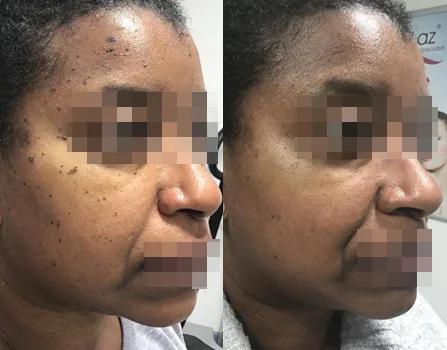
Tiny scabs form at each treated point within twenty-four hours. The skin appears grazed in the treated area immediately after the session, which is the expected pattern. Keep the area clean and dry for the first forty-eight hours, apply the antiseptic balm we provide twice daily for seven to ten days, and let the scabs fall away naturally rather than picking them. Picking is the single biggest cause of post-inflammatory pigmentation in darker skin.
A small pink, pale or temporarily darker mark at each treated point is normal for several weeks while the skin remodels. Most marks settle by three to six months. SPF 50 to the treated area daily for at least eight weeks is non-negotiable, then SPF year-round to keep the result.
New DPN papules can appear over the years as part of the natural pattern. Many patients book a maintenance session every twelve to eighteen months to address new lesions early, before clusters build up again. Avoid saunas, steam rooms, sunbeds and intense exercise for forty-eight hours after each session.
Available at our Derby and Reading clinics
Dermatosis papulosa nigra (dpn) removal is delivered at our CoLaz Derby and Reading clinics by qualified clinicians. Use the clinic finder to choose the location that suits your postcode and schedule, or send a WhatsApp message, most clinics reply within five minutes during opening hours.
Often considered alongside
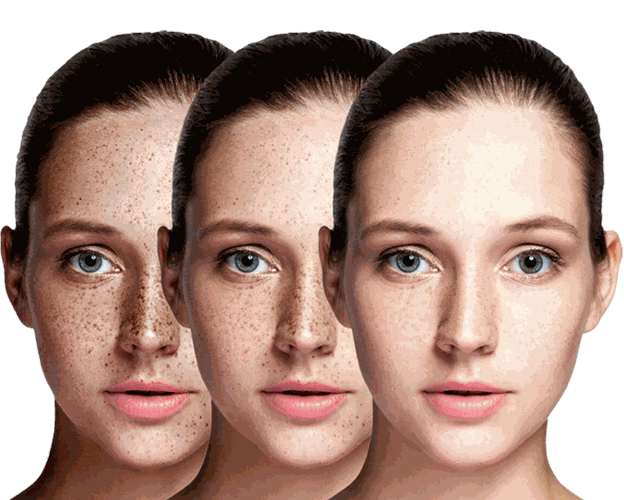
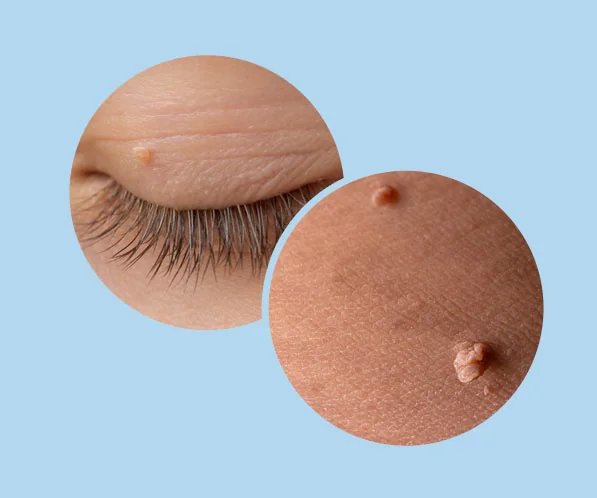
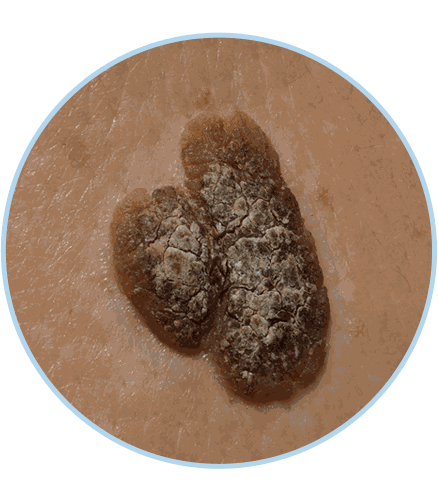
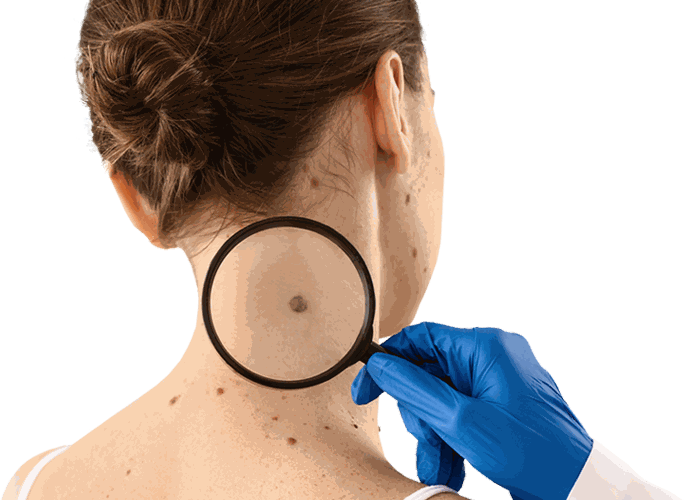
Patients booking DPN removal often consider PICO laser for background pigmentation and uneven tone on darker skin, skin tag removal for soft pedunculated growths on the neck or underarms, seborrhoeic keratosis removal for waxy age-related growths closely related to DPN clinically, and cosmetic mole removal for raised benign moles cleared by their GP.
Common questions
What patients ask first
Something else? Message your nearest clinic and a clinician will answer.
What is Dermatosis Papulosa Nigra?
Dermatosis Papulosa Nigra, or DPN, is a benign skin condition where small dark brown or black raised papules develop on the face, neck and upper chest, most commonly on Fitzpatrick skin types 4 to 6 (darker skin tones). They typically start appearing in late adolescence or early adulthood and increase in number gradually with age. They often run in families. They are entirely benign, do not turn into anything more serious, and they are essentially a darker-skin equivalent of seborrhoeic keratoses.
How does DPN removal work at CoLaz?
We use advanced electrolysis as the precision method for DPN, the same method used by experienced UK practitioners working on darker skin tones. A very fine probe is placed at each papule and a brief low-energy current is delivered for a fraction of a second. The papule is then gently lifted away. The skin appears grazed and tiny scabs form, sloughing away naturally over a few days to reveal clear skin underneath. We treat papules one at a time across the cluster, in staged sessions rather than all at once.
How do I send a photo for a quote?
Tap the Send a photo on WhatsApp button at the top of this page. Choose our Derby or Reading clinic. WhatsApp opens with a pre-filled message; attach a clear, well-lit close-up of the cluster and send. We may ask one or two follow-up questions (your skin tone, family history of DPN, whether anything has changed in the cluster) so we can quote you accurately and choose the safest staging plan.
What if my photo shows something that isn't benign DPN?
If the photo shows a papule that has changed in colour, size or shape, has more than one colour, has uneven edges, itches, bleeds or crusts, or is much larger than the others in the cluster, the clinician will decline to quote and refer you back to your GP. The DPN pattern is benign but individual lesions still need the standard ABCDE check. Changing pigmented lesions should never be cosmetically removed without dermatology assessment first.
I have darker skin and I have been turned away from other clinics. Why are you different?
Many in-clinic devices were originally calibrated for lighter skin tones and carry a real pigment risk on darker skin if used by an inexperienced operator. At CoLaz our team treats DPN regularly, we always start with a test patch on a small area, we use a method (advanced electrolysis) that can be tuned for darker skin tones in trained hands, and we treat in stages so we see how each patch heals before moving on. The photo review is a frank conversation about your skin, your pigment risk and what is realistic for you.
How many sessions will I need?
Most DPN treatment plans run across two to three sessions spaced six to eight weeks apart, because we treat a portion of the cluster at each visit and review how the skin responds before treating more. Single isolated papules sometimes clear in one session. New papules can appear over the years as part of the natural pattern, so many patients book a maintenance session every twelve to eighteen months. We confirm the plan in your photo quote reply.
Will it leave a scar or pigment change?
On Fitzpatrick 4 to 6 skin, post-inflammatory hyperpigmentation (a darker mark at the treated site) and hypopigmentation (a paler mark) are the main risks rather than scarring. Both are usually temporary and settle over three to six months, but they can be permanent in a minority of cases. This is exactly why we always start with a test patch, choose the gentlest effective settings, and treat the cluster in stages rather than clearing it all in one aggressive session. Patients with a personal or family history of keloid scarring should mention this at consultation.
What is the aftercare?
Keep the treated area clean and dry for the first forty-eight hours, apply the antiseptic balm we provide twice daily for seven to ten days, and let the tiny scabs fall away naturally rather than picking them. Picking is the single biggest cause of post-inflammatory pigmentation in darker skin. Avoid saunas, steam rooms, sunbeds, swimming pools and intense exercise for forty-eight hours. SPF 50 to the treated area daily for at least eight weeks is non-negotiable, then SPF year-round to keep the result.
How much does DPN removal cost at CoLaz?
DPN removal is priced by the time needed and the size of the cluster being treated in each staged session. A portion of a typical cluster (often the most visible papules across one cheek or the temples) is at the lower end of the range; a wider area or both sides of the face scales up; the full plan across multiple staged sessions is quoted higher. Pricing is confirmed per photo quote, in writing, before any treatment is booked. Send a photo on WhatsApp and we reply with a firm price for your specific case within one working day.
Where to book
Available at our Derby and Reading clinics
-
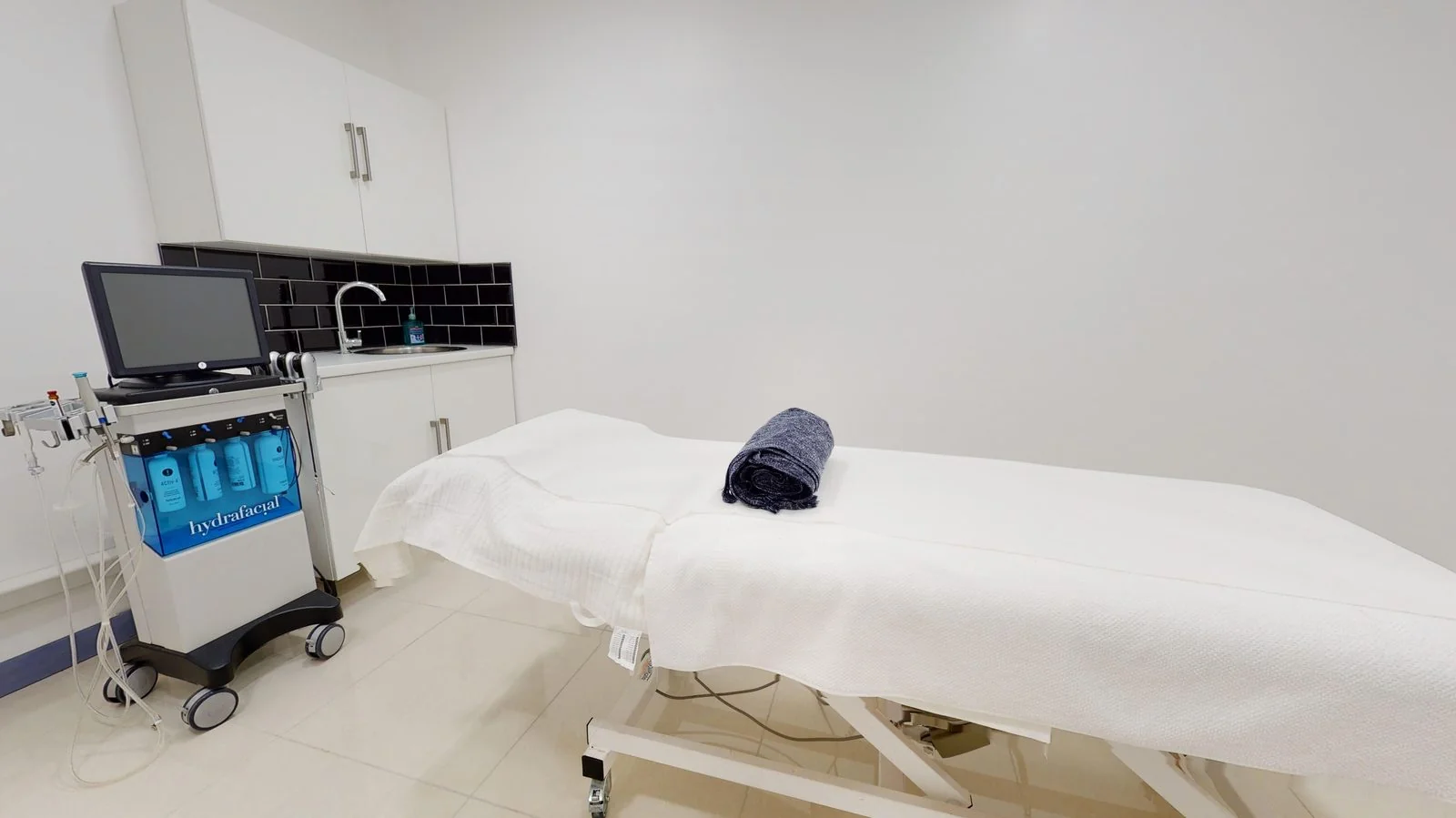 CoLaz Derby 21-23 Pear Tree Road, Derby DE23 6PZ Dermatosis Papulosa Nigra (DPN) Removal in this clinic (Dermatosis Papulosa Nigra (DPN) Removal in Derby)
 -
 CoLaz Reading 292 Oxford Road, Reading RG30 1AD Dermatosis Papulosa Nigra (DPN) Removal in this clinic (Dermatosis Papulosa Nigra (DPN) Removal in Reading)
Often considered alongside
Related treatments
Start with a free dermatosis papulosa nigra (dpn) removal consultation
Tell us what you would like to change. Your clinician will recommend a plan, confirm the price in writing and leave the booking to you.