

Skin · 28 May 2025 · 8 min read
Does dermaplaning ruin your skin barrier? What the evidence says
By Alayika Parvez
Owner, CoLaz Aesthetics Clinic
The short version
- • Done correctly and in moderation, dermaplaning does not ruin your skin barrier: it removes the outermost dead-skin layer, which regrows within days.
- • The barrier is briefly more permeable for 24 to 48 hours after a session, so aftercare matters more than the treatment itself.
- • Damage tends to come from over-doing it: dermaplaning too often, layering strong acids or retinoids on top, treating already-irritated skin, or a poor blade technique.
- • Warning signs of a stressed barrier are tightness, stinging on normally fine products, lasting redness, flaking and new breakouts.
- • Protect it by spacing sessions four to six weeks apart, keeping to gentle products, moisturising with ceramides, wearing daily SPF, and choosing a trained clinician.
TL;DR
- Done correctly and in moderation, dermaplaning does not ruin your skin barrier. It removes the outermost layer of dead cells, which naturally regrows within days.
- The barrier is briefly more permeable for the first 24 to 48 hours after a session, which is why aftercare matters more than the treatment itself.
- Damage usually comes from over-doing it: dermaplaning too often, layering strong acids or retinoids on top, treating already-irritated skin, or a poor blade technique.
- Warning signs of a stressed barrier are tightness, stinging on normally gentle products, lasting redness, flaking and new breakouts.
- Protect it by spacing sessions four to six weeks apart, keeping to gentle products, moisturising with ceramides, wearing daily SPF, and choosing a trained clinician.
Dermaplaning does not ruin your skin barrier when it is done correctly and not too often. A single session removes the outermost layer of dead skin and fine facial hair, and that surface layer regenerates on its own within a few days. The barrier only gets into trouble when the treatment is repeated too frequently, stacked with harsh products, or performed on skin that was already irritated.
This is the single most common worry we hear from first-time dermaplaning patients at CoLaz. Below is what the evidence actually says, the warning signs to watch for, and five practical ways to keep your barrier healthy.
What is your skin barrier, and why does it matter?
Your skin barrier is the outermost layer of your skin, called the stratum corneum, and it keeps moisture in and harmful things out. When it is healthy, skin stays hydrated, calm and comfortable. When it is compromised, you get dryness, redness and sensitivity.
The stratum corneum is only about 10 to 20 micrometres thick, yet it is your first line of defence against the outside world. It is built like a brick wall: flattened dead cells (corneocytes) are the bricks, and a lipid matrix of ceramides, cholesterol and fatty acids is the mortar. According to StatPearls, this layer reduces water loss, resists abrasion and microorganisms, and acts as a permeability barrier to the environment.
When that structure is intact, it protects you from several things at once:
- Water loss. It locks moisture in. A weakened barrier lets water escape (measured as transepidermal water loss), which leaves skin tight and flaky.
- Irritants and pollution. Airborne particles and harsh ingredients are held at the surface rather than penetrating.
- Microorganisms. It blocks bacteria that can trigger breakouts and infection.
- UV and environmental stress. It works alongside sunscreen as part of your daily defence.
Keeping this layer healthy is the whole point of sensible exfoliation, and it is exactly what good dermaplaning aftercare is designed to protect.
What does dermaplaning actually do to the barrier?
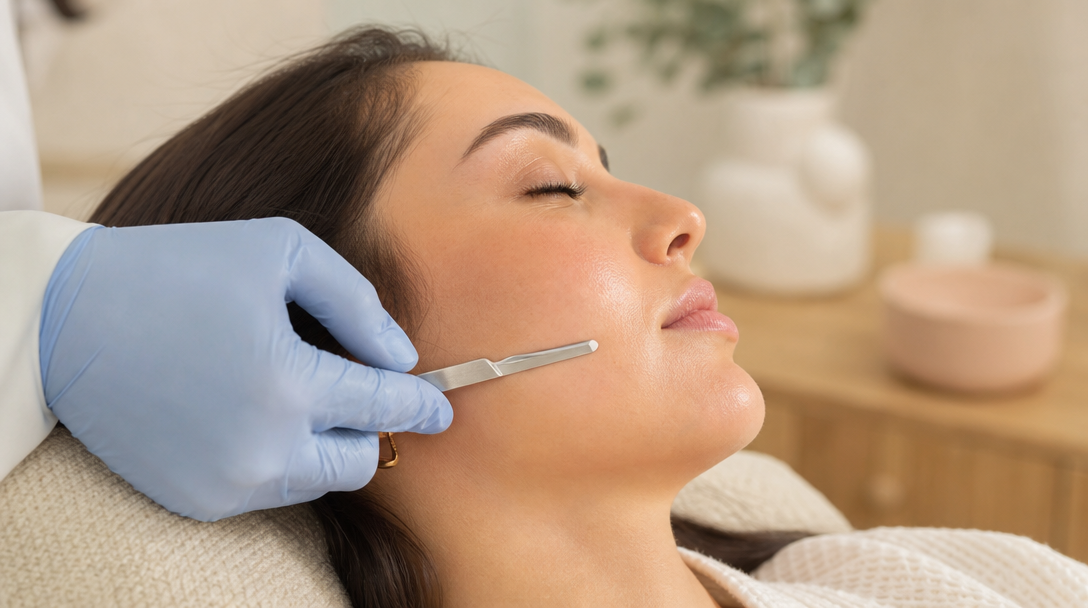
Dermaplaning uses a sterile surgical blade held at an angle to gently scrape away the top layer of dead cells and the fine vellus hair (peach fuzz) on the surface of the face. It is a controlled mechanical exfoliation, not a chemical one, and nothing is meant to penetrate below the surface.
Research confirms the effect is real but shallow. A study on dermaplaning and drug permeation found that histology showed removal of the stratum corneum and some parts of the viable epidermis, with a measurable drop in the barrier’s electrical resistance straight afterwards. In other words, the treatment briefly thins and opens the top layer, which is precisely why skin looks smoother and products absorb better for a short window.
The key word is briefly. A systematic review in Aesthetic Plastic Surgery groups dermaplaning with other non-invasive resurfacing treatments and notes its benefits are immediate but temporary, typically holding for three to four weeks before the stratum corneum regenerates. Your barrier is designed to rebuild itself, and after a single well-performed session it does exactly that.
So does dermaplaning ruin your skin barrier?
No. A correctly performed, appropriately spaced dermaplaning session does not ruin your skin barrier, because the layer it removes is dead skin that your body replaces within days. The barrier is temporarily more permeable, not permanently damaged.
Think of it the same way you would a light chemical peel or a gentle Hydrafacial: the surface is briefly recalibrating, so it needs support rather than more stress. For most healthy skin, a monthly session with sensible aftercare leaves the barrier as strong as it was before, with a smoother finish on top.
The risk is not the single treatment. The risk is the pattern around it, which is where problems start.
When can dermaplaning damage the skin barrier?
Dermaplaning can weaken the barrier when it is over-done or badly done, rather than from one careful session. Four situations account for almost every case of trouble we see.
- Doing it too often. If you remove surface cells faster than the barrier can regenerate, the stratum corneum does not get time to rebuild. Most guidance keeps professional dermaplaning to roughly once a month, and around four to six weeks apart, so the skin fully recovers between sessions.
- Layering strong actives on top. The Academy of Dermatology warns that products like retinoids and benzoyl peroxide already make skin more sensitive and prone to peeling, and that over-exfoliating leaves skin red and irritated. Stacking acids, scrubs or retinol onto freshly dermaplaned skin doubles the exfoliation without doubling the benefit.
- Treating skin that is already irritated. Working over active acne, eczema, cold sores, sunburn or inflamed skin makes an existing problem worse. The barrier is already stressed, so it should be calmed first, not exfoliated.
- Poor technique or a non-sterile blade. The same drug-permeation study noted variation in results between different operators, which is a reminder that skill matters. A reused or dirty blade, or too much pressure, can nick the skin and introduce bacteria.
The AAD is also clear that people with darker skin tones should be cautious with aggressive mechanical exfoliation, because of the risk of post-inflammatory pigmentation. A trained clinician adjusts pressure, frequency and suitability to your skin type rather than treating everyone the same.
How do you know if your skin barrier is damaged?
A stressed or damaged barrier shows itself quickly through how your skin feels and reacts. If you notice these signs after exfoliating, it is a cue to pause and let the skin recover.
- Tightness or a rough, pulled feeling. This is moisture escaping too fast through a weakened barrier.
- Stinging or burning on gentle products. When a normally comfortable moisturiser or serum starts to sting, the barrier is not coping.
- Lasting redness or flaking. Mild redness for a day or two is normal, but redness that lingers past three days, along with peeling, points to over-exfoliation.
- New breakouts or small bumps. A compromised barrier lets bacteria in more easily, which can show up as spots or a rash-like texture.
If you spot these, stop all exfoliation, drop back to a gentle cleanser, a ceramide moisturiser and SPF, and give the skin one to two weeks to settle before doing anything active again.
How do you protect your skin barrier after dermaplaning?
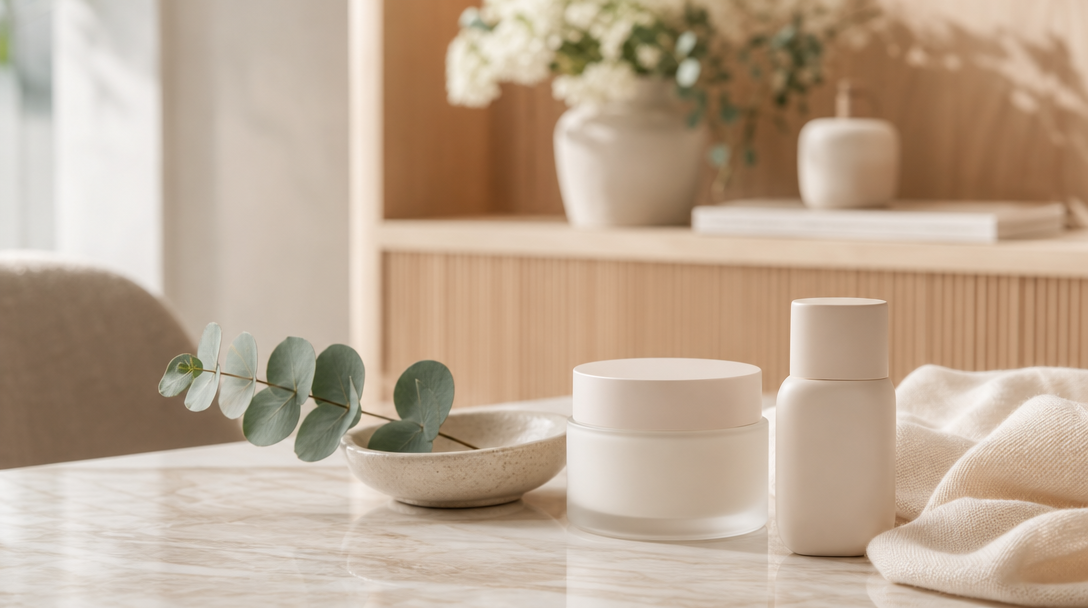
You protect the barrier by keeping the routine simple and gentle for the first week and letting the skin rebuild. Here are the five habits that make the biggest difference.
- Space sessions sensibly. Keep dermaplaning to roughly once a month, four to six weeks apart. If your skin is more sensitive, extending to six to eight weeks gives the barrier extra time to recover.
- Keep to gentle products for a few days. Skip acids (glycolic, lactic, salicylic), retinoids and physical scrubs for around five to seven days. The AAD advises matching how often you exfoliate to how aggressive the method is, and giving the skin recovery time.
- Moisturise to support repair. Reach for a fragrance-free moisturiser with ceramides. Research shows ceramide-containing formulations reduce transepidermal water loss and improve stratum corneum structure, and work in the British Journal of Dermatology has shown that strengthening the barrier’s lipid structure improves its function and protects against irritation.
- Wear SPF every day. Freshly exfoliated skin is briefly more exposed to UV. The NHS recommends a broad-spectrum sunscreen of at least SPF 30 with a four or five-star UVA rating, reapplied through the day. A mineral formula is a good choice in the first 48 hours.
- Avoid heat and sweat for 48 hours. Saunas, steam rooms, hot yoga and swimming pools all put extra stress on a barrier that is still settling, so give them a couple of days.
Follow these and you keep the smooth, fresh result without trading it for irritation later.
Is professional dermaplaning safer than doing it at home?
Yes. Having dermaplaning done by a trained clinician is safer than a home kit, because the tools, the technique and the assessment of your skin are all better controlled. That difference is exactly where barrier damage is prevented or caused.
A professional uses a single-use sterile blade, knows how much pressure to apply, and judges whether your skin type and current condition are suitable before starting. The NHS advises checking that whoever performs any cosmetic procedure has the right training, and its guidance on choosing a practitioner is a sensible baseline. In the UK, you can also check a practitioner against the JCCP register or the Save Face register, both accredited by the Professional Standards Authority.
At-home blades carry a higher risk of cuts, uneven pressure and over-use, precisely the pattern that stresses the barrier over time. A clinic setting removes most of those variables.
How CoLaz protects your skin barrier
Every CoLaz dermaplaning patient is assessed for suitability first, treated with a fresh sterile blade, and sent home with clear aftercare so the barrier stays protected in the days that follow. Aftercare is part of the treatment, not an optional extra.
If you are weighing dermaplaning against, or alongside, another route such as a chemical peel or a Hydrafacial, the spacing and product advice change slightly, and we write that plan out for you rather than leaving you to guess. Done properly, dermaplaning gives you the smooth, glowing result without putting your barrier at risk.
If you would like a straightforward assessment of whether dermaplaning suits your skin, a free consultation is the place to start.
Ready to begin
Book a free Dermaplaning consultation at your nearest CoLaz clinic.
Thirty minutes with a qualified clinician. Skin assessment, candid recommendation, no obligation. Read about Dermaplaning at CoLaz, from £65 (full face, single session).
WhatsApp replies in minutes during opening hours
About the author
Alayika Parvez
Owner, CoLaz Aesthetics Clinic
Alaiyka Parvez bought the CoLaz franchise network in 2023, having joined the company as a Slough clinic employee in 2013 and gone on to open the Hounslow and Wembley franchises. She writes here on the treatments CoLaz delivers across its seven UK clinics.
Read more about Alaiyka and CoLaz →More on Skin
Keep reading.

15 September 2026 · 8 min
Salmon DNA polynucleotides: what they are and why aesthetics is hooked
Purified fragments of salmon DNA, known as polynucleotides or PDRN, are one of the fastest-growing skin boosters in UK clinics. Here is what the research says about how they work and what to realistically expect.

11 August 2026 · 10 min
HIFU treatment results: month by month, what is realistic
HIFU tightens skin gradually rather than instantly. Here is the honest month-by-month results timeline, how long the effect lasts, and who is a good candidate.
28 July 2026 · 10 min
Types of chemical peels: glycolic, salicylic, TCA and Jessner explained
Glycolic for dull and sun-damaged skin, salicylic for oily and acne-prone, lactic for sensitive, mandelic for pigmentation in deeper skin tones, TCA for resurfacing with downtime. A clear decision guide to the main types of chemical peels.
Begin
Book a free consultation
at your nearest CoLaz clinic.
Thirty minutes with a qualified clinician. Skin assessment, candid recommendation, written plan. No obligation.