
What happens if you inject B12 wrong?
 Owner, CoLaz Aesthetics Clinic
The short version
- A poorly placed or rushed B12 injection most often causes short-lived pain, bruising or a small lump that settles in a day or two.
- Injecting into fat instead of muscle reduces absorption, so the dose may not work as intended.
- Poor hygiene or reused needles can cause infection, and an injection placed badly can rarely irritate a nerve.
- These risks are exactly why an intramuscular injection is safer given by a trained clinician than self-administered at home.
- Spreading redness, fever, lasting numbness or weakness are not normal and need medical attention.
A B12 injection looks simple, and in trained hands it is. But the technique still matters: the needle has to reach muscle, the site has to be clean, and the dose has to be right. When any of those slips, the result is usually minor and short-lived, but it is worth understanding what can actually go wrong, and why we think this is a job for a clinician rather than a kitchen-table DIY.
If you are considering B12 injections, here is an honest account of the risks of poor technique and how a clinic avoids them.
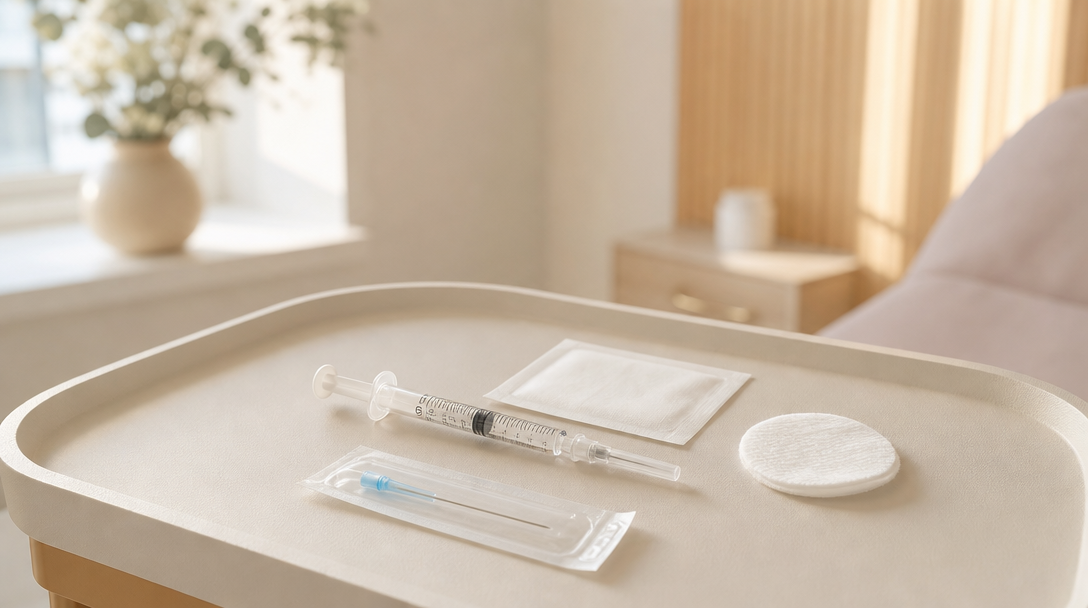
The common technique mistakes
Most problems trace back to a handful of errors: using the wrong needle length so the dose lands in fat rather than muscle, not cleaning the skin, injecting too fast, injecting at the wrong angle, or reusing a needle. None of these are exotic, which is exactly why training and a sterile setup matter.
What can go wrong
Pain, swelling and a small lump
The most common outcome of a rushed or badly angled injection is local irritation: soreness, redness, a small firm lump or a bruise. The NHS lists injection-site pain and itching as common and self-limiting. This usually settles within a day or two.
The dose landing in fat instead of muscle
B12 is given as an intramuscular injection for a reason: muscle has the blood supply to absorb it steadily. If the needle is too short for the person, or the angle is wrong, the dose can end up in subcutaneous fat, where absorption is slower and less predictable. Correct needle selection and a 90-degree angle into the right site are part of standard intramuscular technique.
Infection
Skipping skin cleaning or reusing a needle can introduce bacteria. Signs of an injection-site infection or abscess include skin that is red, warm and increasingly painful, discharge, or a fever. This needs medical attention, not watchful waiting.
Irritating a nerve
Injected in the wrong spot, a needle can come close to a nerve and cause sharp pain, tingling, numbness or weakness. Using the correct anatomical site is precisely how trained clinicians avoid this. Persistent numbness or weakness after an injection should always be reviewed by a doctor.
Bruising and bleeding
If the needle nicks a small blood vessel you may get a bruise. Gentle pressure afterwards usually settles it. People on blood thinners bruise more easily and should mention it beforehand.
The dose simply not working
An incorrect dose, or one that mostly landed in fat, may mean your symptoms do not improve as expected. That is not always obvious at the time, which is why dose and schedule should be set against a confirmed clinical picture rather than guesswork.
Why this belongs in a clinic
Every risk above is reduced by the same things: the right needle, a clean field, correct site selection, a steady pace, and a single-use needle each time. A trained clinician does this routinely. The NHS treatment pathway and the 2024 NICE guideline both assume B12 injections are given in a clinical setting against a confirmed deficiency, not self-sourced and self-administered.
At CoLaz we give B12 injections only after a free consultation and only where treatment is appropriate. We do not provide kits or instructions for unsupervised self-injection.
When to seek medical help
See a doctor promptly if you have spreading redness or warmth around the site, discharge or a fever, numbness or weakness that does not settle, or any swelling of the face, lips or throat or difficulty breathing, which can signal a rare allergic reaction and is a medical emergency.
Ready to begin
Book a free B12 Injections consultation at your nearest CoLaz clinic
Time with a qualified clinician: a skin assessment, an honest recommendation and no obligation. Read about B12 Injections at CoLaz, from £50 (single injection).
More on Wellness
Keep reading
-

IV vitamin C drip: what it actually does and what it doesn't
An IV vitamin C drip reaches blood levels oral tablets cannot. The honest answer on what high-dose vitamin C supports, what it does not do, and how we screen patients at CoLaz. Read the article -

B12 injections: who actually needs them and how often?
B12 injections are the standard NHS treatment for proven vitamin B12 deficiency, not a routine wellness boost. Here is who really needs them, at what frequency, and how we approach them at CoLaz. Read the article -

What do IV vitamin drips actually do for you?
IV vitamin drips deliver fluids and nutrients straight to the bloodstream, bypassing the gut. The honest answer about what they do, what the evidence says, and how we approach them at CoLaz. Read the article
Book a free consultation at your nearest CoLaz clinic
Time with a qualified clinician: a skin assessment, an honest recommendation and a written plan. No obligation.